Before you start
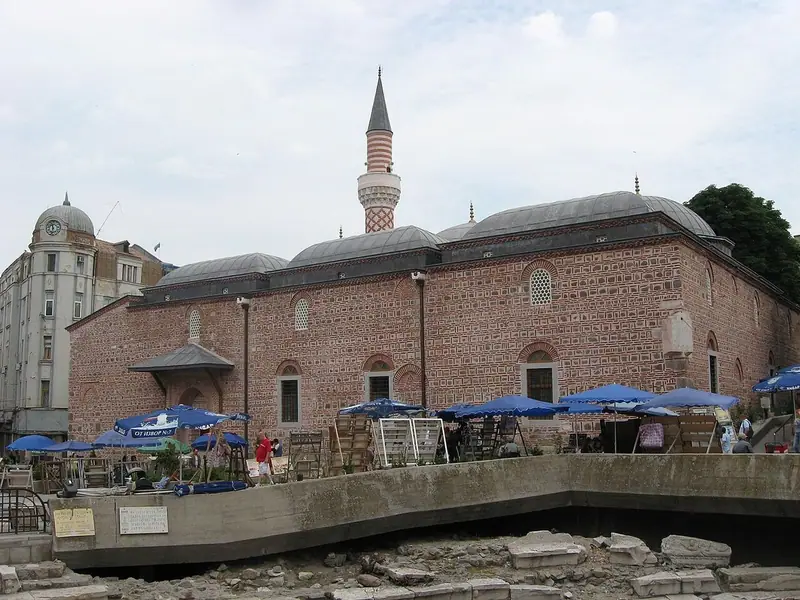
Plovdiv, Bulgaria’s second city, is one of the oldest continuously inhabited cities in Europe, built on a cluster of hills above the River Maritsa. Its layers of history sit side by side: a Roman stadium beneath the main square, an Ottoman mosque, a Roman theatre still used for concerts, and an old town of colourful nineteenth-century merchants’ houses. The old town lies on three hills and its streets are steep and cobbled, so wear good shoes. This guide starts at the Bishop’s Basilica and the Roman Stadium in the modern centre, visits the Dzhumaya Mosque, climbs to the Ancient Theatre, and explores the old town before ending on the hill of Nebet Tepe.
Use it as a self-guided tour of Old Plovdiv: 8 stops in visit order, each played when you’re ready, at your own pace.
 Free preview · Stop 1
Bishop’s Basilica
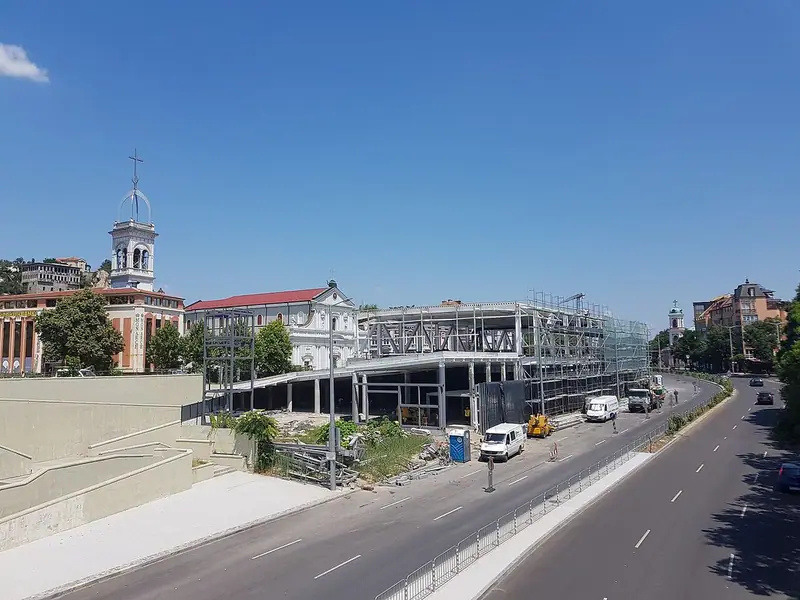
Begin at the Bishop’s Basilica of Philippopolis, where a modern building protects the remains of one of the largest early Christian churches in Bulgaria, built in the fourth century. Walk along the raised walkways above the floor and look down at the magnificent mosaics, covering hundreds of square metres, with geometric patterns and many birds, including peacocks, pigeons, ducks and pheasants, symbols of paradise and eternal life. The basilica was used for several centuries before falling into ruin, and later buildings, including a medieval church and graves, were built over it. Its remains were excavated over many years and opened to visitors after restoration. The basilica shows how important Philippopolis was in the early Christian period. Then walk north along the main street to Dzhumaya Square.
Photo: Realsteel007 · CC BY-SA 4.0 · Wikimedia Commons
What to see at Old Plovdiv: 8 stops, in visit order
- 01
 Bishop’s BasilicaEarly Christian mosaicsFree preview
- 02
 Roman StadiumBeneath the main streetIn the guide
- 03
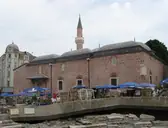 Dzhumaya MosqueAn early Ottoman mosqueIn the guide
- 04
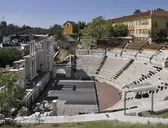 Ancient TheatreStill in useIn the guide
- 05
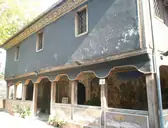 St Constantine and St HelenaAn old town churchIn the guide
- 06
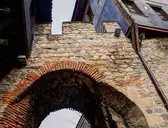 Hisar KapiaThe old gateIn the guide
- 07
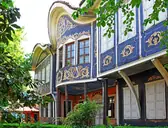 Ethnographic MuseumKuyumdzhioglu HouseIn the guide
- 08
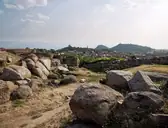 Nebet TepeWhere Plovdiv beganIn the guide
Site map of Old Plovdiv
History of Old Plovdiv
Thracians lived on Plovdiv’s hills thousands of years ago. In 342 BCE the city was conquered by Philip II of Macedon, father of Alexander the Great, and it became known as Philippopolis. Under the Romans it grew into a great city, the capital of the province of Thrace, with a stadium, theatre and forum. It was later ruled by the Byzantines and Bulgarians, and from the fourteenth century by the Ottomans, who called it Filibe. In the eighteenth and nineteenth centuries, rich merchants built the houses of the old town during the Bulgarian National Revival. After 1878 the city was the capital of Eastern Rumelia, which was united with Bulgaria in 1885.
Old Plovdiv guide: questions
How many stops does the Old Plovdiv guide have?
8 stops, in visit order: 1. Bishop’s Basilica; 2. Roman Stadium; 3. Dzhumaya Mosque; 4. Ancient Theatre; 5. St Constantine and St Helena; 6. Hisar Kapia; 7. Ethnographic Museum; 8. Nebet Tepe.
Can I do a self-guided tour of Old Plovdiv with this guide?
Yes. The guide is made for a self-guided tour: 8 stops in visit order, each with a photo, a story and a voice, so you can explore Old Plovdiv at your own pace, without joining a group. Download it before you go and it works offline.
How long is each guide?
The 8 stops add up to about 6 minutes of listening in total. You play each stop when you’re ready, so you can go at your own pace.
Does the guide work offline?
Yes, once it’s downloaded. The guide is a single self-contained web page (about 7.5 MB) with the photos, text and audio built in. Download it to your phone before you go (Wi-Fi is best); after that it opens in any modern browser on iPhone or Android, with no app, account or mobile signal needed.
Does it use GPS or need my location?
No. The guide doesn’t use GPS and doesn’t know where you are: you play each stop when you reach it. It works on iPhone and Android in any modern browser, and it’s in English.
What’s included?
One self-contained HTML guide: 8 stops in visit order, each with a photo, text and a voice, plus the story of who built the site.
Who built Old Plovdiv?
Thracians lived on Plovdiv’s hills thousands of years ago. In 342 BCE the city was conquered by Philip II of Macedon, father of Alexander the Great, and it became known as Philippopolis.
Where is Old Plovdiv?
Plovdiv, Bulgaria’s second city, is one of the oldest continuously inhabited cities in Europe, built on a cluster of hills above the River Maritsa.
Is there a free audio guide to Old Plovdiv?
The first stop, Bishop’s Basilica, is free to read and hear on this page, so you can try the Old Plovdiv audio tour before you buy. The full guide, with all 8 stops, is a one-off purchase: download it once and it’s yours to keep, working offline.
Is the Old Plovdiv guide worth it?
If you’d like to know what you’re looking at, yes. For $10 you get 8 stops in visit order, each with a photo, a short history and a voice you play when you’re ready, plus a site map of the stops, and about 6 minutes of listening in all. It’s short on purpose, so you spend your time looking, not listening. It’s yours to keep, works offline and needs no app. The first stop is free on this page, so you can try it before you buy. If you’d like hours of detail, a guided tour will go deeper.
Audio guide or guided tour?
It depends how you like to visit. This guide lets you explore Old Plovdiv at your own pace, at any time, for a one-off price. A guided tour gives you a live expert you can ask questions, but at fixed times and usually for a higher price. Many people use both: a tour for the big picture, and the guide to read beforehand or to revisit the stops in their own time.
Is this the official Old Plovdiv guide?
No. It’s an independent guide by The Historian Guide, not affiliated with or endorsed by the operator of Old Plovdiv. For tickets and opening hours, check the official site operator before you go.
Does the guide include entry tickets or opening hours?
No. The guide is a digital companion only. Admission to Old Plovdiv is separate, so check the official site operator for current tickets and opening hours before you go.
- Stop 1 · Bishop’s Basilica: Realsteel007 · CC BY-SA 4.0 · Wikimedia Commons · resized
- Stop 2 · Roman Stadium: BrankaVV · CC BY-SA 4.0 · Wikimedia Commons · resized
- Stop 3 · Dzhumaya Mosque (also the cover): Explorer1940 · CC BY-SA 4.0 · Wikimedia Commons · resized
- Stop 4 · Ancient Theatre: Plamen Agov • studiolemontree.com · CC BY-SA 3.0 · Wikimedia Commons · resized
- Stop 5 · St Constantine and St Helena: Бирдас · CC BY-SA 3.0 · Wikimedia Commons · resized
- Stop 6 · Hisar Kapia: Gitanes232 · CC0 · Wikimedia Commons · resized
- Stop 7 · Ethnographic Museum: Dennis G. Jarvis · CC BY-SA 2.0 · Wikimedia Commons · resized
- Stop 8 · Nebet Tepe: Laurens R. Krol · CC BY 4.0 · Wikimedia Commons · resized


All photographs from Wikimedia Commons under the licences shown.
More guides in Bulgaria
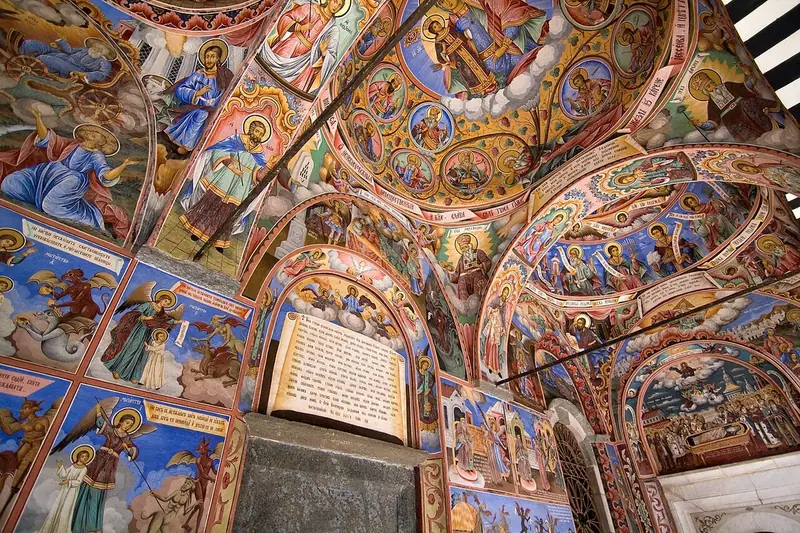 Bulgarian Empire7 stops · 10th–19th century
Rila Monastery audio guide
Pass through the gates of Bulgaria’s great monastery in the Rila Mountains to its striped arcades, painted church and Hrelyo’s Tower.
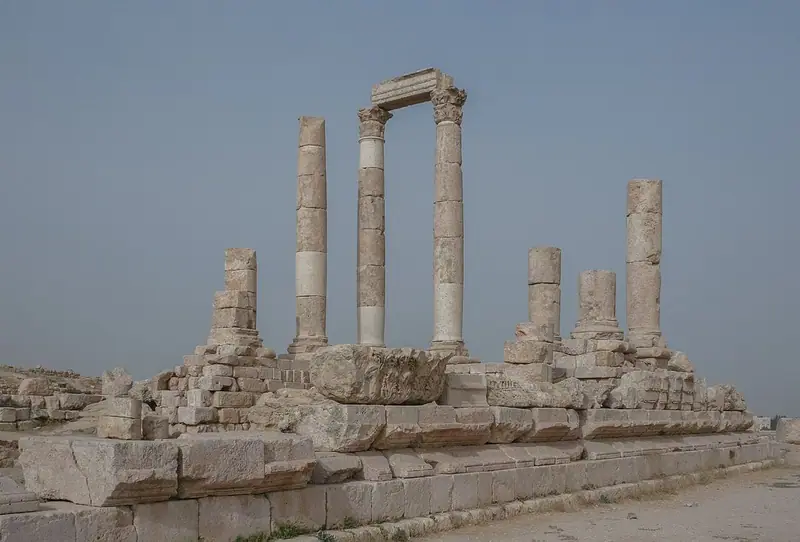 Roman7 stops · 2nd–8th century CE
Amman Citadel and Roman Theatre audio guide
From the Temple of Hercules and its colossal hand to the Umayyad palace, then down to the Roman Theatre carved into the hill.
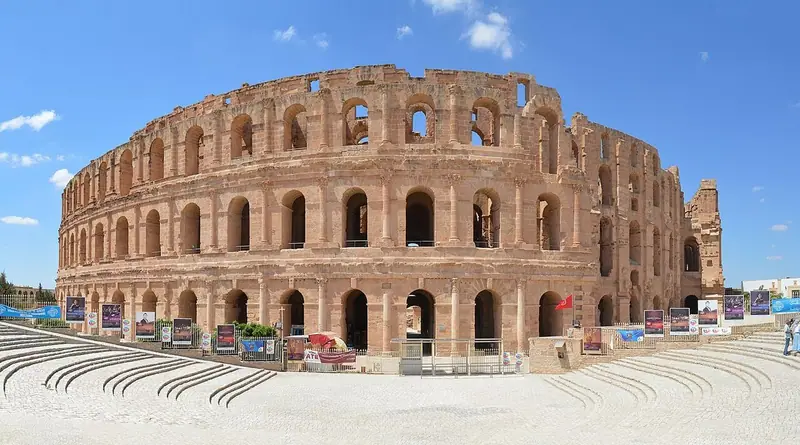 Roman8 stops · 3rd century CE
Amphitheatre of El Jem audio guide
Stand in the arena of one of the largest and best preserved amphitheatres of the Roman world, built for the town of Thysdrus and its thirty-five thousand spectators.
Every guide, in every country
Old Plovdiv and every other guide we publish, including future ones. One payment, no subscription.