Before you start
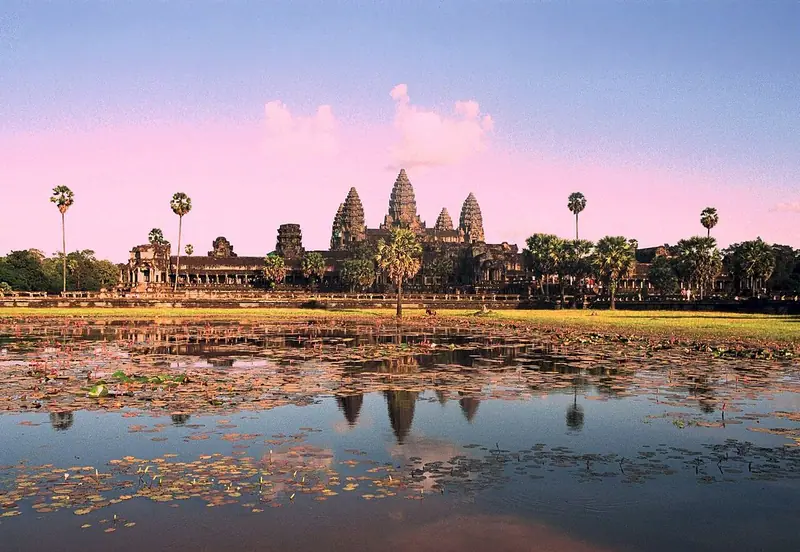
Angkor Wat lies about six kilometres north of the town of Siem Reap, within the Angkor Archaeological Park, a UNESCO World Heritage Site since 1992. You need an Angkor Pass, which you buy from the official ticket centre or online before entering the park; keep it with you, as it is checked at the temples. Most visitors travel by tuk-tuk, car, bicycle or on a tour. Angkor Wat is an active Buddhist place of worship, so cover your shoulders and knees, and remove hats in the shrines. The temple is huge, with long galleries and very steep stairs to the upper level. This guide follows the main western approach across the moat, through the great gateway and along the causeway, around the famous bas-reliefs of the outer gallery, and up through the Gallery of a Thousand Buddhas to the central sanctuary.
Use it as a self-guided tour of Angkor Wat: 8 stops in visit order, each played when you’re ready, at your own pace.
 Free preview · Stop 1
The Western Causeway
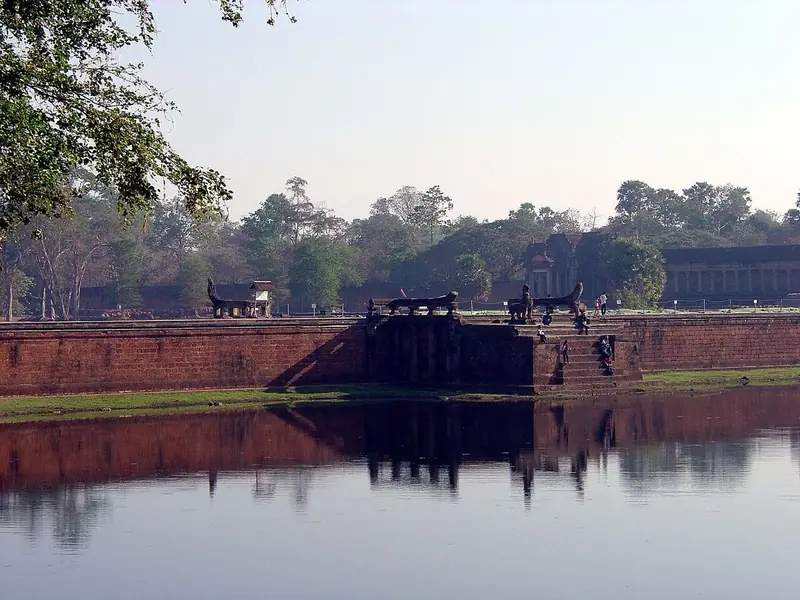
Begin at the western end of the causeway that crosses the moat, the main entrance to Angkor Wat. Unusually for a Khmer temple, Angkor Wat faces west, perhaps because Vishnu was associated with that direction, or because it was intended as the king’s funerary temple. The moat is about 190 metres wide and more than five kilometres around, and together with the outer wall it encloses a site of over 160 hectares, making Angkor Wat the largest religious monument in the world. The moat may symbolise the ocean surrounding Mount Meru, the mountain home of the gods, which the temple represents. It also formed part of the Angkor water system. Look at the guardian lions on the steps and the long stone causeway ahead, and the towers of the temple rising beyond the gateway. The causeway has been restored in recent years.
Photo: Michael Gunther · CC BY-SA 4.0 · Wikimedia Commons
What to see at Angkor Wat: 8 stops, in visit order
- 01
 The Western CausewayAcross the great moatFree preview
- 02
 The Western GopuraTa Reach and the elephant gatesIn the guide
- 03
 The Processional WayLibraries and reflecting poolsIn the guide
- 04
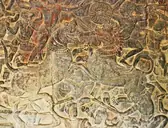 The Battle ReliefsThe western galleryIn the guide
- 05
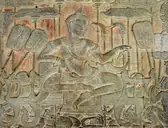 King Suryavarman IIProcession, heavens and hellsIn the guide
- 06
 The ChurningThe Sea of MilkIn the guide
- 07
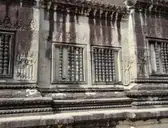 The Thousand BuddhasPreah Poan and the devatasIn the guide
- 08
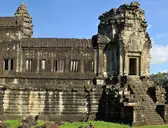 The BakanThe central sanctuaryIn the guide
Site map of Angkor Wat
History of Angkor Wat
Angkor Wat was built by the Khmer, whose empire was founded in the early ninth century, when Jayavarman II declared himself universal monarch in 802, and which dominated much of mainland South-East Asia for the next six centuries, with its capital at Angkor. Its kings built hundreds of temples and a vast system of reservoirs and canals. Angkor Wat was constructed between about 1113 and 1150 under King Suryavarman II, as a Hindu temple dedicated to Vishnu and probably also as his funerary temple. From the late thirteenth century, as Khmer kings adopted Buddhism, it became a Buddhist temple, and it has remained in use ever since. The empire declined in the fourteenth and fifteenth centuries, and the court moved south after Angkor was attacked from Ayutthaya, traditionally in 1431.
Angkor Wat guide: questions
How many stops does the Angkor Wat guide have?
8 stops, in visit order: 1. The Western Causeway; 2. The Western Gopura; 3. The Processional Way; 4. The Battle Reliefs; 5. King Suryavarman II; 6. The Churning; 7. The Thousand Buddhas; 8. The Bakan.
Can I do a self-guided tour of Angkor Wat with this guide?
Yes. The guide is made for a self-guided tour: 8 stops in visit order, each with a photo, a story and a voice, so you can explore Angkor Wat at your own pace, without joining a group. Download it before you go and it works offline.
How long is each guide?
The 8 stops add up to about 6 minutes of listening in total. You play each stop when you’re ready, so you can go at your own pace.
Does the guide work offline?
Yes, once it’s downloaded. The guide is a single self-contained web page (about 7.9 MB) with the photos, text and audio built in. Download it to your phone before you go (Wi-Fi is best); after that it opens in any modern browser on iPhone or Android, with no app, account or mobile signal needed.
Does it use GPS or need my location?
No. The guide doesn’t use GPS and doesn’t know where you are: you play each stop when you reach it. It works on iPhone and Android in any modern browser, and it’s in English.
What’s included?
One self-contained HTML guide: 8 stops in visit order, each with a photo, text and a voice, plus the story of who built the site.
Who built Angkor Wat?
Angkor Wat was built by the Khmer, whose empire was founded in the early ninth century, when Jayavarman II declared himself universal monarch in 802, and which dominated much of mainland South-East Asia for the next six centuries, with its capital at Angkor. Its kings built hundreds of temples and a vast system of reservoirs and canals.
Where is Angkor Wat?
Angkor Wat lies about six kilometres north of the town of Siem Reap, within the Angkor Archaeological Park, a UNESCO World Heritage Site since 1992.
Is there a free audio guide to Angkor Wat?
The first stop, The Western Causeway, is free to read and hear on this page, so you can try the Angkor Wat audio tour before you buy. The full guide, with all 8 stops, is a one-off purchase: download it once and it’s yours to keep, working offline.
Is the Angkor Wat guide worth it?
If you’d like to know what you’re looking at, yes. For $10 you get 8 stops in visit order, each with a photo, a short history and a voice you play when you’re ready, plus a site map of the stops, and about 6 minutes of listening in all. It’s short on purpose, so you spend your time looking, not listening. It’s yours to keep, works offline and needs no app. The first stop is free on this page, so you can try it before you buy. If you’d like hours of detail, a guided tour will go deeper.
Audio guide or guided tour?
It depends how you like to visit. This guide lets you explore Angkor Wat at your own pace, at any time, for a one-off price. A guided tour gives you a live expert you can ask questions, but at fixed times and usually for a higher price. Many people use both: a tour for the big picture, and the guide to read beforehand or to revisit the stops in their own time.
Is this the official Angkor Wat guide?
No. It’s an independent guide by The Historian Guide, not affiliated with or endorsed by the operator of Angkor Wat. For tickets and opening hours, check the official site operator before you go.
Does the guide include entry tickets or opening hours?
No. The guide is a digital companion only. Admission to Angkor Wat is separate, so check the official site operator for current tickets and opening hours before you go.
- Stop 1 · The Western Causeway: Michael Gunther · CC BY-SA 4.0 · Wikimedia Commons · resized
- Stop 2 · The Western Gopura: Photo: Marcin Konsek / Wikimedia Commons · CC BY-SA 4.0 · Wikimedia Commons · resized
- Stop 3 · The Processional Way (also the cover): Gisling · CC BY-SA 3.0 · Wikimedia Commons · resized
- Stop 4 · The Battle Reliefs: Gerd Eichmann · CC BY-SA 4.0 · Wikimedia Commons · resized
- Stop 5 · King Suryavarman II: Michael Gunther · CC BY-SA 4.0 · Wikimedia Commons · resized
- Stop 6 · The Churning: Jadamta · CC BY-SA 3.0 · Wikimedia Commons · resized
- Stop 7 · The Thousand Buddhas: Olaf Tausch · CC BY 3.0 · Wikimedia Commons · resized
- Stop 8 · The Bakan: LBM1948 · CC BY-SA 4.0 · Wikimedia Commons · resized


All photographs from Wikimedia Commons under the licences shown.
More guides in Cambodia
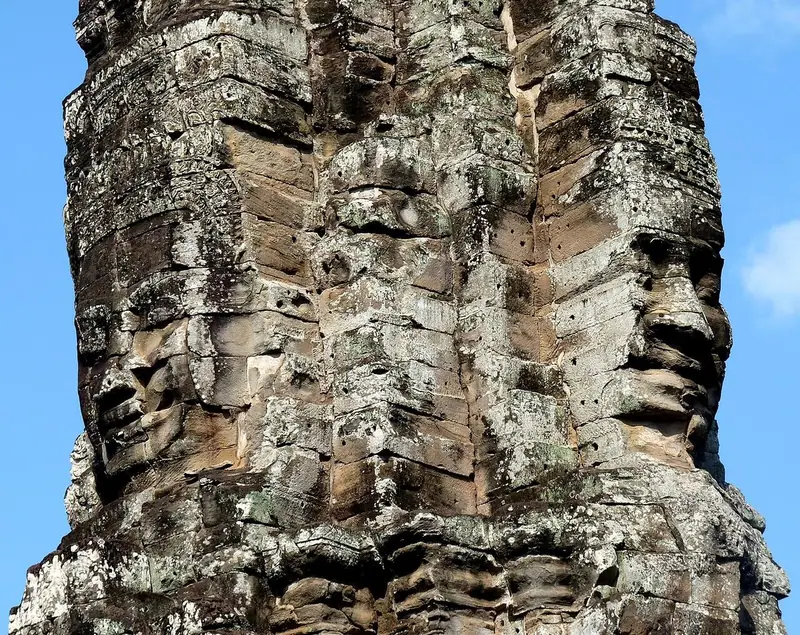 Khmer7 stops · 11th–13th century CE
Angkor Thom and the Bayon audio guide
Pass through the South Gate into the royal city of Jayavarman VII, where serene stone faces gaze from every tower of the Bayon.
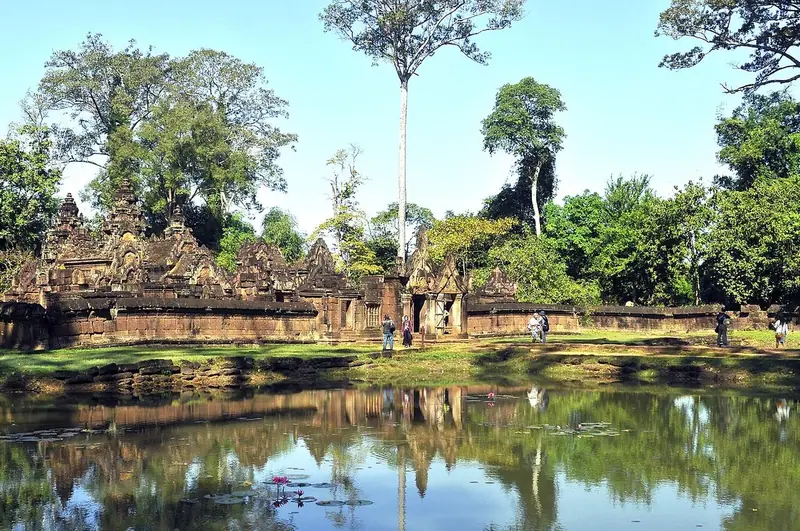 Khmer7 stops · 967 CE
Banteay Srei audio guide
A small, exquisitely carved temple, with Shiva the Dancer over its doors, that was unusually not built by a king.
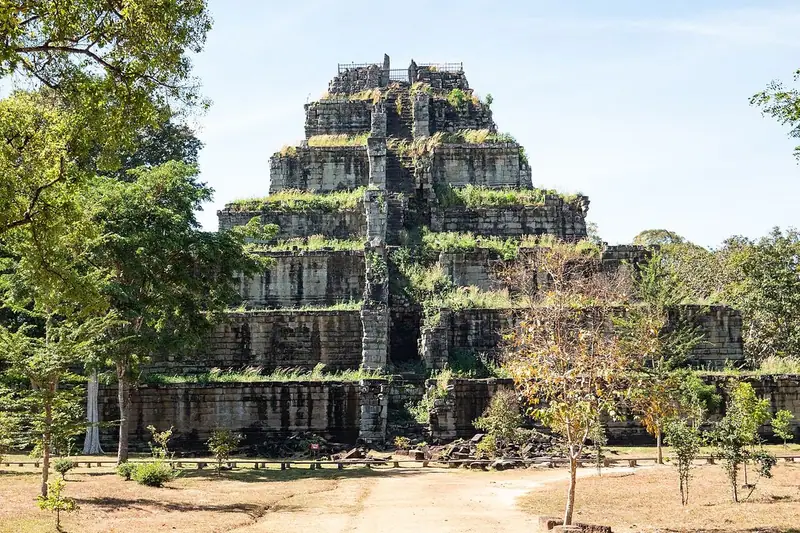 Khmer7 stops · 10th – early 13th century CE
Koh Ker audio guide
The forest capital of the Khmer king Jayavarman IV: brick towers in the roots, linga shrines carved from bedrock, the red tower of Prasat Krahom and the seven-tiered pyramid of the Prang.
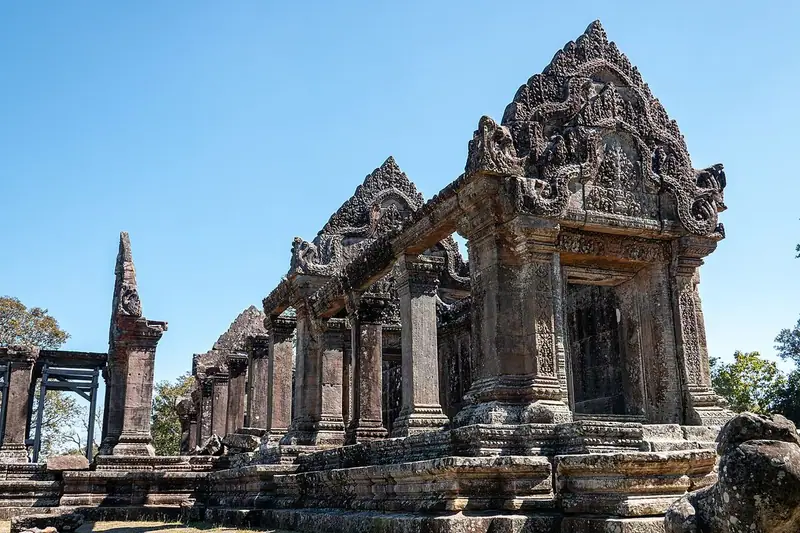 Khmer10 stops · 9th – 12th century CE
Preah Vihear audio guide
A Khmer temple to Shiva strung along a clifftop above the Cambodian plain: five gateways, carved pediments and a sanctuary on the brink, damaged in the border fighting of 2025.
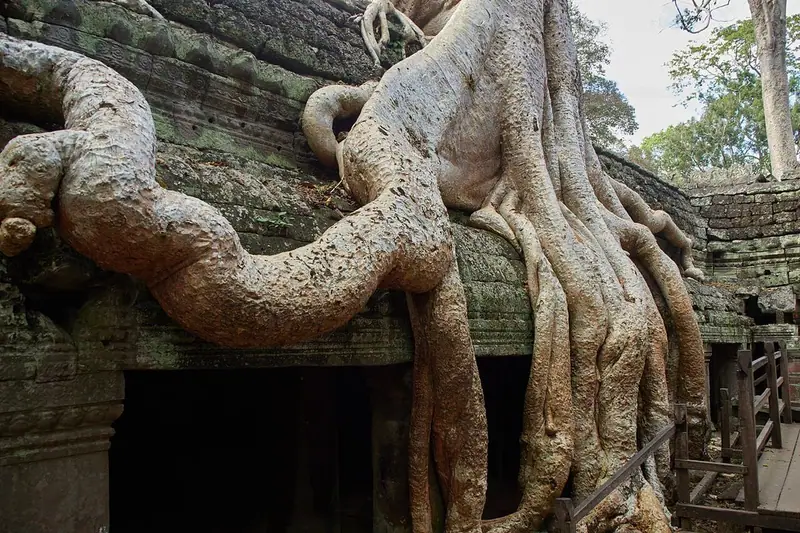 Khmer6 stops · from 1186 CE
Ta Prohm audio guide
A temple held in the grip of giant trees, its towers and carved devatas half swallowed by the forest.
Every guide, in every country
Angkor Wat and every other guide we publish, including future ones. One payment, no subscription.