
Before you start
The Hungarian Parliament Building, known in Hungarian as the Országház, the House of the Nation, stands on the Pest bank of the Danube, the largest building in Hungary and one of the great symbols of Budapest. Its long Gothic Revival front, crowned by a tall dome, faces the river, while its official entrance opens onto Kossuth Square. This guide begins with the view from the riverside, continues around the square and follows the route of the guided tour inside, past the grand staircase to the Dome Hall and the Holy Crown, before ending at a memorial on the Danube bank. The inside can only be visited on a guided tour, and as it is a working parliament, tours may change or be cancelled on some days, so book ahead. Expect security checks like those at an airport.
Use it as a self-guided tour of the Hungarian Parliament: 8 stops in visit order, each played when you’re ready, at your own pace.
 Free preview · Stop 1
The River Front
Before you go in, see the building as it was meant to be seen, from the river. The best view is from the Buda bank opposite, around Batthyány Square, or from a boat on the Danube. The main front faces the water, 268 metres long, with rows of pointed towers and pinnacles, and the great dome in the centre. Notice how the building is symmetrical, with two matching wings, each built for one of the two houses of the old parliament. The dome rises to 96 metres, a height chosen to recall the year 896, when, by tradition, the Magyars settled in the Carpathian Basin. The same height was given to Saint Stephen’s Basilica, across the city. Come back after dark, when the whole building is floodlit and its reflection glows in the river.
Photo: Florian Fèvre · CC BY-SA 4.0 · Wikimedia Commons
What to see at the Hungarian Parliament: 8 stops, in visit order
- 01
 The River FrontA Palace on the DanubeFree preview
- 02
 Kossuth SquareThe Square of the NationIn the guide
- 03
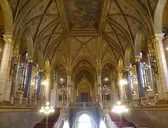 The Grand StaircaseGold and FrescoesIn the guide
- 04
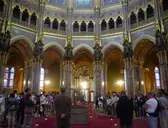 The Dome HallThe Heart of the BuildingIn the guide
- 05
 The Holy CrownThe Crown of Saint StephenIn the guide
- 06
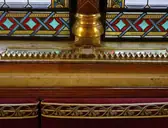 The LobbyMembers’ LobbyIn the guide
- 07
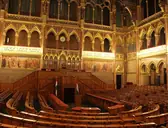 The Old Upper HouseThe Assembly HallIn the guide
- 08
 Shoes on the Danube BankA MemorialIn the guide
History of the Hungarian Parliament
In 1873 the towns of Buda, Óbuda and Pest were united as Budapest, and a few years later the Hungarian Diet decided to build a grand new parliament to express the sovereignty of the nation. An international competition was won by the Hungarian architect Imre Steindl, whose Gothic Revival design recalls the Palace of Westminster in London, as Hungarian reformers admired the British parliament. Building began in 1885, the house was inaugurated in 1896, for the thousandth anniversary of the Hungarian conquest, and it was finished in 1904. Steindl died in 1902, shortly before the building was handed over.
Hungarian Parliament guide: questions
How many stops does the Hungarian Parliament guide have?
8 stops, in visit order: 1. The River Front; 2. Kossuth Square; 3. The Grand Staircase; 4. The Dome Hall; 5. The Holy Crown; 6. The Lobby; 7. The Old Upper House; 8. Shoes on the Danube Bank.
Can I do a self-guided tour of the Hungarian Parliament with this guide?
Yes. The guide is made for a self-guided tour: 8 stops in visit order, each with a photo, a story and a voice, so you can explore the Hungarian Parliament at your own pace, without joining a group. Download it before you go and it works offline.
How long is each guide?
The 8 stops add up to about 6 minutes of listening in total. You play each stop when you’re ready, so you can go at your own pace.
Does the guide work offline?
Yes, once it’s downloaded. The guide is a single self-contained web page (about 6.9 MB) with the photos, text and audio built in. Download it to your phone before you go (Wi-Fi is best); after that it opens in any modern browser on iPhone or Android, with no app, account or mobile signal needed.
Does it use GPS or need my location?
No. The guide doesn’t use GPS and doesn’t know where you are: you play each stop when you reach it. It works on iPhone and Android in any modern browser, and it’s in English.
What’s included?
One self-contained HTML guide: 8 stops in visit order, each with a photo, text and a voice, plus the story of who built the site.
Who built the Hungarian Parliament?
In 1873 the towns of Buda, Óbuda and Pest were united as Budapest, and a few years later the Hungarian Diet decided to build a grand new parliament to express the sovereignty of the nation. An international competition was won by the Hungarian architect Imre Steindl, whose Gothic Revival design recalls the Palace of Westminster in London, as Hungarian reformers admired the British parliament.
Where is the Hungarian Parliament?
The Hungarian Parliament Building, known in Hungarian as the Országház, the House of the Nation, stands on the Pest bank of the Danube, the largest building in Hungary and one of the great symbols of Budapest.
Is there a free audio guide to the Hungarian Parliament?
The first stop, The River Front, is free to read and hear on this page, so you can try the Hungarian Parliament audio tour before you buy. The full guide, with all 8 stops, is a one-off purchase: download it once and it’s yours to keep, working offline.
Is the Hungarian Parliament guide worth it?
If you’d like to know what you’re looking at, yes. For $10 you get 8 stops in visit order, each with a photo, a short history and a voice you play when you’re ready, about 6 minutes of listening in all. It’s short on purpose, so you spend your time looking, not listening. It’s yours to keep, works offline and needs no app. The first stop is free on this page, so you can try it before you buy. If you’d like hours of detail, a guided tour will go deeper.
Audio guide or guided tour?
It depends how you like to visit. This guide lets you explore the Hungarian Parliament at your own pace, at any time, for a one-off price. A guided tour gives you a live expert you can ask questions, but at fixed times and usually for a higher price. Many people use both: a tour for the big picture, and the guide to read beforehand or to revisit the stops in their own time.
Is this the official Hungarian Parliament guide?
No. It’s an independent guide by The Historian Guide, not affiliated with or endorsed by the operator of the Hungarian Parliament. For tickets and opening hours, check the official site operator before you go.
Does the guide include entry tickets or opening hours?
No. The guide is a digital companion only. Admission to the Hungarian Parliament is separate, so check the official site operator for current tickets and opening hours before you go.
- Stop 1 · The River Front (also the cover): Florian Fèvre · CC BY-SA 4.0 · Wikimedia Commons · resized
- Stop 2 · Kossuth Square: Jules Verne Times Two / www.julesvernex2.com · CC BY-SA 4.0 · Wikimedia Commons · resized
- Stop 3 · The Grand Staircase: Zairon · CC BY-SA 3.0 · Wikimedia Commons · resized
- Stop 4 · The Dome Hall: Zairon · CC BY-SA 3.0 · Wikimedia Commons · resized
- Stop 5 · The Holy Crown: Zairon · CC BY-SA 3.0 · Wikimedia Commons · resized
- Stop 6 · The Lobby: Adrian Grycuk · CC BY-SA 3.0 pl · Wikimedia Commons · resized
- Stop 7 · The Old Upper House: Suicasmo · CC BY-SA 4.0 · Wikimedia Commons · resized
- Stop 8 · Shoes on the Danube Bank: Balon Greyjoy · CC0 · Wikimedia Commons · resized


All photographs from Wikimedia Commons under the licences shown.
More guides in Hungary
 Medieval8 stops · from 1241 CE
Buda Castle Hill audio guide
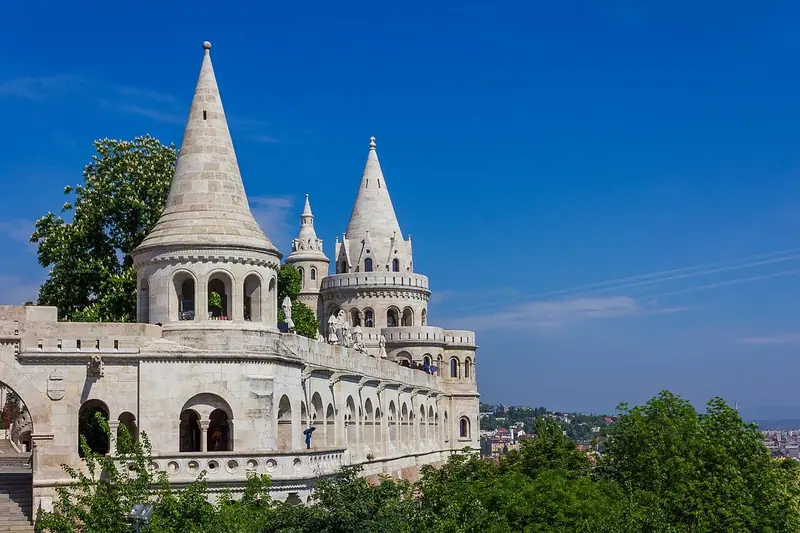
Ride the funicular up to Buda’s royal ridge above the Danube for the palace of Hungary’s kings, the Matthias Church and the Fisherman’s Bastion.
 Jewish7 stops · 1854–1859 CE
Dohány Street Synagogue audio guide
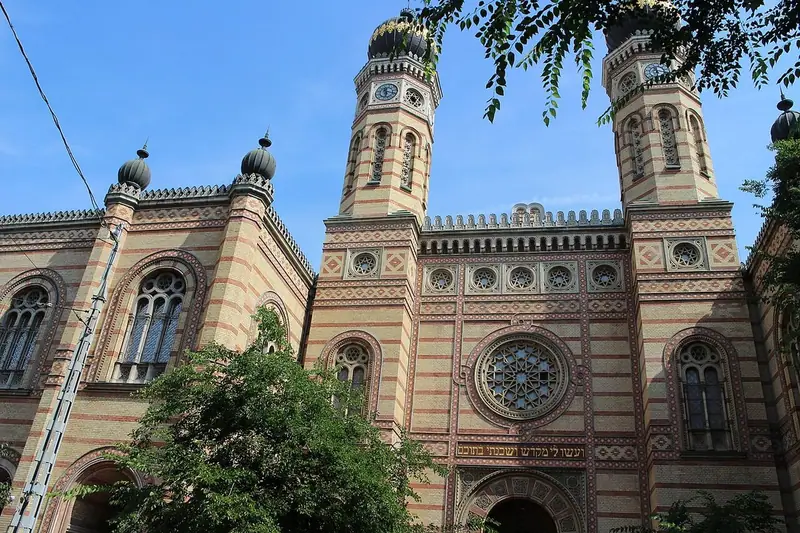
Visit Europe’s largest synagogue, built in the Moorish style for the Jewish community of Pest, and its courtyards of remembrance.
 Modern Europe7 stops · 1851–1905 CE
St Stephen’s Basilica audio guide
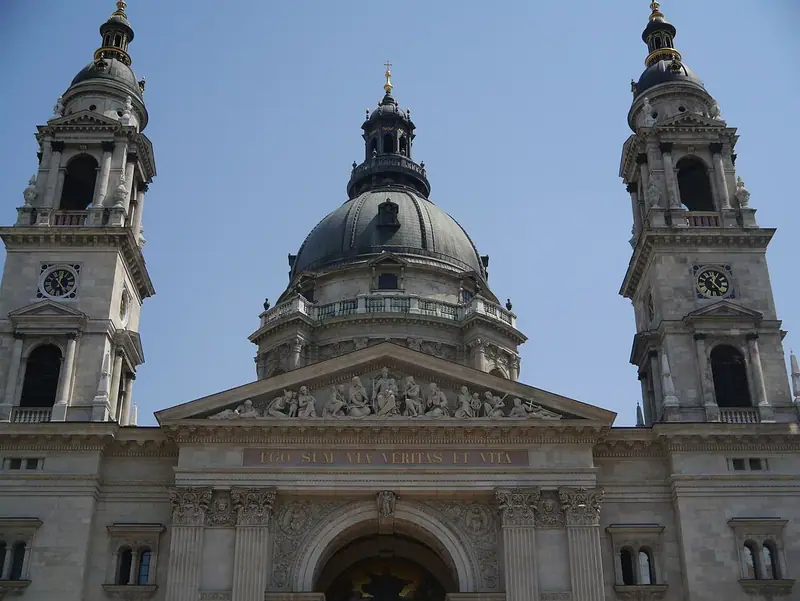
Step under the great dome of Budapest’s largest church to see the Holy Right, then climb to the dome terrace above Pest.
Every guide, in every country
Hungarian Parliament and every other guide we publish, including future ones. One payment, no subscription.