Before you start
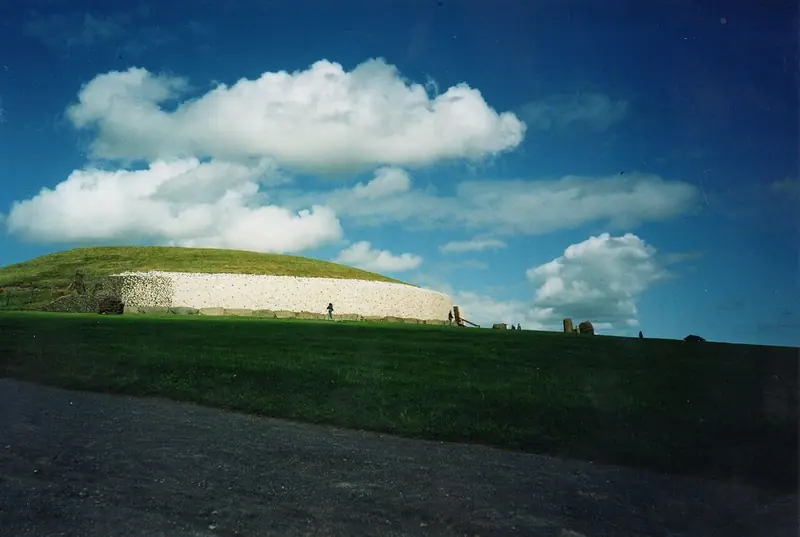
Newgrange, on a ridge above the River Boyne in County Meath, is a great passage tomb built around 3100 BCE by Neolithic farmers, older than Stonehenge and the pyramids of Giza. It is the best known monument of Brú na Bóinne, the palace of the Boyne, a World Heritage Site that also includes the great tombs of Knowth and Dowth. Newgrange can only be visited on a guided tour that begins at the Brú na Bóinne Visitor Centre, from where a bus takes you to the monument, and places are limited, so book ahead or arrive early. This guide follows the visit, from the Visitor Centre to the mound, into the passage and chamber, and around the outside. The passage is narrow and low in places, so it may not suit those with claustrophobia or limited mobility.
Use it as a self-guided tour of Newgrange: 8 stops in visit order, each played when you’re ready, at your own pace.
 Free preview · Stop 1
The Visitor Centre
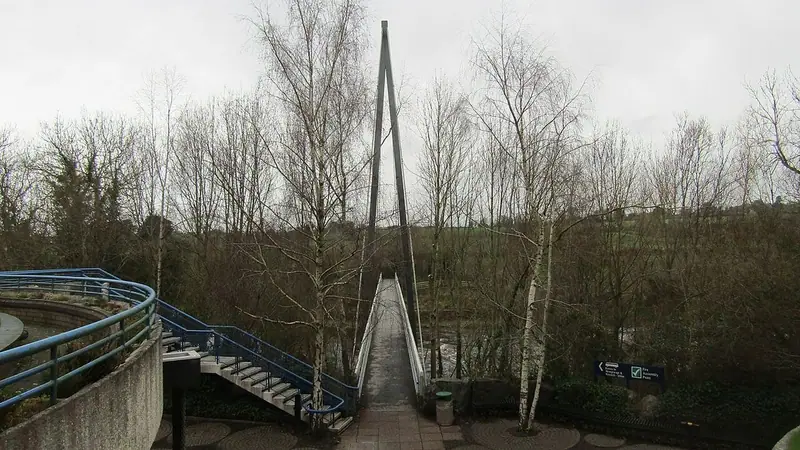
Begin at the Brú na Bóinne Visitor Centre, on the south bank of the River Boyne, where an exhibition introduces the monuments and the people who built them. Look for the replica of the chamber and the displays on the Neolithic farmers of the valley. To reach the buses, you cross the river on a footbridge. Pause on the bridge and look at the Boyne, which loops around a great bend here, almost enclosing the ancient landscape on the far side. Within this bend lie at least ninety monuments, including passage tombs, mounds, standing stones and enclosures, and the area has the largest collection of megalithic art in Europe. In Irish legend, the river was linked to the goddess Bóinn, and the tombs were seen as doorways to the Otherworld.
Photo: TheOminousDonut · CC BY-SA 4.0 · Wikimedia Commons
What to see at Newgrange: 8 stops, in visit order
- 01
 The Visitor CentreAcross the BoyneFree preview
- 02
 The Stone CircleGiants on the HillIn the guide
- 03
 The Quartz FaçadeThe White WallIn the guide
- 04
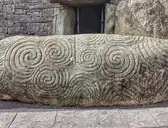 The Entrance StoneSpirals in StoneIn the guide
- 05
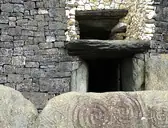 The Roof-boxA Window for the SunIn the guide
- 06
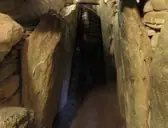 The PassageInto the MoundIn the guide
- 07
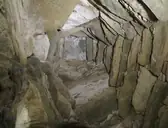 The ChamberThe Heart of the TombIn the guide
- 08
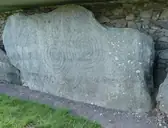 The KerbstonesAround the MoundIn the guide
History of Newgrange
Newgrange was built in the Neolithic, or New Stone Age, by farming communities who lived in the Boyne Valley more than five thousand years ago, long before writing reached Ireland. We do not know what they called themselves, or exactly what the monument meant to them, but it was clearly a place of great religious importance, linked to the dead and to the movements of the sun. After about a thousand years it fell into ruin, but it lived on in Irish myth as the home of the god known as the Dagda and his son Aengus. It was rediscovered in 1699 and excavated and partly reconstructed in the 1960s and 1970s by the archaeologist Michael O’Kelly, for the state, now the Republic of Ireland.
Newgrange guide: questions
How many stops does the Newgrange guide have?
8 stops, in visit order: 1. The Visitor Centre; 2. The Stone Circle; 3. The Quartz Façade; 4. The Entrance Stone; 5. The Roof-box; 6. The Passage; 7. The Chamber; 8. The Kerbstones.
Can I do a self-guided tour of Newgrange with this guide?
Yes. The guide is made for a self-guided tour: 8 stops in visit order, each with a photo, a story and a voice, so you can explore Newgrange at your own pace, without joining a group. Download it before you go and it works offline.
How long is each guide?
The 8 stops add up to about 5 minutes of listening in total. You play each stop when you’re ready, so you can go at your own pace.
Does the guide work offline?
Yes, once it’s downloaded. The guide is a single self-contained web page (about 6.8 MB) with the photos, text and audio built in. Download it to your phone before you go (Wi-Fi is best); after that it opens in any modern browser on iPhone or Android, with no app, account or mobile signal needed.
Does it use GPS or need my location?
No. The guide doesn’t use GPS and doesn’t know where you are: you play each stop when you reach it. It works on iPhone and Android in any modern browser, and it’s in English.
What’s included?
One self-contained HTML guide: 8 stops in visit order, each with a photo, text and a voice, plus the story of who built the site.
Who built Newgrange?
Newgrange was built in the Neolithic, or New Stone Age, by farming communities who lived in the Boyne Valley more than five thousand years ago, long before writing reached Ireland. We do not know what they called themselves, or exactly what the monument meant to them, but it was clearly a place of great religious importance, linked to the dead and to the movements of the sun.
Where is Newgrange?
Newgrange, on a ridge above the River Boyne in County Meath, is a great passage tomb built around 3100 BCE by Neolithic farmers, older than Stonehenge and the pyramids of Giza.
Is there a free audio guide to Newgrange?
The first stop, The Visitor Centre, is free to read and hear on this page, so you can try the Newgrange audio tour before you buy. The full guide, with all 8 stops, is a one-off purchase: download it once and it’s yours to keep, working offline.
Is the Newgrange guide worth it?
If you’d like to know what you’re looking at, yes. For $10 you get 8 stops in visit order, each with a photo, a short history and a voice you play when you’re ready, about 5 minutes of listening in all. It’s short on purpose, so you spend your time looking, not listening. It’s yours to keep, works offline and needs no app. The first stop is free on this page, so you can try it before you buy. If you’d like hours of detail, a guided tour will go deeper.
Audio guide or guided tour?
It depends how you like to visit. This guide lets you explore Newgrange at your own pace, at any time, for a one-off price. A guided tour gives you a live expert you can ask questions, but at fixed times and usually for a higher price. Many people use both: a tour for the big picture, and the guide to read beforehand or to revisit the stops in their own time.
Is this the official Newgrange guide?
No. It’s an independent guide by The Historian Guide, not affiliated with or endorsed by the operator of Newgrange. For tickets and opening hours, check the official site operator before you go.
Does the guide include entry tickets or opening hours?
No. The guide is a digital companion only. Admission to Newgrange is separate, so check the official site operator for current tickets and opening hours before you go.
- Stop 1 · The Visitor Centre: TheOminousDonut · CC BY-SA 4.0 · Wikimedia Commons · resized
- Stop 2 · The Stone Circle: Christopher Holt · CC BY 2.0 · Wikimedia Commons · resized
- Stop 3 · The Quartz Façade (also the cover): Newgrange Passage Tomb, County Meath by Stanley Howe · CC BY-SA 2.0 · Wikimedia Commons · resized
- Stop 4 · The Entrance Stone: Jal74 · CC BY-SA 4.0 · Wikimedia Commons · resized
- Stop 5 · The Roof-box: Allen Karsina · Public domain · Wikimedia Commons · resized
- Stop 6 · The Passage: © O'Dea at Wikimedia Commons, · CC BY-SA 4.0 · Wikimedia Commons · resized
- Stop 7 · The Chamber: © O'Dea at Wikimedia Commons, · CC BY-SA 4.0 · Wikimedia Commons · resized
- Stop 8 · The Kerbstones: bastique from San Francisco, United States · CC BY-SA 2.0 · Wikimedia Commons · resized


All photographs from Wikimedia Commons under the licences shown.
More guides in Ireland
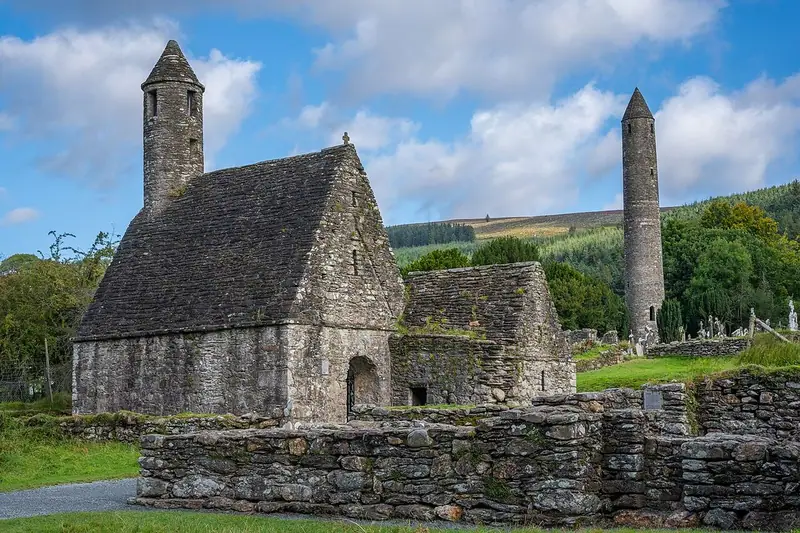 Early Christian Irish8 stops · 6th–14th century CE
Glendalough audio guide
Saint Kevin’s valley of the two lakes in the Wicklow Mountains, with the round tower, stone churches and crosses of his monastery.
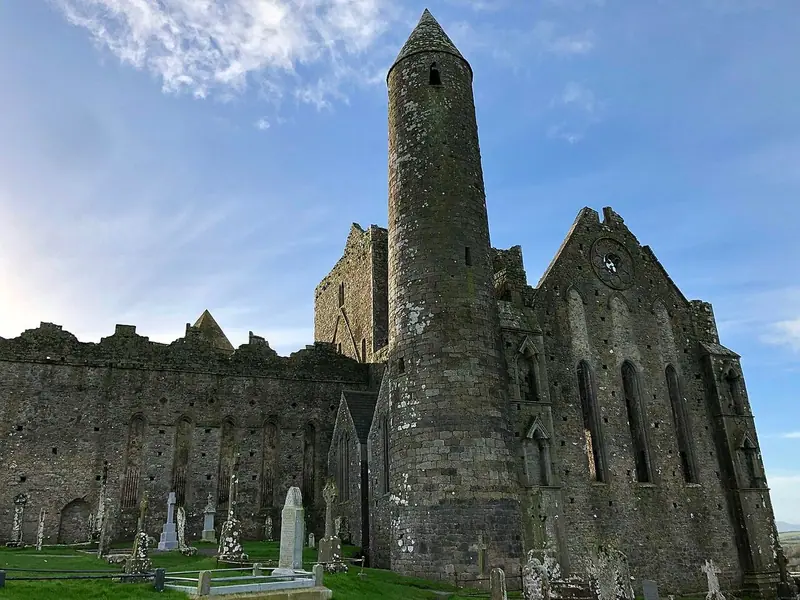 Medieval7 stops · 12th–13th century CE
Rock of Cashel audio guide
Climb to the seat of the kings of Munster, crowned by a round tower, Cormac’s Romanesque chapel and a roofless Gothic cathedral.
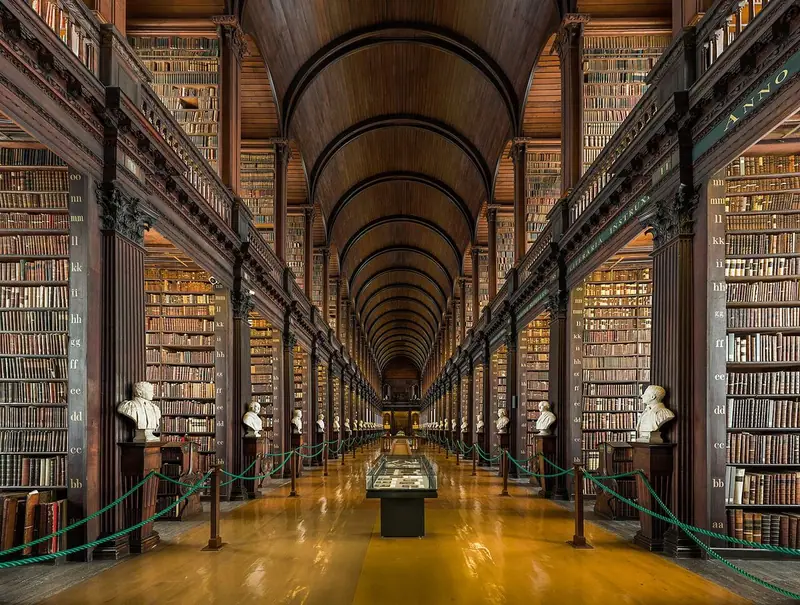 Tudor8 stops · 1592–18th century CE
Trinity College Dublin audio guide
Cross the cobbled squares of Ireland’s oldest university to the Book of Kells and the Long Room of the Old Library.
Every guide, in every country
Newgrange and every other guide we publish, including future ones. One payment, no subscription.