Before you start
Riga, the capital of Latvia, grew up beside the broad River Daugava near the Baltic Sea, and for centuries it was one of the great trading cities of northern Europe. Its medieval old town of church spires, merchants' houses and guildhalls is ringed by nineteenth-century boulevards and by streets lined with what UNESCO calls the finest concentration of Art Nouveau architecture in the world. UNESCO inscribed the Historic Centre of Riga as a World Heritage Site in 1997. This guide begins at the castle on the river, winds through the old town, and ends among the extraordinary facades of the Art Nouveau quarter.
Use it as a self-guided tour of Riga: 9 stops in visit order, each played when you’re ready, at your own pace.
 Free preview · Stop 1
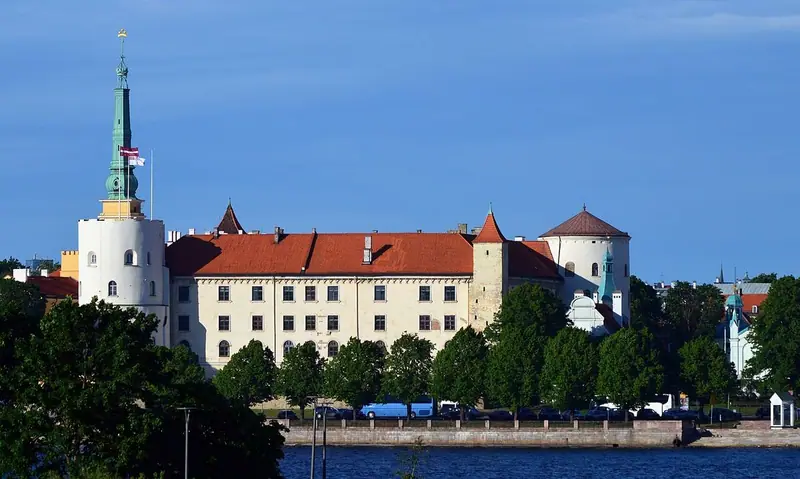
Riga Castle
Begin at Riga Castle, on the bank of the Daugava at the north-western edge of the old town. It was founded in 1330 by the Livonian Order, a branch of the crusading Teutonic Knights, after the people of Riga had rebelled against them and demolished their earlier castle in the centre of the town. Relations remained stormy: the townspeople destroyed this castle too in 1484, and when they lost the struggle they were forced to rebuild it, a task finished in 1515. Later Polish-Lithuanian, Swedish and Russian governors ruled from here, and the Swedes added large annexes in 1641. Since 1938, apart from the years of occupation, it has been the official residence of the President of Latvia, and it also houses museums. Look at its sturdy round towers and low walls, much altered over the centuries, and imagine the tensions between the knights and the merchant city.
Photo: Scotch Mist · CC BY-SA 4.0 · Wikimedia Commons
What to see at Riga: 9 stops, in visit order
- 01
 Riga CastleOn the banks of the DaugavaFree preview
- 02
 The Three BrothersHouses of three centuriesIn the guide
- 03
 Riga CathedralThe largest medieval church in the BalticIn the guide
- 04
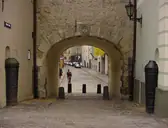 The Swedish GateThe last of the town gatesIn the guide
- 05
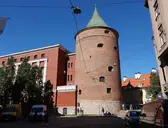 The Powder TowerCannonballs in the wallsIn the guide
- 06
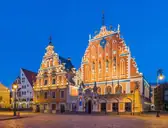 The House of the BlackheadsA merchants' palace rebornIn the guide
- 07
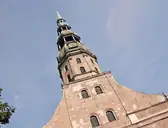 St Peter’s ChurchA steeple above the cityIn the guide
- 08
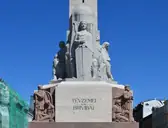 The Freedom MonumentShine like a starIn the guide
- 09
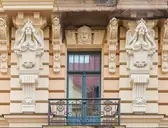 Alberta ielaThe Art Nouveau quarterIn the guide
Site map of Riga
History of Riga
Riga was founded as a port town in 1201 by Bishop Albert, a churchman from Lower Saxony who came to convert the pagan peoples of the eastern Baltic, backed by crusading knights. German merchants settled here, and from the thirteenth to the fifteenth century Riga was one of the leading towns of the Hanseatic League, trading furs, wax, timber and grain. The city passed in turn to Polish-Lithuanian, Swedish and, from 1710, Russian rule; in the seventeenth century it was the largest town in the Swedish realm. In the nineteenth century, as an industrial port of the Russian Empire, it grew rapidly beyond its old walls, and its new districts were built up in the fashionable Art Nouveau style. Riga became the capital of independent Latvia in 1918, suffered occupation by Soviet and Nazi forces, and regained its freedom in 1991.
Riga guide: questions
How many stops does the Riga guide have?
9 stops, in visit order: 1. Riga Castle; 2. The Three Brothers; 3. Riga Cathedral; 4. The Swedish Gate; 5. The Powder Tower; 6. The House of the Blackheads; 7. St Peter’s Church; 8. The Freedom Monument; 9. Alberta iela.
Can I do a self-guided tour of Riga with this guide?
Yes. The guide is made for a self-guided tour: 9 stops in visit order, each with a photo, a story and a voice, so you can explore Riga at your own pace, without joining a group. Download it before you go and it works offline.
How long do you need at Riga?
We suggest allowing A full day. The 9 stops add up to about 7 minutes of listening, and you play each one when you’re ready, so you can linger wherever you like.
How long is each guide?
The 9 stops add up to about 7 minutes of listening in total. You play each stop when you’re ready, so you can go at your own pace.
Does the guide work offline?
Yes, once it’s downloaded. The guide is a single self-contained web page (about 7.8 MB) with the photos, text and audio built in. Download it to your phone before you go (Wi-Fi is best); after that it opens in any modern browser on iPhone or Android, with no app, account or mobile signal needed.
Does it use GPS or need my location?
No. The guide doesn’t use GPS and doesn’t know where you are: you play each stop when you reach it. It works on iPhone and Android in any modern browser, and it’s in English.
What’s included?
One self-contained HTML guide: 9 stops in visit order, each with a photo, text and a voice, plus the story of who built the site.
Who built Riga?
Riga was founded as a port town in 1201 by Bishop Albert, a churchman from Lower Saxony who came to convert the pagan peoples of the eastern Baltic, backed by crusading knights. German merchants settled here, and from the thirteenth to the fifteenth century Riga was one of the leading towns of the Hanseatic League, trading furs, wax, timber and grain.
Where is Riga?
Riga, the capital of Latvia, grew up beside the broad River Daugava near the Baltic Sea, and for centuries it was one of the great trading cities of northern Europe.
Is there a free audio guide to Riga?
The first stop, Riga Castle, is free to read and hear on this page, so you can try the Riga audio tour before you buy. The full guide, with all 9 stops, is a one-off purchase: download it once and it’s yours to keep, working offline.
Is the Riga guide worth it?
If you’d like to know what you’re looking at, yes. For $10 you get 9 stops in visit order, each with a photo, a short history and a voice you play when you’re ready, plus a site map of the stops, and about 7 minutes of listening in all. It’s short on purpose, so you spend your time looking, not listening. It’s yours to keep, works offline and needs no app. The first stop is free on this page, so you can try it before you buy. If you’d like hours of detail, a guided tour will go deeper.
Audio guide or guided tour?
It depends how you like to visit. This guide lets you explore Riga at your own pace, at any time, for a one-off price. A guided tour gives you a live expert you can ask questions, but at fixed times and usually for a higher price. Many people use both: a tour for the big picture, and the guide to read beforehand or to revisit the stops in their own time.
Is this the official Riga guide?
No. It’s an independent guide by The Historian Guide, not affiliated with or endorsed by the operator of Riga. For tickets and opening hours, check the official site operator before you go.
Does the guide include entry tickets or opening hours?
No. The guide is a digital companion only. Admission to Riga is separate, so check the official site operator for current tickets and opening hours before you go.
- Stop 1 · Riga Castle: © Scotch Mist / Wikimedia Commons · CC BY-SA 4.0 · Wikimedia Commons · resized
- Stop 2 · The Three Brothers: giggel · CC BY 3.0 · Wikimedia Commons · resized
- Stop 3 · Riga Cathedral: acediscovery · CC BY 4.0 · Wikimedia Commons · resized
- Stop 4 · The Swedish Gate: Tahbepet · CC BY-SA 2.0 · Wikimedia Commons · resized
- Stop 5 · The Powder Tower: Nenea hartia · CC BY-SA 4.0 · Wikimedia Commons · resized
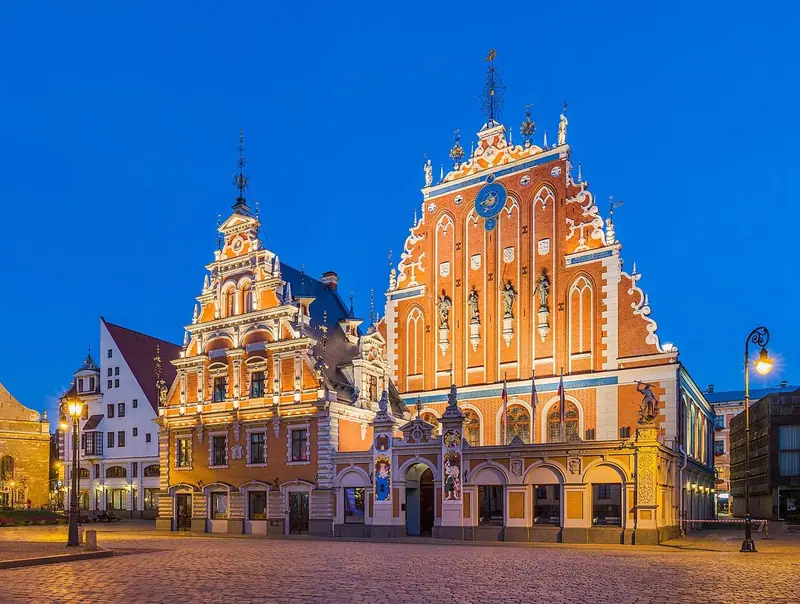
- Stop 6 · The House of the Blackheads (also the cover): Diliff · CC BY-SA 3.0 · Wikimedia Commons · resized
- Stop 7 · St Peter’s Church: Bahnfrend · CC BY-SA 4.0 · Wikimedia Commons · resized
- Stop 8 · The Freedom Monument: © Scotch Mist / Wikimedia Commons · CC BY-SA 4.0 · Wikimedia Commons · resized
- Stop 9 · Alberta iela: Diego Delso · CC BY-SA 3.0 · Wikimedia Commons · resized


All photographs from Wikimedia Commons under the licences shown.
More guides
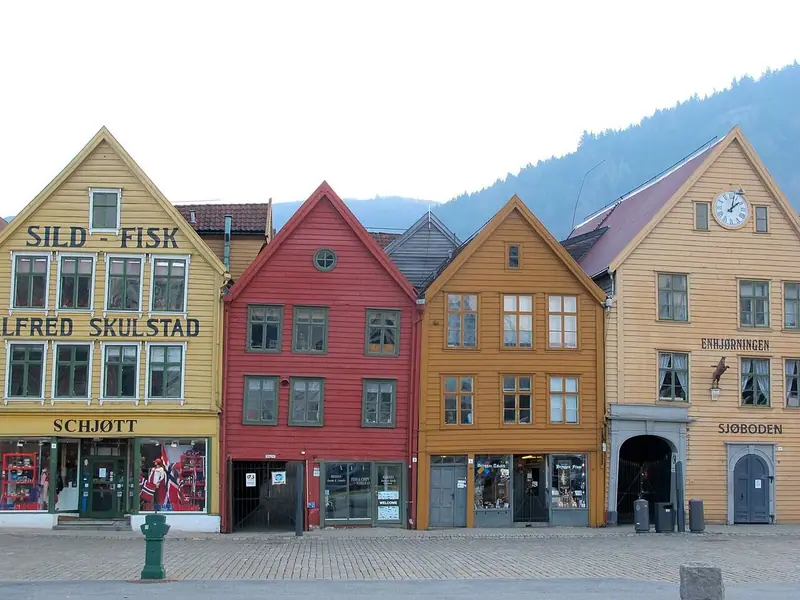 Hanseatic8 stops · 14th–18th century
Bryggen audio guide
Explore the gabled wooden wharf of Bergen, one of the great trading posts of the Hanseatic League, and its narrow passages.
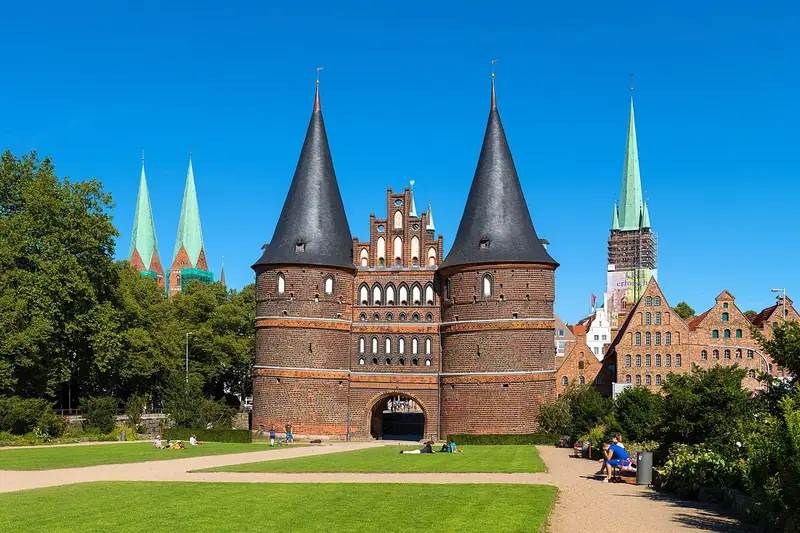 Hanseatic9 stops · 1143 – 16th century
Lübeck audio guide
The brick Gothic island city that led the Hanseatic League, with the Holstentor, the salt warehouses, St Mary’s Church and the town hall.
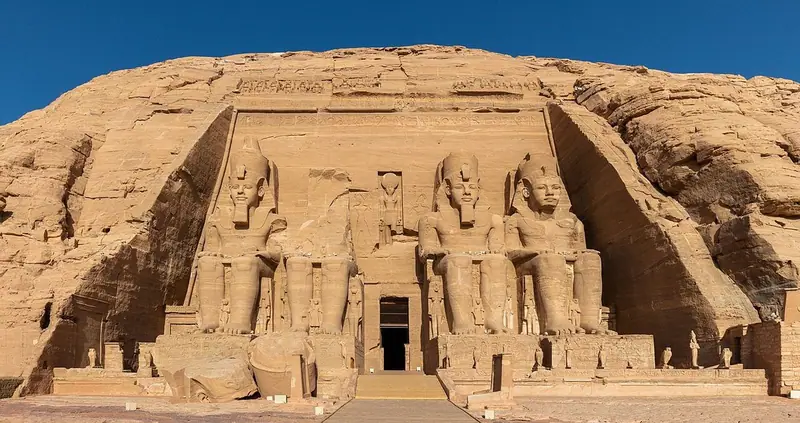 Ancient Egyptian8 stops · 13th century BCE
Abu Simbel audio guide
Ramesses II’s colossal temple façade, the Temple of Nefertari, and how both were rescued from the waters of Lake Nasser.
Every guide, in every country
Riga and every other guide we publish, including future ones. One payment, no subscription.