Before you start
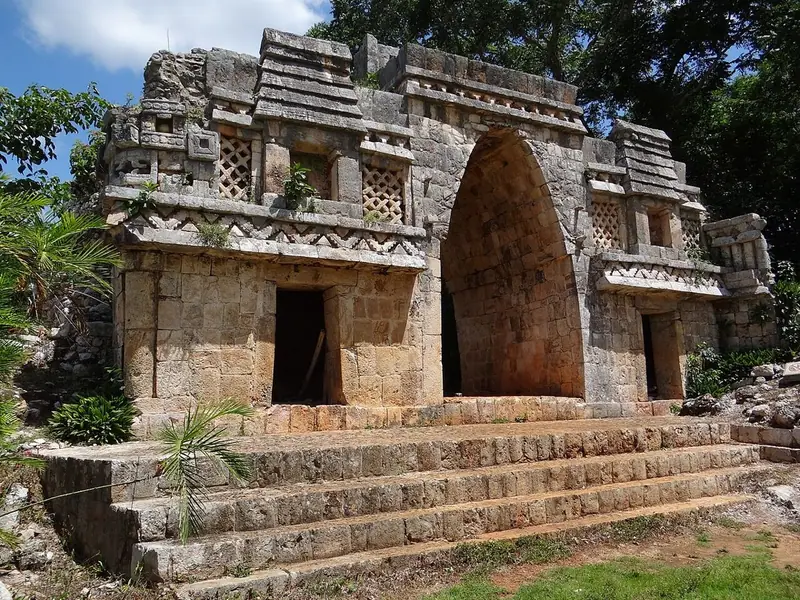
The Ruta Puuc strings together four ancient Maya cities in the low Puuc hills of southern Yucatán state, Mexico, south of Uxmal and roughly 100 to 130 kilometres from Mérida. Uxmal itself is a UNESCO World Heritage Site, inscribed in 1996 as the Pre-Hispanic Town of Uxmal; Kabah, Sayil, Xlapak and Labná are not part of that listing, but they share its Puuc architectural style and are protected archaeological zones managed by INAH, Mexico’s National Institute of Anthropology and History. This guide follows the usual driving order from the Uxmal side: Kabah, with its Codz Poop, Palace and arch, then east along the Puuc road to Sayil’s Great Palace, little Xlapak, and finally Labná’s palace, arch and El Mirador.
Use it as a self-guided tour of the Puuc Route: 8 stops in visit order, each played when you’re ready, at your own pace.
 Free preview · Stop 1
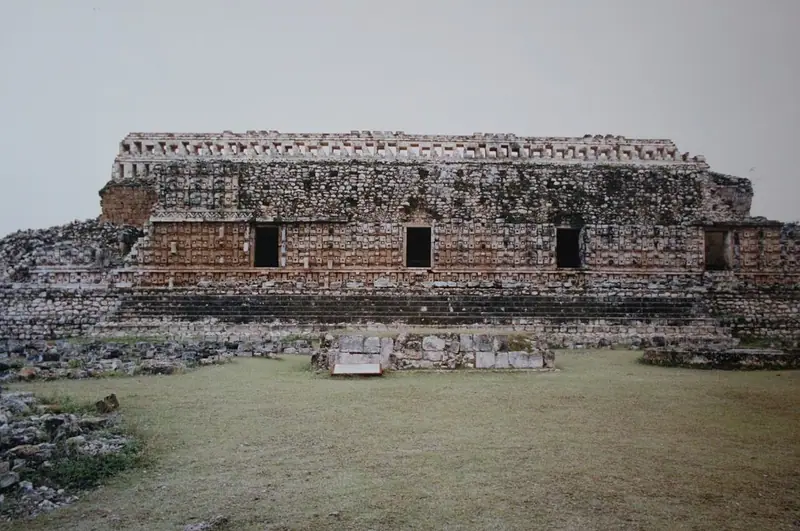
Codz Poop, Kabah
Your first stop is Kabah, Uxmal’s near neighbour, and one of the most startling buildings in the Maya world. The Codz Poop, a Maya name usually translated as ‘rolled mat’, is a long palace whose entire western façade is covered in stone masks, each built up from dozens of carved pieces. They were long thought to depict Chaac, the long-nosed rain god, but INAH now interprets them as Witz, the spirit of the sacred mountain. During recent conservation INAH counted 161 complete masks, 125 of them on this west façade, which is about 53 metres long; they rise from the ground to the roofline, so close that you step on a curled snout to reach the doorways. In a region with no rivers, where every drop of rain mattered, that repetition was a prayer in stone. Walk round to the back to see carved figures of standing rulers, rare portraits in the Puuc style.
Photo: Gary Todd · CC0 · Wikimedia Commons
What to see at the Puuc Route: 8 stops, in visit order
- 01
 Codz Poop, KabahPalacio de los MascaronesFree preview
- 02
 The Palace, KabahEl PalacioIn the guide
- 03
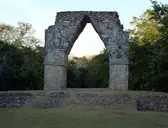 The Arch of KabahArco de KabahIn the guide
- 04
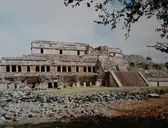 Great Palace, SayilGran PalacioIn the guide
- 05
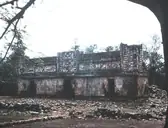 Xlapak PalaceEstructura 1In the guide
- 06
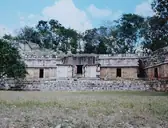 Labná PalaceEl PalacioIn the guide
- 07
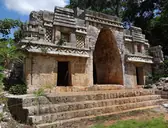 Labná ArchArco de LabnáIn the guide
- 08
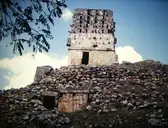 El Mirador, LabnáEl CastilloIn the guide
Site map of the Puuc Route
History of the Puuc Route
The Puuc cities were built by the Maya — specifically Yucatec-speaking Maya of the Late and Terminal Classic. They belonged to a far older story. Farming villages appeared in the Maya lowlands by around 2000 BCE; the first cities and great pyramids rose in the Preclassic period, before about 250 CE; the Classic period, roughly 250 to 900 CE, was the age of rival kingdoms, written inscriptions and dated monuments; and in the Postclassic, power shifted north to cities such as Chichén Itzá and Mayapán. The Spanish conquest of Yucatán began in the 1520s and was only completed in 1697, when the last independent Maya kingdom, Nojpetén in Guatemala, fell. The Maya never disappeared: millions of people speak Mayan languages today, including Yucatec Maya across this peninsula.
The full history continues in the guide.
Puuc Route guide: questions
How many stops does the Puuc Route guide have?
8 stops, in visit order: 1. Codz Poop, Kabah; 2. The Palace, Kabah; 3. The Arch of Kabah; 4. Great Palace, Sayil; 5. Xlapak Palace; 6. Labná Palace; 7. Labná Arch; 8. El Mirador, Labná.
Can I do a self-guided tour of the Puuc Route with this guide?
Yes. The guide is made for a self-guided tour: 8 stops in visit order, each with a photo, a story and a voice, so you can explore the Puuc Route at your own pace, without joining a group. Download it before you go and it works offline.
How long is each guide?
The 8 stops add up to about 7 minutes of listening in total. You play each stop when you’re ready, so you can go at your own pace.
Does the guide work offline?
Yes, once it’s downloaded. The guide is a single self-contained web page (about 8.6 MB) with the photos, text and audio built in. Download it to your phone before you go (Wi-Fi is best); after that it opens in any modern browser on iPhone or Android, with no app, account or mobile signal needed.
Does it use GPS or need my location?
No. The guide doesn’t use GPS and doesn’t know where you are: you play each stop when you reach it. It works on iPhone and Android in any modern browser, and it’s in English.
What’s included?
One self-contained HTML guide: 8 stops in visit order, each with a photo, text and a voice, plus the story of who built the site.
Who built the Puuc Route?
The Puuc cities were built by the Maya — specifically Yucatec-speaking Maya of the Late and Terminal Classic. They belonged to a far older story.
Where is the Puuc Route?
The Ruta Puuc strings together four ancient Maya cities in the low Puuc hills of southern Yucatán state, Mexico, south of Uxmal and roughly 100 to 130 kilometres from Mérida.
Is there a free audio guide to the Puuc Route?
The first stop, Codz Poop, Kabah, is free to read and hear on this page, so you can try the Puuc Route audio tour before you buy. The full guide, with all 8 stops, is a one-off purchase: download it once and it’s yours to keep, working offline.
Is the Puuc Route guide worth it?
If you’d like to know what you’re looking at, yes. For $10 you get 8 stops in visit order, each with a photo, a short history and a voice you play when you’re ready, plus a site map of the stops, and about 7 minutes of listening in all. It’s short on purpose, so you spend your time looking, not listening. It’s yours to keep, works offline and needs no app. The first stop is free on this page, so you can try it before you buy. If you’d like hours of detail, a guided tour will go deeper.
Audio guide or guided tour?
It depends how you like to visit. This guide lets you explore the Puuc Route at your own pace, at any time, for a one-off price. A guided tour gives you a live expert you can ask questions, but at fixed times and usually for a higher price. Many people use both: a tour for the big picture, and the guide to read beforehand or to revisit the stops in their own time.
Is this the official Puuc Route guide?
No. It’s an independent guide by The Historian Guide, not affiliated with or endorsed by the operator of the Puuc Route. For tickets and opening hours, check the official site operator before you go.
Does the guide include entry tickets or opening hours?
No. The guide is a digital companion only. Admission to the Puuc Route is separate, so check the official site operator for current tickets and opening hours before you go.
- Stop 1 · Codz Poop, Kabah: Gary Todd · CC0 · Wikimedia Commons · resized
- Stop 2 · The Palace, Kabah: Gary Todd · CC0 · Wikimedia Commons · resized
- Stop 3 · The Arch of Kabah: Rob Young from United Kingdom · CC BY 2.0 · Wikimedia Commons · resized
- Stop 4 · Great Palace, Sayil: Gary Todd · CC0 · Wikimedia Commons · resized
- Stop 5 · Xlapak Palace: Gary Todd · CC0 · Wikimedia Commons · resized
- Stop 6 · Labná Palace: Gary Todd · CC0 · Wikimedia Commons · resized
- Stop 7 · Labná Arch (also the cover): jtyoder-601591 · CC0 · Wikimedia Commons · resized
- Stop 8 · El Mirador, Labná: Gary Todd · CC0 · Wikimedia Commons · resized


All photographs from Wikimedia Commons under the licences shown.
More guides in Mexico
 New Spain and Mexico8 stops · Colonial and modern Mexico
The Basilica of Guadalupe audio guide
Cross the great plaza of the world’s most visited Catholic shrine to see the image of Our Lady of Guadalupe, then climb the hill of Tepeyac.
 Maya6 stops · c. 600–800 CE
Bonampak audio guide
Three small rooms in the Lacandon forest painted with vivid Maya murals: a royal court, a battle and a celebration.
 Maya6 stops · c. 250–900 CE
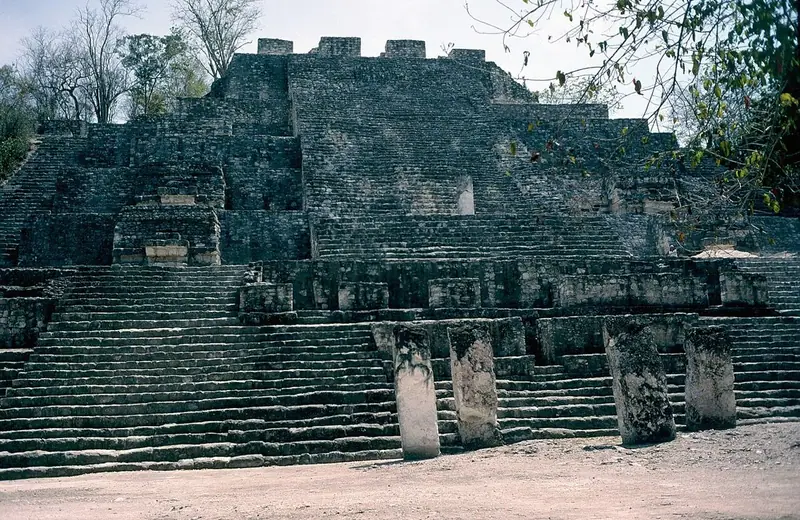
Calakmul audio guide
Capital of the Snake Kingdom, rising out of the Campeche rainforest.
 New Spain and Mexico8 stops · Second Mexican Empire
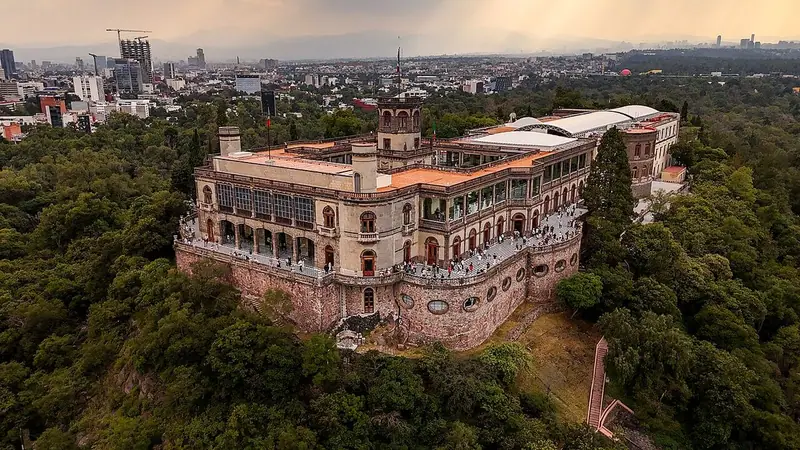
Chapultepec Castle audio guide
Climb the hill of Chapultepec to the castle of a viceroy, an emperor and presidents, now the National Museum of History.
 Maya8 stops · c. 600–1200 CE
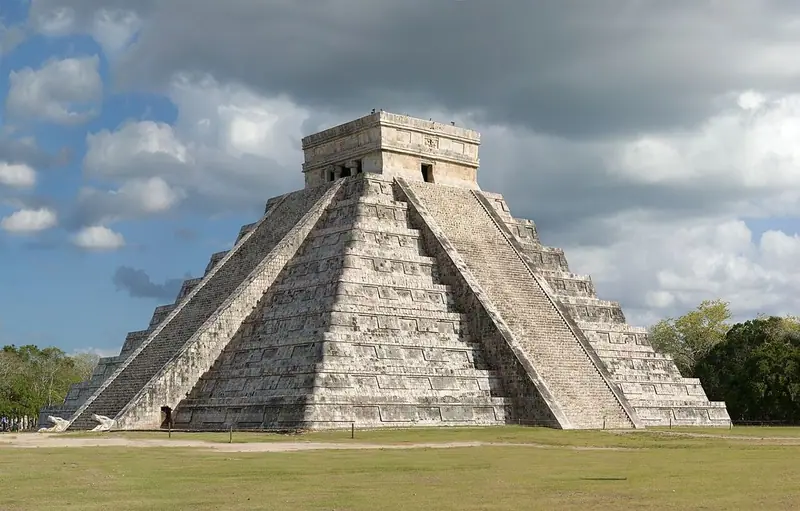
Chichén Itzá audio guide
El Castillo and its serpent of light, the greatest ballcourt in Mesoamerica and the Sacred Cenote.
 Mesoamerican6 stops · c. 300 BCE – 900 CE (pyramid)
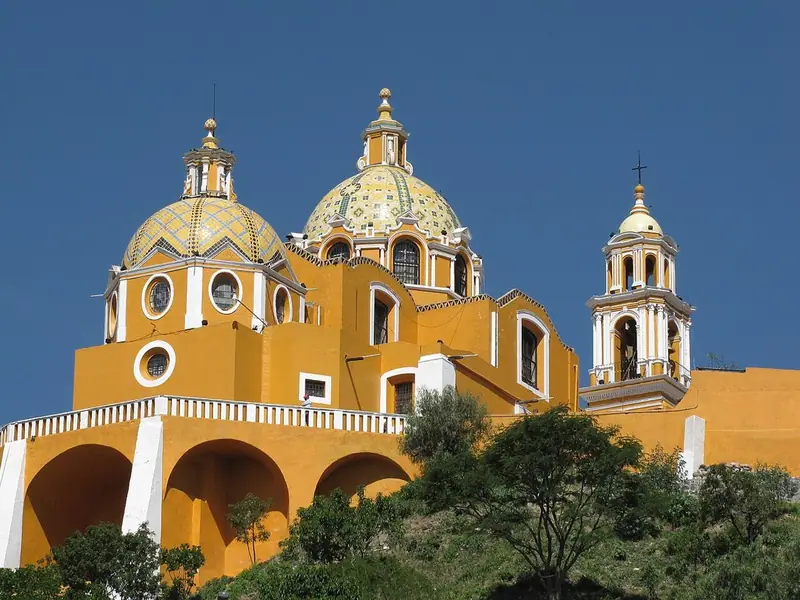
Cholula audio guide
Tunnel into the Great Pyramid, then climb to the church on its summit and the view of the volcanoes.
Every guide, in every country
Puuc Route and every other guide we publish, including future ones. One payment, no subscription.