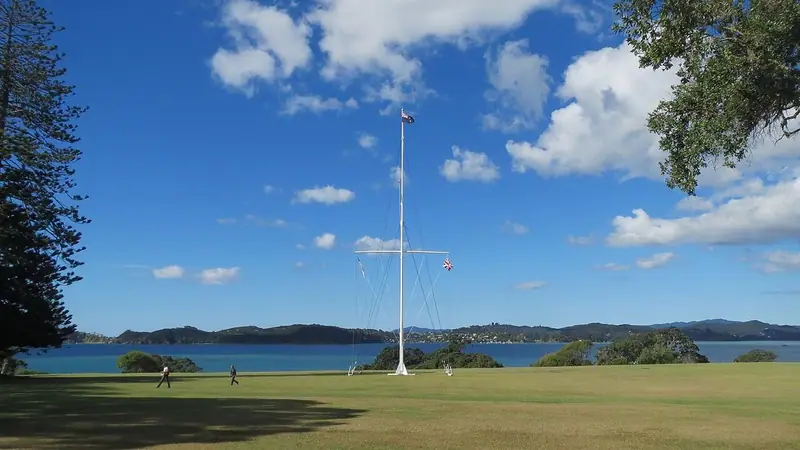
Before you start
The Waitangi Treaty Grounds lie on a headland above the Bay of Islands, in Northland, at the top of New Zealand’s North Island. Here, on 6 February 1840, representatives of the British Crown and Māori chiefs first signed the Treaty of Waitangi, Te Tiriti o Waitangi, New Zealand’s founding document. The tour starts at the museum of the Treaty, crosses the lawns to the Treaty House and the carved meeting house, visits the flagstaff, goes down to the great war canoe at Hobson’s Beach, and ends at the museum honouring Māori who served in war. The paths are mostly gentle, with a slope down to the beach. Allow at least three hours, and longer if you join a guided tour or cultural performance.
Use it as a self-guided tour of the Waitangi Treaty Grounds: 6 stops in visit order, each played when you’re ready, at your own pace.
 Free preview · Stop 1
Te Kōngahu Museum
Begin at Te Kōngahu, the Museum of Waitangi, opened in 2016, near the entrance to the grounds. Its exhibitions tell the story of the Treaty of Waitangi, from the first meetings between Māori and Europeans to the present day. Look for the full-size copies of the Treaty documents and of the Declaration of Independence of 1835, signed here by northern chiefs. The Treaty was written in English and in Māori, but the two texts differ: in the Māori text the chiefs granted the Crown kawanatanga, or governance, and were promised their tino rangatiratanga, or full chieftainship, while the English text spoke of ceding sovereignty. Those differences have been debated ever since. Look too for the displays on the long struggle for recognition of the Treaty, which led in 1975 to the creation of the Waitangi Tribunal, which investigates claims of breaches of the Treaty.
Photo: Archives New Zealand from New Zealand · CC BY-SA 2.0 · Wikimedia Commons
What to see at the Waitangi Treaty Grounds: 6 stops, in visit order
- 01
 Te Kōngahu MuseumThe story of the TreatyFree preview
- 02
 The Treaty HouseHome of the British ResidentIn the guide
- 03
 Te Whare RūnangaThe carved meeting houseIn the guide
- 04
 The FlagstaffWhere the Treaty was signedIn the guide
- 05
 Te Rau ArohaThe price of citizenshipIn the guide
- 06
 NgātokimatawhaoruaThe great war canoeIn the guide
Site map of the Waitangi Treaty Grounds
History of the Waitangi Treaty Grounds
The ancestors of the Māori sailed to New Zealand from eastern Polynesia, and archaeologists date their settlement to around 1250 to 1300 CE. Over the following centuries they developed a distinct culture, organised into iwi, or tribes, and hapū, or sub-tribes; the people of this region are mainly Ngāpuhi. Europeans arrived in growing numbers from the late eighteenth century. In 1833 James Busby came to Waitangi as the British Resident, and his house was built here. In 1835 northern chiefs signed a Declaration of Independence here, and in 1840 the Treaty created the British colony of New Zealand, which became a self-governing dominion in 1907. Māori culture and language remain central to the life of the grounds today.
Waitangi Treaty Grounds guide: questions
How many stops does the Waitangi Treaty Grounds guide have?
6 stops, in visit order: 1. Te Kōngahu Museum; 2. The Treaty House; 3. Te Whare Rūnanga; 4. The Flagstaff; 5. Te Rau Aroha; 6. Ngātokimatawhaorua.
Can I do a self-guided tour of the Waitangi Treaty Grounds with this guide?
Yes. The guide is made for a self-guided tour: 6 stops in visit order, each with a photo, a story and a voice, so you can explore the Waitangi Treaty Grounds at your own pace, without joining a group. Download it before you go and it works offline.
How long is each guide?
The 6 stops add up to about 5 minutes of listening in total. You play each stop when you’re ready, so you can go at your own pace.
Does the guide work offline?
Yes, once it’s downloaded. The guide is a single self-contained web page (about 5.7 MB) with the photos, text and audio built in. Download it to your phone before you go (Wi-Fi is best); after that it opens in any modern browser on iPhone or Android, with no app, account or mobile signal needed.
Does it use GPS or need my location?
No. The guide doesn’t use GPS and doesn’t know where you are: you play each stop when you reach it. It works on iPhone and Android in any modern browser, and it’s in English.
What’s included?
One self-contained HTML guide: 6 stops in visit order, each with a photo, text and a voice, plus the story of who built the site.
Who built the Waitangi Treaty Grounds?
The ancestors of the Māori sailed to New Zealand from eastern Polynesia, and archaeologists date their settlement to around 1250 to 1300 CE. Over the following centuries they developed a distinct culture, organised into iwi, or tribes, and hapū, or sub-tribes; the people of this region are mainly Ngāpuhi.
Where is the Waitangi Treaty Grounds?
The Waitangi Treaty Grounds lie on a headland above the Bay of Islands, in Northland, at the top of New Zealand’s North Island.
Is there a free audio guide to the Waitangi Treaty Grounds?
The first stop, Te Kōngahu Museum, is free to read and hear on this page, so you can try the Waitangi Treaty Grounds audio tour before you buy. The full guide, with all 6 stops, is a one-off purchase: download it once and it’s yours to keep, working offline.
Is the Waitangi Treaty Grounds guide worth it?
If you’d like to know what you’re looking at, yes. For $10 you get 6 stops in visit order, each with a photo, a short history and a voice you play when you’re ready, plus a site map of the stops, and about 5 minutes of listening in all. It’s short on purpose, so you spend your time looking, not listening. It’s yours to keep, works offline and needs no app. The first stop is free on this page, so you can try it before you buy. If you’d like hours of detail, a guided tour will go deeper.
Audio guide or guided tour?
It depends how you like to visit. This guide lets you explore the Waitangi Treaty Grounds at your own pace, at any time, for a one-off price. A guided tour gives you a live expert you can ask questions, but at fixed times and usually for a higher price. Many people use both: a tour for the big picture, and the guide to read beforehand or to revisit the stops in their own time.
Is this the official Waitangi Treaty Grounds guide?
No. It’s an independent guide by The Historian Guide, not affiliated with or endorsed by the operator of the Waitangi Treaty Grounds. For tickets and opening hours, check the official site operator before you go.
Does the guide include entry tickets or opening hours?
No. The guide is a digital companion only. Admission to the Waitangi Treaty Grounds is separate, so check the official site operator for current tickets and opening hours before you go.
- Stop 1 · Te Kōngahu Museum: Archives New Zealand from New Zealand · CC BY-SA 2.0 · Wikimedia Commons · resized
- Stop 2 · The Treaty House: Winstonwolfe at the English-language Wikipedia · CC BY-SA 3.0 · Wikimedia Commons · resized
- Stop 3 · Te Whare Rūnanga: New Zealand Government, Office of the Governor-General · CC BY 4.0 · Wikimedia Commons · resized
- Stop 4 · The Flagstaff (also the cover): Sheila Thomson · CC BY 2.0 · Wikimedia Commons · resized
- Stop 5 · Te Rau Aroha: Archives New Zealand from New Zealand · CC BY 2.0 · Wikimedia Commons · resized
- Stop 6 · Ngātokimatawhaorua: Steve · CC BY 2.0 · Wikimedia Commons · resized


All photographs from Wikimedia Commons under the licences shown.
More guides in New Zealand
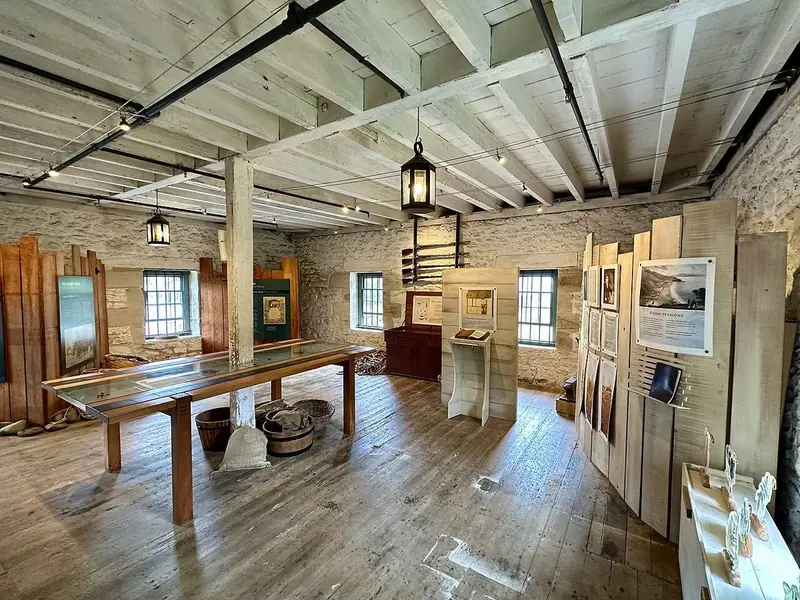 Māori7 stops · 1819–1848
Kerikeri Mission Station audio guide
Visit New Zealand’s two oldest European buildings, the Mission House and the Stone Store, beneath Hongi Hika’s Kororipo Pā.
 Modern9 stops · 1931 – 1938 (rebuilding after the Hawke’s Bay earthquake)
Napier audio guide
The Art Deco city rebuilt after the 1931 Hawke’s Bay earthquake: Marine Parade, Pania of the Reef, the Veronica Sunbay, Māori patterns on the former Bank of New Zealand and the National Tobacco Company Building.
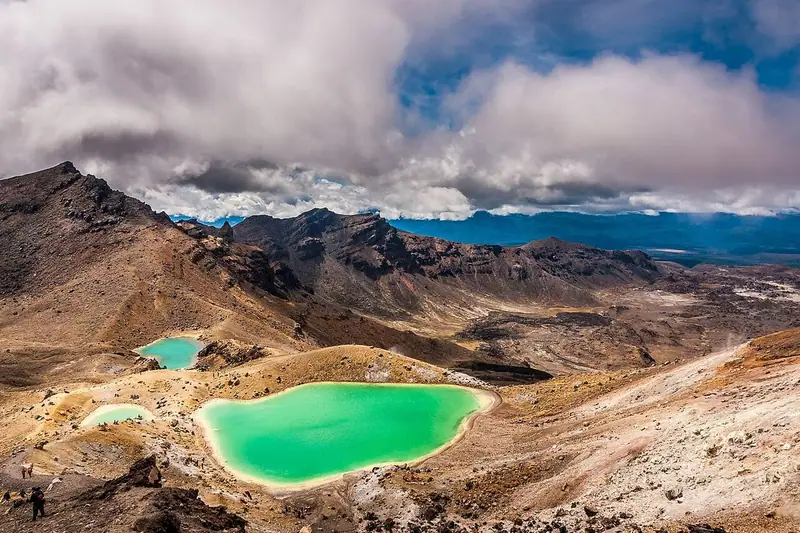 Māori9 stops · 1887–1993
Tongariro National Park audio guide
Sacred volcanoes gifted by Ngāti Tūwharetoa in 1887, New Zealand’s first national park and a dual World Heritage cultural landscape.
Every guide, in every country
Waitangi Treaty Grounds and every other guide we publish, including future ones. One payment, no subscription.