Before you start
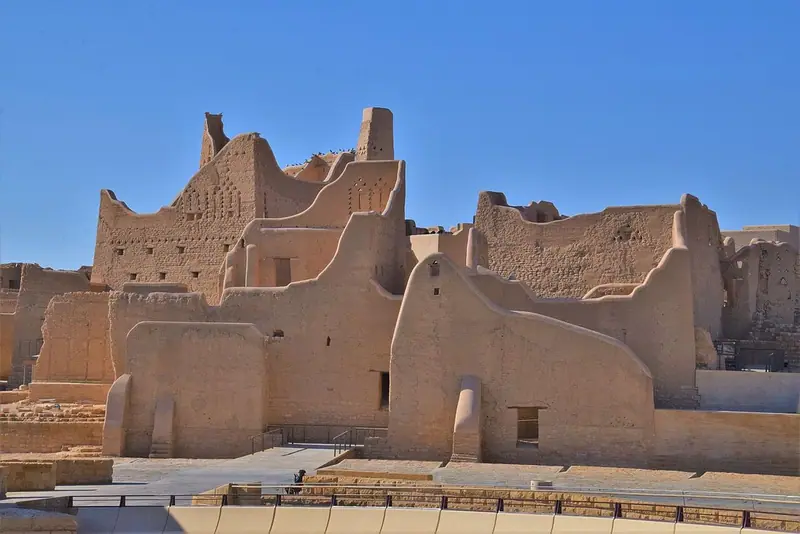
Diriyah lies on the north-western edge of Riyadh, along the palm-lined valley of Wadi Hanifa. It was the original home of the House of Saud and the capital of the First Saudi State, and its old district of At-Turaif, a hilltop city of mud-brick palaces, mosques and houses, was inscribed as a UNESCO World Heritage Site in 2010. After a long restoration, At-Turaif is now an open-air museum with galleries in its historic buildings, while the neighbouring Al-Bujairi district, across the valley, has restaurants and cafés. This guide starts in Al-Bujairi, looks across the wadi, then enters At-Turaif to explore its palaces, mosque and lanes.
Use it as a self-guided tour of Diriyah and At-Turaif: 8 stops in visit order, each played when you’re ready, at your own pace.
 Free preview · Stop 1
Al-Bujairi
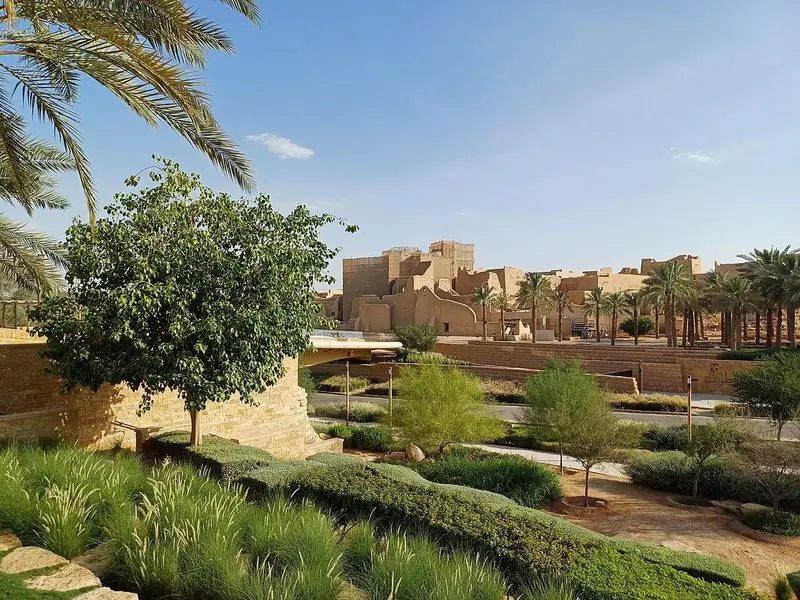
Begin in Al-Bujairi, the district on the eastern side of Wadi Hanifa. In the days of the First Saudi State it was known as a centre of religious learning, where scholars taught and students came to study. Muhammad ibn Abd al-Wahhab, the scholar whose alliance with Muhammad bin Saud shaped the Saudi state, taught here, and a mosque bearing his name stands in the district. Today much of Al-Bujairi has been rebuilt in the traditional Najdi style, with sand-coloured walls, crenellated parapets and small triangular openings, and it is lined with restaurants and cafés along a terrace known as Bujairi Terrace. As you walk, notice the buildings’ thick, plain walls and narrow windows, designed to keep out the heat and the glare of the sun. Then make your way to the edge of the terrace, where the view opens across the valley.
Photo: Radosław Botev · CC BY 3.0 pl · Wikimedia Commons
What to see at Diriyah and At-Turaif: 8 stops, in visit order
- 01
 Al-BujairiA district of learningFree preview
- 02
 Wadi HanifaThe valley of palmsIn the guide
- 03
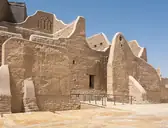 Najdi ArchitectureBuilding with mudIn the guide
- 04
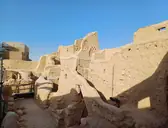 Sabalat MoudhiCharity and bathsIn the guide
- 05
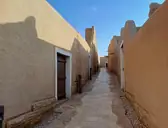 At-TuraifThe hilltop capitalIn the guide
- 06
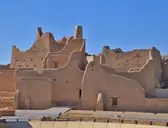 Salwa PalaceThe seat of powerIn the guide
- 07
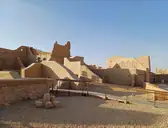 Imam Muhammad bin Saud MosquePalace and prayerIn the guide
- 08
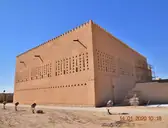 Saad bin Saud PalaceThe prince’s houseIn the guide
Site map of Diriyah and At-Turaif
History of Diriyah and At-Turaif
According to the chroniclers of Najd, Diriyah was founded in the fifteenth century by Mani’ al-Muraydi, an ancestor of the Saudi royal family. Muhammad bin Saud became its ruler in 1727, the date now marked in Saudi Arabia as Founding Day. In 1744 he formed an alliance with the religious scholar Muhammad ibn Abd al-Wahhab, and over the following decades the Saudi state expanded across much of Arabia. This alarmed the Ottoman Empire, and in 1818 an Ottoman-Egyptian army under Ibrahim Pasha besieged Diriyah, captured it and destroyed it. The Saudis later made Riyadh their capital, and the ruins stood largely deserted until restoration began in recent decades.
Diriyah and At-Turaif guide: questions
How many stops does the Diriyah and At-Turaif guide have?
8 stops, in visit order: 1. Al-Bujairi; 2. Wadi Hanifa; 3. Najdi Architecture; 4. Sabalat Moudhi; 5. At-Turaif; 6. Salwa Palace; 7. Imam Muhammad bin Saud Mosque; 8. Saad bin Saud Palace.
Can I do a self-guided tour of Diriyah and At-Turaif with this guide?
Yes. The guide is made for a self-guided tour: 8 stops in visit order, each with a photo, a story and a voice, so you can explore Diriyah and At-Turaif at your own pace, without joining a group. Download it before you go and it works offline.
How long is each guide?
The 8 stops add up to about 6 minutes of listening in total. You play each stop when you’re ready, so you can go at your own pace.
Does the guide work offline?
Yes, once it’s downloaded. The guide is a single self-contained web page (about 7.0 MB) with the photos, text and audio built in. Download it to your phone before you go (Wi-Fi is best); after that it opens in any modern browser on iPhone or Android, with no app, account or mobile signal needed.
Does it use GPS or need my location?
No. The guide doesn’t use GPS and doesn’t know where you are: you play each stop when you reach it. It works on iPhone and Android in any modern browser, and it’s in English.
What’s included?
One self-contained HTML guide: 8 stops in visit order, each with a photo, text and a voice, plus the story of who built the site.
Who built Diriyah and At-Turaif?
According to the chroniclers of Najd, Diriyah was founded in the fifteenth century by Mani’ al-Muraydi, an ancestor of the Saudi royal family. Muhammad bin Saud became its ruler in 1727, the date now marked in Saudi Arabia as Founding Day.
Where is Diriyah and At-Turaif?
Diriyah lies on the north-western edge of Riyadh, along the palm-lined valley of Wadi Hanifa.
Is there a free audio guide to Diriyah and At-Turaif?
The first stop, Al-Bujairi, is free to read and hear on this page, so you can try the Diriyah and At-Turaif audio tour before you buy. The full guide, with all 8 stops, is a one-off purchase: download it once and it’s yours to keep, working offline.
Is the Diriyah and At-Turaif guide worth it?
If you’d like to know what you’re looking at, yes. For $10 you get 8 stops in visit order, each with a photo, a short history and a voice you play when you’re ready, plus a site map of the stops, and about 6 minutes of listening in all. It’s short on purpose, so you spend your time looking, not listening. It’s yours to keep, works offline and needs no app. The first stop is free on this page, so you can try it before you buy. If you’d like hours of detail, a guided tour will go deeper.
Audio guide or guided tour?
It depends how you like to visit. This guide lets you explore Diriyah and At-Turaif at your own pace, at any time, for a one-off price. A guided tour gives you a live expert you can ask questions, but at fixed times and usually for a higher price. Many people use both: a tour for the big picture, and the guide to read beforehand or to revisit the stops in their own time.
Is this the official Diriyah and At-Turaif guide?
No. It’s an independent guide by The Historian Guide, not affiliated with or endorsed by the operator of Diriyah and At-Turaif. For tickets and opening hours, check the official site operator before you go.
Does the guide include entry tickets or opening hours?
No. The guide is a digital companion only. Admission to Diriyah and At-Turaif is separate, so check the official site operator for current tickets and opening hours before you go.
- Stop 1 · Al-Bujairi: Radosław Botev · CC BY 3.0 pl · Wikimedia Commons · resized
- Stop 2 · Wadi Hanifa: Radosław Botev · CC BY 3.0 pl · Wikimedia Commons · resized
- Stop 3 · Najdi Architecture: xiquinhosilva · CC BY 2.0 · Wikimedia Commons · resized
- Stop 4 · Sabalat Moudhi: Radosław Botev · CC BY 3.0 pl · Wikimedia Commons · resized
- Stop 5 · At-Turaif: Radosław Botev · CC BY 3.0 pl · Wikimedia Commons · resized
- Stop 6 · Salwa Palace (also the cover): Heritage Commission · CC BY-SA 4.0 · Wikimedia Commons · resized
- Stop 7 · Imam Muhammad bin Saud Mosque: Radosław Botev · CC BY 3.0 pl · Wikimedia Commons · resized
- Stop 8 · Saad bin Saud Palace: Heritage Commission · CC BY-SA 4.0 · Wikimedia Commons · resized


All photographs from Wikimedia Commons under the licences shown.
More guides in Saudi Arabia
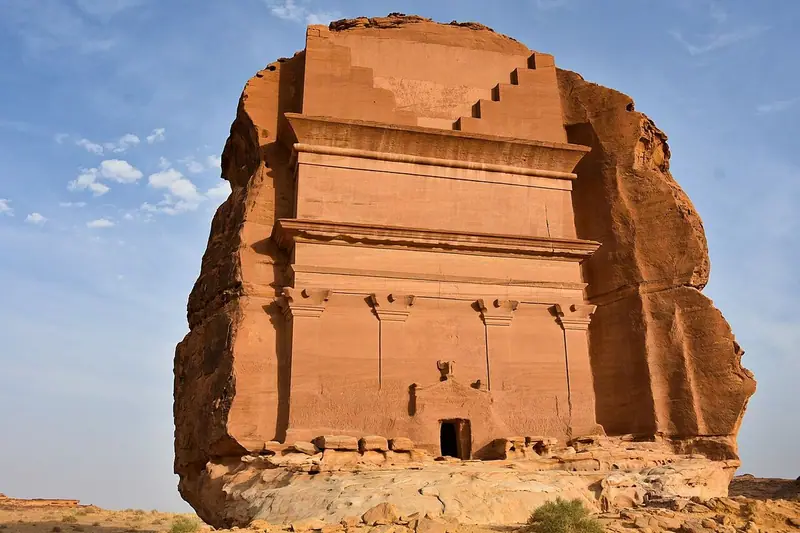 Nabataean6 stops · 1st century BCE – 1st century CE
Hegra audio guide
Tour the desert near AlUla among more than a hundred monumental Nabataean tombs carved into outcrops of golden sandstone.
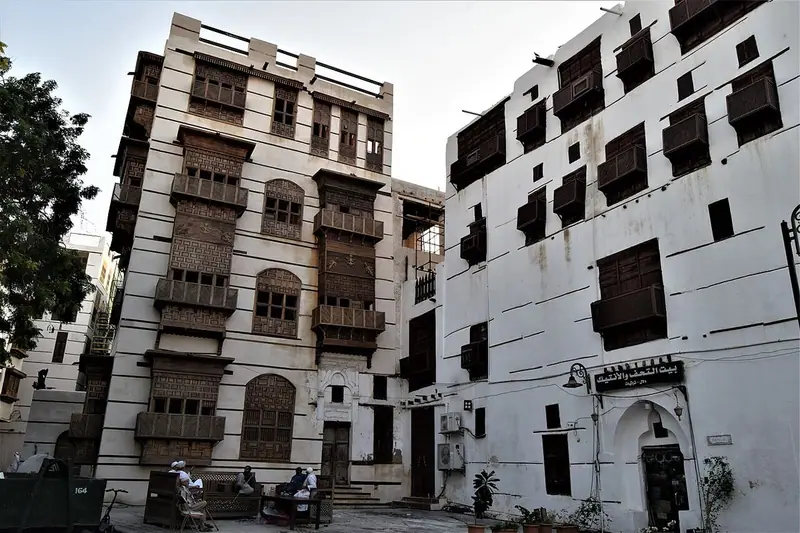 Hejazi7 stops · 647–1925
Historic Jeddah, Al-Balad audio guide
Enter Al-Balad by the Makkah Gate and follow the old market street past coral-stone houses with great wooden bay windows to Bayt Nasseef.
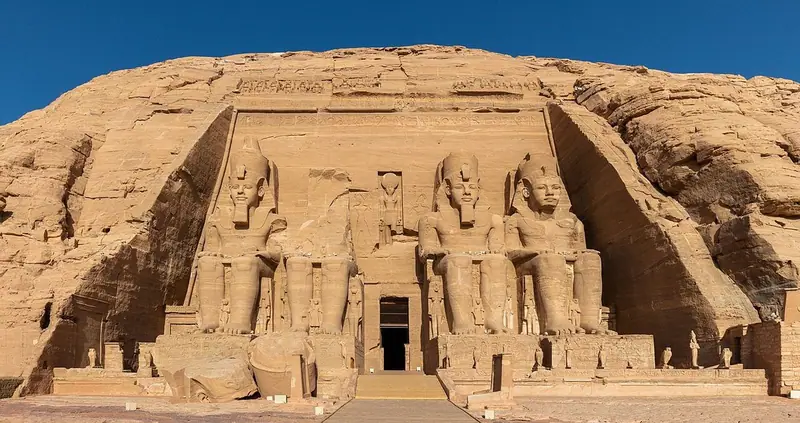 Ancient Egyptian8 stops · 13th century BCE
Abu Simbel audio guide
Ramesses II’s colossal temple façade, the Temple of Nefertari, and how both were rescued from the waters of Lake Nasser.
Every guide, in every country
Diriyah and At-Turaif and every other guide we publish, including future ones. One payment, no subscription.