Before you start
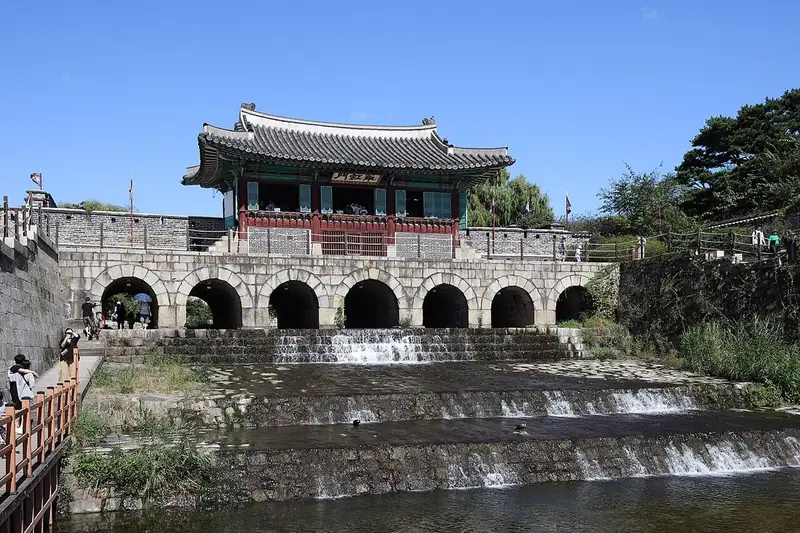
Hwaseong Fortress encircles the old centre of Suwon, about thirty kilometres south of Seoul. Its walls run for some 5.7 kilometres over the hill of Paldalsan and across the flat town, with four great gates, watchtowers, command posts and a beacon tower, and you can walk almost the whole circuit along the top. The fortress became a UNESCO World Heritage Site in 1997. Much of it was damaged in the twentieth century and rebuilt in the 1970s from a detailed record of the original construction. This guide starts at the royal temporary palace in the centre, then follows the wall from the south gate up over Paldalsan and round anticlockwise by the west, north and east gates to the beacon tower. The full circuit takes two to three hours, with a steep climb at the start.
Use it as a self-guided tour of Hwaseong Fortress: 8 stops in visit order, each played when you’re ready, at your own pace.
 Free preview · Stop 1
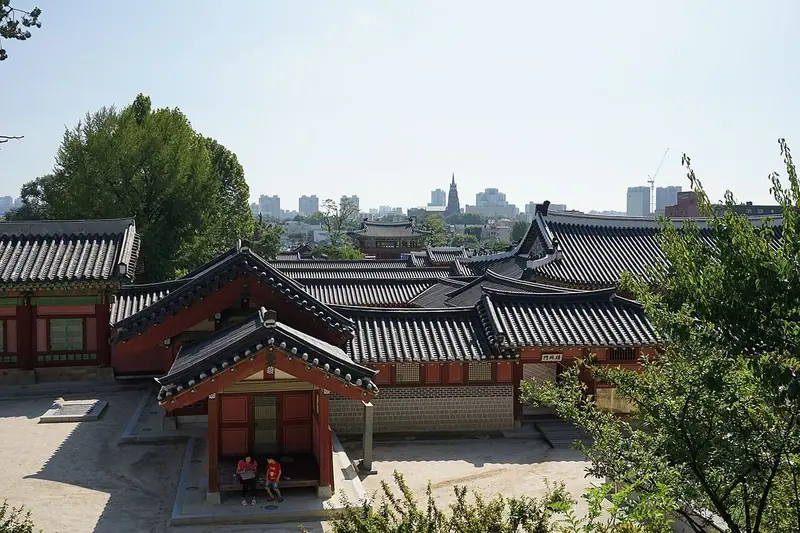
Hwaseong Haenggung
Begin in the centre of the town at Hwaseong Haenggung, the temporary palace where King Jeongjo stayed on his visits to his father’s tomb nearby. It was the largest of the Joseon kings’ temporary palaces, with offices, living quarters and a garden. In 1795 Jeongjo came here with his mother, Lady Hyegyeong, Sado’s widow, and held a great banquet in honour of her sixtieth birthday. The event was recorded in detail in illustrated court records and screen paintings. During the colonial period most of the palace was demolished and the site was used for other buildings, including a hospital. What you see today was rebuilt from 1996 onwards, guided by the historical records, and the last buildings were completed in 2024. Walk through the courtyards to the main hall, then head out to the south gate.
Photo: De-Shao Liu (Terry850324) · CC BY-SA 4.0 · Wikimedia Commons
What to see at Hwaseong Fortress: 8 stops, in visit order
- 01
 Hwaseong HaenggungTemporary PalaceFree preview
- 02
 PaldalmunSouth GateIn the guide
- 03
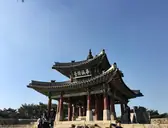 SeojangdaeWestern Command PostIn the guide
- 04
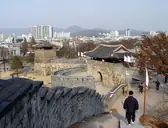 HwaseomunWest GateIn the guide
- 05
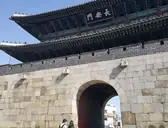 JanganmunNorth GateIn the guide
- 06
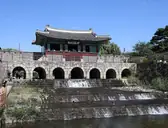 HwahongmunNorthern FloodgateIn the guide
- 07
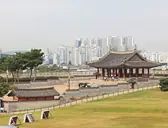 DongjangdaeEastern Command PostIn the guide
- 08
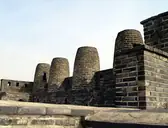 BongdonBeacon TowerIn the guide
Site map of Hwaseong Fortress
History of Hwaseong Fortress
Hwaseong was built by the Joseon dynasty, which ruled Korea from 1392 until 1897, when King Gojong proclaimed the Korean Empire; that empire ended with Japanese annexation in 1910. It was the project of King Jeongjo, who reigned from 1776 to 1800. His father, Crown Prince Sado, had been put to death in 1762 on the orders of his own father, King Yeongjo, by being shut in a rice chest. Jeongjo moved Sado’s tomb to Suwon and built a new walled town beside it between 1794 and 1796. The design was by the scholar Jeong Yak-yong, a leading figure of the Silhak, or ‘practical learning’, movement, who used brick, pulleys and lifting machines, and the workers were paid wages rather than called up for unpaid labour. The building work was recorded in a detailed report, published in 1801.
Hwaseong Fortress guide: questions
How many stops does the Hwaseong Fortress guide have?
8 stops, in visit order: 1. Hwaseong Haenggung; 2. Paldalmun; 3. Seojangdae; 4. Hwaseomun; 5. Janganmun; 6. Hwahongmun; 7. Dongjangdae; 8. Bongdon.
Can I do a self-guided tour of Hwaseong Fortress with this guide?
Yes. The guide is made for a self-guided tour: 8 stops in visit order, each with a photo, a story and a voice, so you can explore Hwaseong Fortress at your own pace, without joining a group. Download it before you go and it works offline.
How long is each guide?
The 8 stops add up to about 5 minutes of listening in total. You play each stop when you’re ready, so you can go at your own pace.
Does the guide work offline?
Yes, once it’s downloaded. The guide is a single self-contained web page (about 7.2 MB) with the photos, text and audio built in. Download it to your phone before you go (Wi-Fi is best); after that it opens in any modern browser on iPhone or Android, with no app, account or mobile signal needed.
Does it use GPS or need my location?
No. The guide doesn’t use GPS and doesn’t know where you are: you play each stop when you reach it. It works on iPhone and Android in any modern browser, and it’s in English.
What’s included?
One self-contained HTML guide: 8 stops in visit order, each with a photo, text and a voice, plus the story of who built the site.
Who built Hwaseong Fortress?
Hwaseong was built by the Joseon dynasty, which ruled Korea from 1392 until 1897, when King Gojong proclaimed the Korean Empire; that empire ended with Japanese annexation in 1910. It was the project of King Jeongjo, who reigned from 1776 to 1800.
Where is Hwaseong Fortress?
Hwaseong Fortress encircles the old centre of Suwon, about thirty kilometres south of Seoul.
Is there a free audio guide to Hwaseong Fortress?
The first stop, Hwaseong Haenggung, is free to read and hear on this page, so you can try the Hwaseong Fortress audio tour before you buy. The full guide, with all 8 stops, is a one-off purchase: download it once and it’s yours to keep, working offline.
Is the Hwaseong Fortress guide worth it?
If you’d like to know what you’re looking at, yes. For $10 you get 8 stops in visit order, each with a photo, a short history and a voice you play when you’re ready, plus a site map of the stops, and about 5 minutes of listening in all. It’s short on purpose, so you spend your time looking, not listening. It’s yours to keep, works offline and needs no app. The first stop is free on this page, so you can try it before you buy. If you’d like hours of detail, a guided tour will go deeper.
Audio guide or guided tour?
It depends how you like to visit. This guide lets you explore Hwaseong Fortress at your own pace, at any time, for a one-off price. A guided tour gives you a live expert you can ask questions, but at fixed times and usually for a higher price. Many people use both: a tour for the big picture, and the guide to read beforehand or to revisit the stops in their own time.
Is this the official Hwaseong Fortress guide?
No. It’s an independent guide by The Historian Guide, not affiliated with or endorsed by the operator of Hwaseong Fortress. For tickets and opening hours, check the official site operator before you go.
Does the guide include entry tickets or opening hours?
No. The guide is a digital companion only. Admission to Hwaseong Fortress is separate, so check the official site operator for current tickets and opening hours before you go.
- Stop 1 · Hwaseong Haenggung: De-Shao Liu (Terry850324) · CC BY-SA 4.0 · Wikimedia Commons · resized
- Stop 2 · Paldalmun: Mobius6 · CC BY-SA 4.0 · Wikimedia Commons · resized
- Stop 3 · Seojangdae: revi · CC BY 2.0 kr · Wikimedia Commons · resized
- Stop 4 · Hwaseomun: Jpbarrass · Public domain · Wikimedia Commons · resized
- Stop 5 · Janganmun: Adil · CC BY-SA 4.0 · Wikimedia Commons · resized
- Stop 6 · Hwahongmun (also the cover): Mobius6 · CC BY-SA 4.0 · Wikimedia Commons · resized
- Stop 7 · Dongjangdae: Bernard Gagnon · CC0 · Wikimedia Commons · resized
- Stop 8 · Bongdon: Jpbarrass · Public domain · Wikimedia Commons · resized


All photographs from Wikimedia Commons under the licences shown.
More guides in South Korea
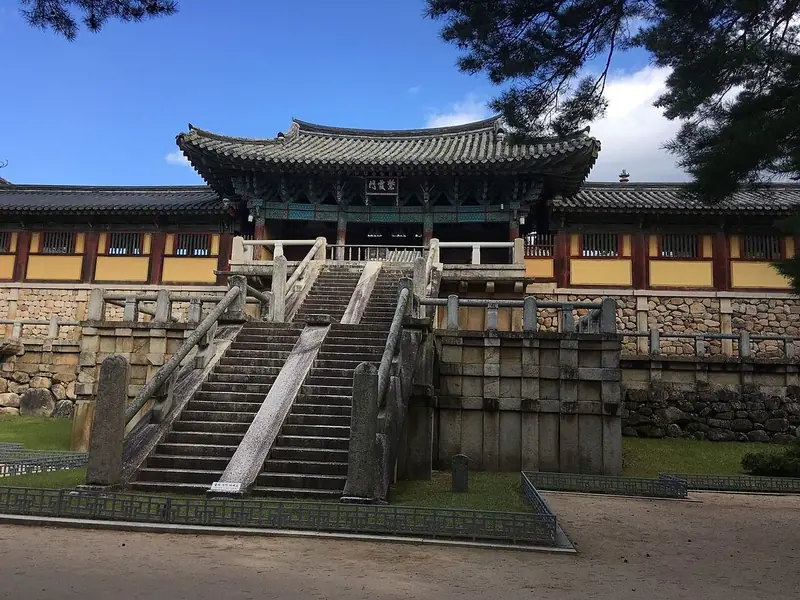 Silla8 stops · 751–774 CE
Bulguksa and Seokguram audio guide
Stone stairways and twin pagodas at the Temple of the Buddha Land, then up the mountain to the Buddha of Seokguram.
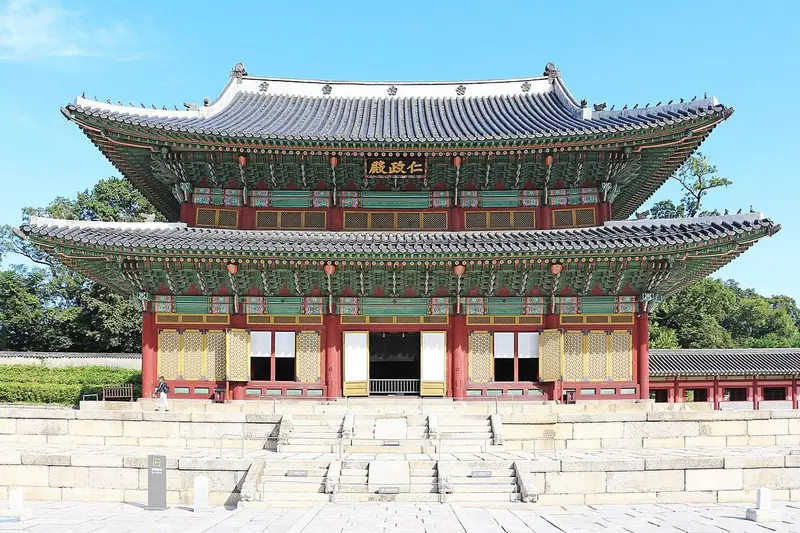 Joseon8 stops · from 1405
Changdeokgung audio guide
A Joseon palace whose halls are tucked into the slopes, with garden ponds and pavilions behind.
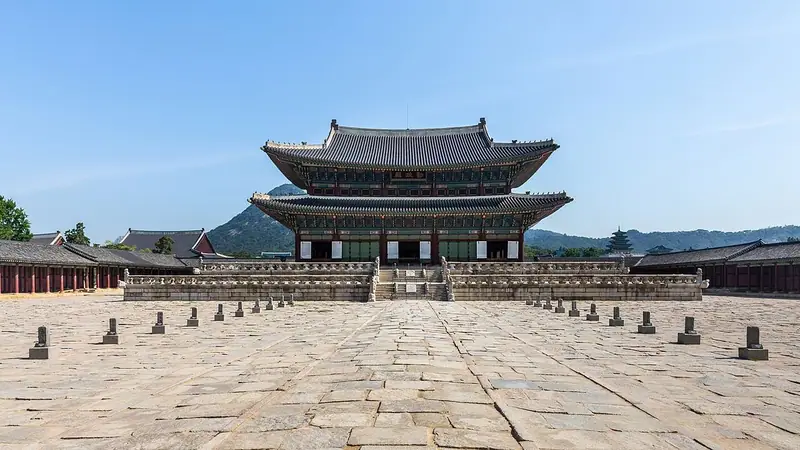 Joseon8 stops · 1395; rebuilt 1867
Gyeongbokgung audio guide
Through Gwanghwamun to the throne hall and the Gyeonghoeru pavilion on its lake, in Joseon’s grandest palace.
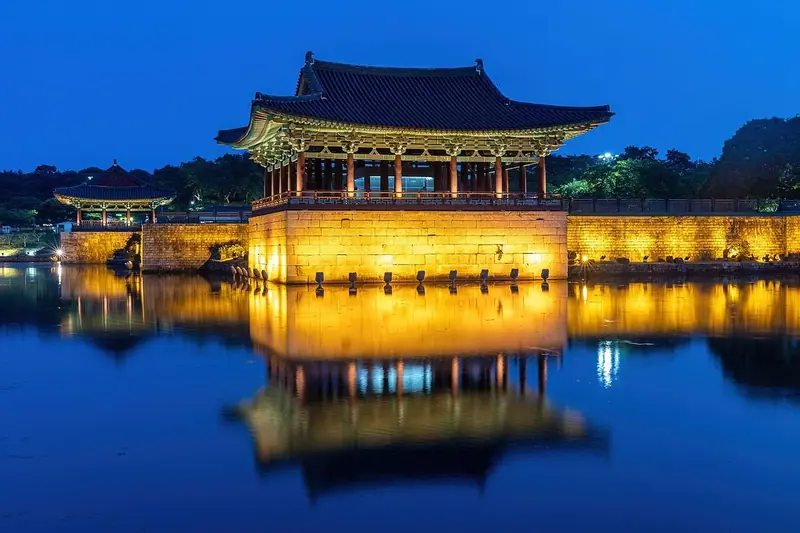 Silla8 stops · 57 BCE – 935 CE
Gyeongju Historic Areas audio guide
Royal tombs, Cheomseongdae and the palace pond of Donggung and Wolji, in Silla’s capital of almost a thousand years.
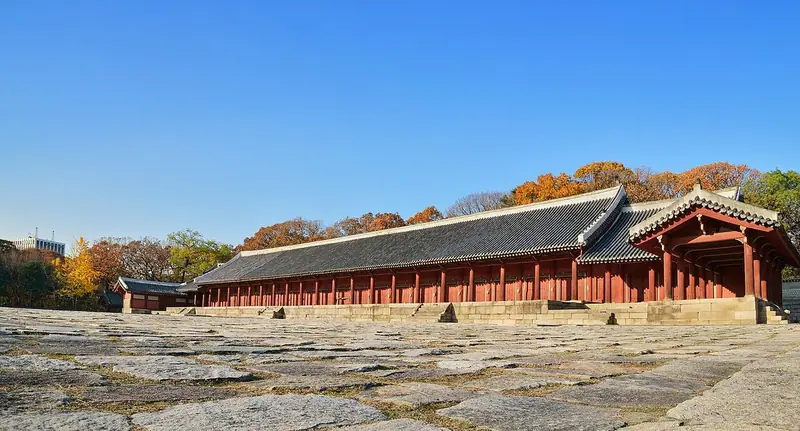 Joseon7 stops · 1395; rebuilt 1608
Jongmyo Shrine audio guide
Along the spirit path to the long hall of Jeongjeon, where the tablets of Joseon’s kings and queens still receive their rites.
Every guide, in every country
Hwaseong Fortress and every other guide we publish, including future ones. One payment, no subscription.