Before you start
Tamsui lies at the mouth of the Tamsui River, where it meets the Taiwan Strait, at the end of the metro line from central Taipei. For four centuries it has been a gateway to northern Taiwan, fought over by the Spanish, the Dutch, the Chinese, the French and the Japanese, and later home to British consuls and Canadian missionaries. The guide opens on the riverside Old Street, visits a temple and a church, climbs to Oxford College, the British consul’s residence and the red fort of Santo Domingo, and ends at Hobe Fort. The route is a little over two kilometres, with a gentle climb. Allow half a day, and stay for the sunset over the river.
Use it as a self-guided tour of Historic Tamsui: 7 stops in visit order, each played when you’re ready, at your own pace.
 Free preview · Stop 1
Tamsui Old Street
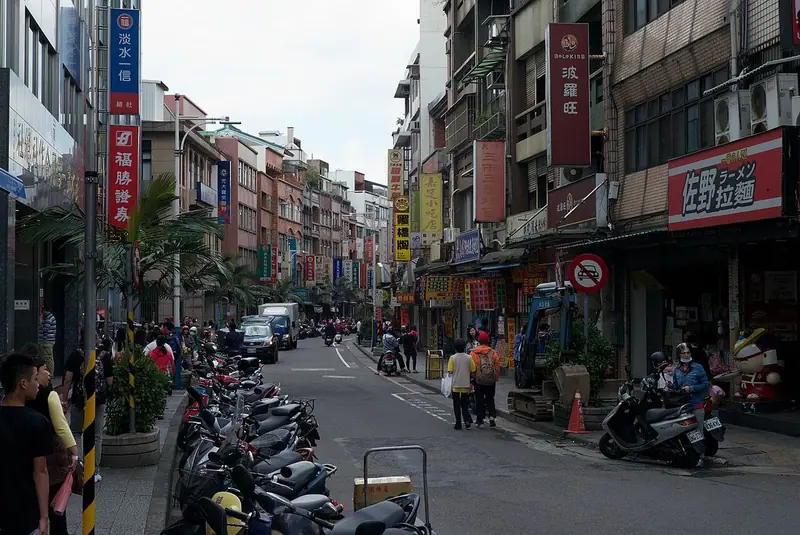
Begin on Tamsui Old Street and the riverside walk beside it, a short stroll from the metro station. Here, for centuries, boats unloaded goods from mainland China and beyond, and merchants built their shops and warehouses along the river. Walk along the busy street and look at the shops selling local snacks, among them a-gei, tofu stuffed with noodles, the dark, chewy iron eggs, fish balls and fried fish crackers. Then walk down to the waterfront. Look across the river to Guanyin Mountain, whose long ridge rises on the far bank, and watch the ferries crossing to Bali on the far bank and the harbour at Fisherman’s Wharf. Notice how wide the river is here, just before it meets the sea. It was this sheltered harbour that drew traders, soldiers and missionaries to Tamsui from across the world.
Photo: Morgan Calliope · CC BY 2.0 · Wikimedia Commons
What to see at Historic Tamsui: 7 stops, in visit order
- 01
 Tamsui Old StreetSnacks by the riverFree preview
- 02
 Fuyou TempleThe temple of the sea goddessIn the guide
- 03
 Tamsui ChurchA church above the riverIn the guide
- 04
 Oxford CollegeMackay’s schoolIn the guide
- 05
 The Consul’s ResidenceAn English house in AsiaIn the guide
- 06
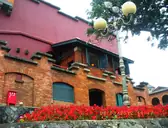 Fort Santo DomingoThe red-haired fortIn the guide
- 07
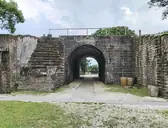 Hobe FortThe key to the north gateIn the guide
Site map of Historic Tamsui
History of Historic Tamsui
The land around the river mouth was home to the Ketagalan, one of the Indigenous peoples of the plains of Taiwan. In 1628 the Spanish, based in Manila, built a wooden fort here, which they named Santo Domingo. In 1642 the Dutch East India Company drove them out, and built a new fort on the same site. After 1683 the island came under the Qing dynasty of China, and Han Chinese settlers turned Tamsui into a busy port. After the Second Opium War it was opened to foreign trade, and from 1868 the British used the old fort as their consulate. Japan ruled Taiwan from 1895 to 1945.
Historic Tamsui guide: questions
How many stops does the Historic Tamsui guide have?
7 stops, in visit order: 1. Tamsui Old Street; 2. Fuyou Temple; 3. Tamsui Church; 4. Oxford College; 5. The Consul’s Residence; 6. Fort Santo Domingo; 7. Hobe Fort.
Can I do a self-guided tour of Historic Tamsui with this guide?
Yes. The guide is made for a self-guided tour: 7 stops in visit order, each with a photo, a story and a voice, so you can explore Historic Tamsui at your own pace, without joining a group. Download it before you go and it works offline.
How long is each guide?
The 7 stops add up to about 5 minutes of listening in total. You play each stop when you’re ready, so you can go at your own pace.
Does the guide work offline?
Yes, once it’s downloaded. The guide is a single self-contained web page (about 7.3 MB) with the photos, text and audio built in. Download it to your phone before you go (Wi-Fi is best); after that it opens in any modern browser on iPhone or Android, with no app, account or mobile signal needed.
Does it use GPS or need my location?
No. The guide doesn’t use GPS and doesn’t know where you are: you play each stop when you reach it. It works on iPhone and Android in any modern browser, and it’s in English.
What’s included?
One self-contained HTML guide: 7 stops in visit order, each with a photo, text and a voice, plus the story of who built the site.
Who built Historic Tamsui?
The land around the river mouth was home to the Ketagalan, one of the Indigenous peoples of the plains of Taiwan. In 1628 the Spanish, based in Manila, built a wooden fort here, which they named Santo Domingo.
Where is Historic Tamsui?
Tamsui lies at the mouth of the Tamsui River, where it meets the Taiwan Strait, at the end of the metro line from central Taipei.
Is there a free audio guide to Historic Tamsui?
The first stop, Tamsui Old Street, is free to read and hear on this page, so you can try the Historic Tamsui audio tour before you buy. The full guide, with all 7 stops, is a one-off purchase: download it once and it’s yours to keep, working offline.
Is the Historic Tamsui guide worth it?
If you’d like to know what you’re looking at, yes. For $10 you get 7 stops in visit order, each with a photo, a short history and a voice you play when you’re ready, plus a site map of the stops, and about 5 minutes of listening in all. It’s short on purpose, so you spend your time looking, not listening. It’s yours to keep, works offline and needs no app. The first stop is free on this page, so you can try it before you buy. If you’d like hours of detail, a guided tour will go deeper.
Audio guide or guided tour?
It depends how you like to visit. This guide lets you explore Historic Tamsui at your own pace, at any time, for a one-off price. A guided tour gives you a live expert you can ask questions, but at fixed times and usually for a higher price. Many people use both: a tour for the big picture, and the guide to read beforehand or to revisit the stops in their own time.
Is this the official Historic Tamsui guide?
No. It’s an independent guide by The Historian Guide, not affiliated with or endorsed by the operator of Historic Tamsui. For tickets and opening hours, check the official site operator before you go.
Does the guide include entry tickets or opening hours?
No. The guide is a digital companion only. Admission to Historic Tamsui is separate, so check the official site operator for current tickets and opening hours before you go.
- Stop 1 · Tamsui Old Street: Morgan Calliope · CC BY 2.0 · Wikimedia Commons · resized
- Stop 2 · Fuyou Temple: T Gordon Cheng · CC BY-SA 4.0 · Wikimedia Commons · resized
- Stop 3 · Tamsui Church: Diahf42 · CC BY-SA 3.0 · Wikimedia Commons · resized
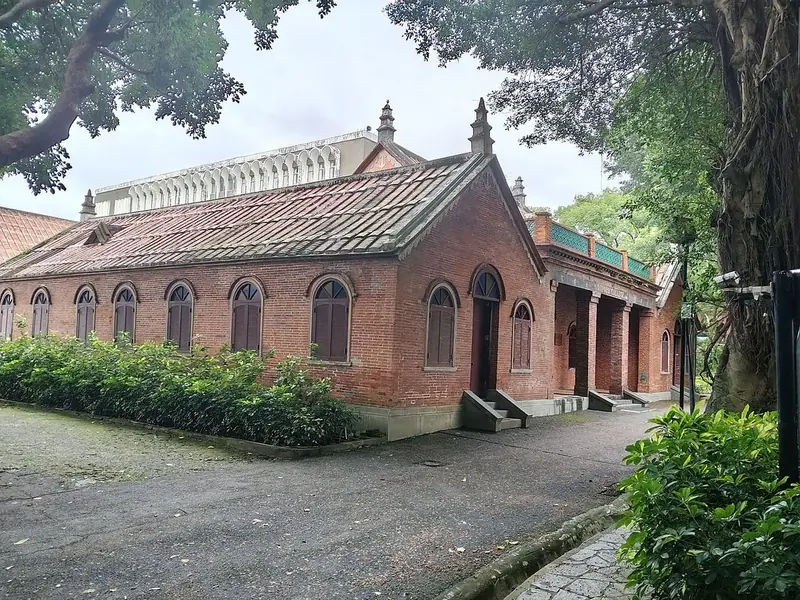
- Stop 4 · Oxford College (also the cover): Allervous · CC BY-SA 3.0 · Wikimedia Commons · resized
- Stop 5 · The Consul’s Residence: lienyuan lee · CC BY 3.0 · Wikimedia Commons · resized
- Stop 6 · Fort Santo Domingo: Diahf42 · CC BY-SA 3.0 · Wikimedia Commons · resized
- Stop 7 · Hobe Fort: 阿道 · CC BY-SA 4.0 · Wikimedia Commons · resized


All photographs from Wikimedia Commons under the licences shown.
More guides in Taiwan
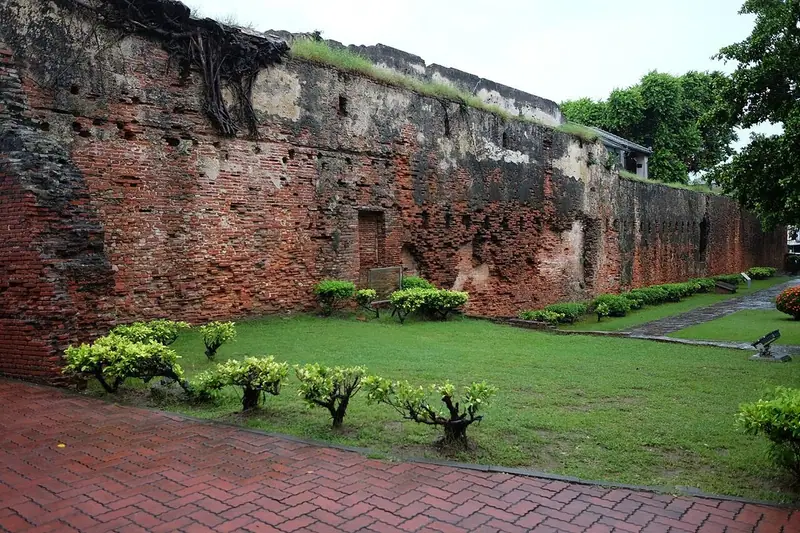 Dutch Colonial8 stops · 1624–1895
Anping audio guide
Start at the Dutch walls of Fort Zeelandia and follow Anping Old Street to the Mazu temple and the banyan-covered Tree House.
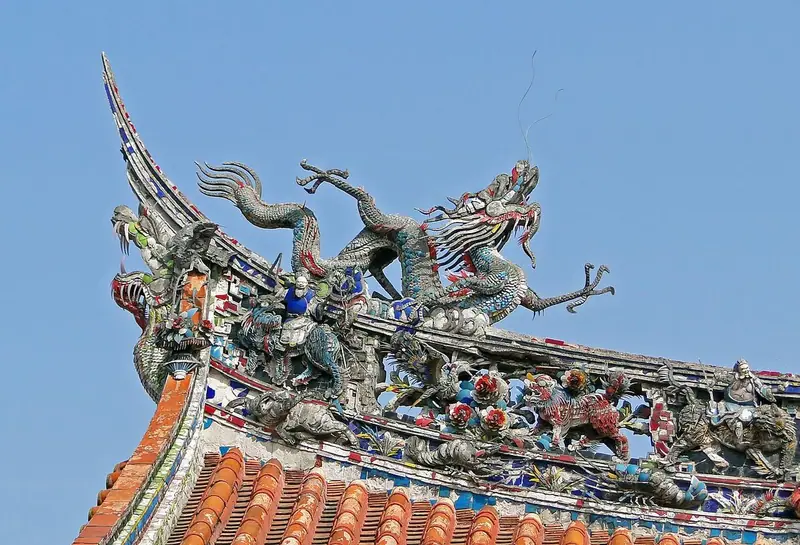 Qing7 stops · 1738–1945
Longshan Temple and Old Bangka audio guide
Start by the river where Taipei began and pass through the gates and halls of Longshan Temple, busy with worshippers from morning till night.
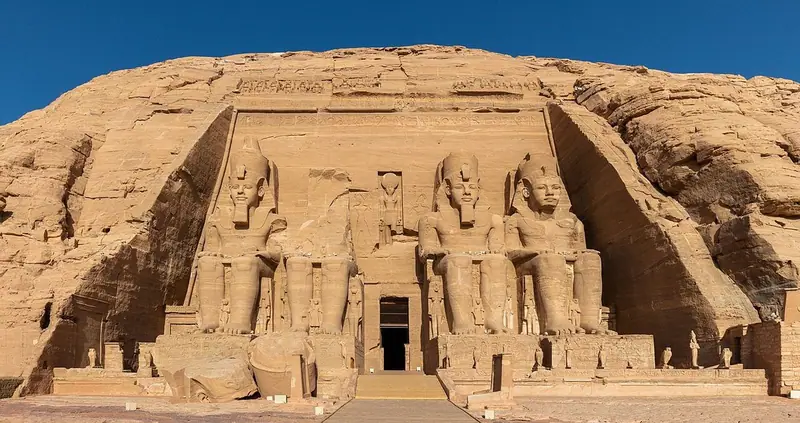 Ancient Egyptian8 stops · 13th century BCE
Abu Simbel audio guide
Ramesses II’s colossal temple façade, the Temple of Nefertari, and how both were rescued from the waters of Lake Nasser.
Every guide, in every country
Historic Tamsui and every other guide we publish, including future ones. One payment, no subscription.