Before you start
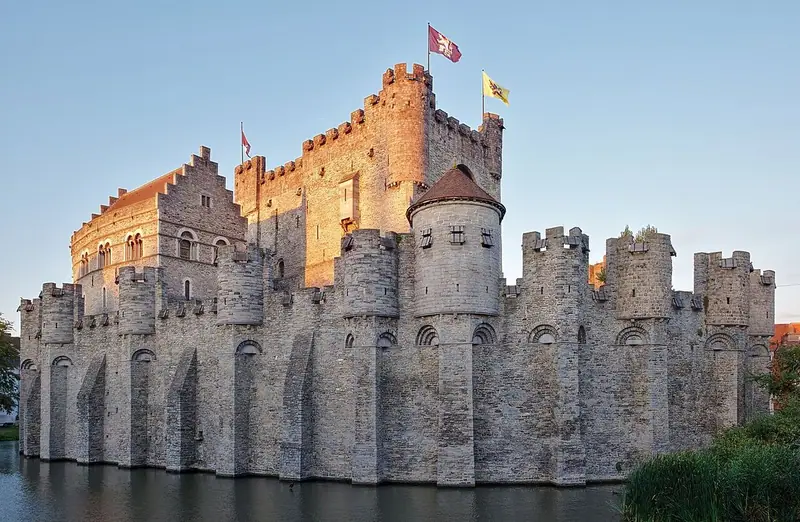
Ghent, in East Flanders, is a lively university city whose medieval heart, with its towers, guild houses, canals and castle, is among the finest in Europe. Its Belfry is part of the UNESCO World Heritage listing of the Belfries of Belgium and France, and its beguinages are part of the listing of the Flemish béguinages. The old centre is compact and largely free of cars, and you can walk this route in a few hours, though you will want longer for the cathedral, the castle and the canals. This guide begins at St Bavo’s Cathedral, home of the Ghent Altarpiece, then passes the Belfry, the City Hall and St Nicholas’ Church to St Michael’s Bridge, follows the quays of the Graslei and Korenlei to the Gravensteen, and ends in the Vrijdagmarkt.
Use it as a self-guided tour of Ghent: 8 stops in visit order, each played when you’re ready, at your own pace.
 Free preview · Stop 1
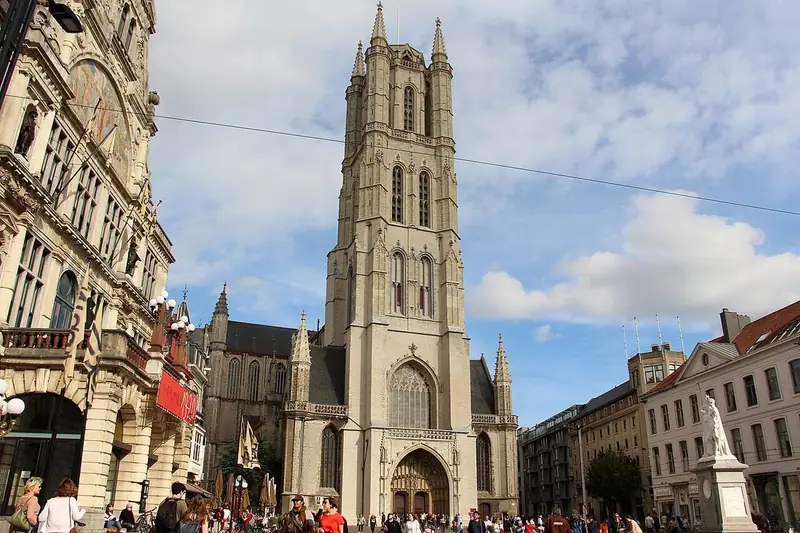
St Bavo’s Cathedral
Begin at St Bavo’s Cathedral, built in stages from the Romanesque to the late Gothic period on the site of an older church, with a great tower over the west front. Inside, its most famous treasure is the Ghent Altarpiece, the Adoration of the Mystic Lamb, painted by the brothers Hubert and Jan van Eyck and completed in 1432, one of the masterpieces of European art. Its panels show Adam and Eve, angels, singers, and crowds of saints, prophets and pilgrims converging on the Lamb of God, painted in astonishing detail. The altarpiece has been stolen, hidden and fought over many times, and one panel, the Just Judges, was stolen in 1934 and has never been found; the one you see is a copy. Look also for the painting by Peter Paul Rubens of St Bavo entering the abbey. Visits to the altarpiece require a ticket.
Photo: Fred Romero from Paris, France · CC BY 2.0 · Wikimedia Commons
What to see at Ghent: 8 stops, in visit order
- 01
 St Bavo’s CathedralThe Ghent AltarpieceFree preview
- 02
 Belfry and Cloth HallDragon on the towerIn the guide
- 03
 City HallTwo styles in one buildingIn the guide
- 04
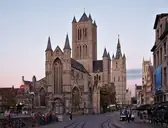 St Nicholas’ ChurchScheldt GothicIn the guide
- 05
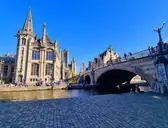 St Michael’s BridgeThree towers in a rowIn the guide
- 06
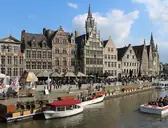 Graslei and KorenleiThe medieval harbourIn the guide
- 07
 GravensteenCastle of the CountsIn the guide
- 08
 VrijdagmarktA square of rebelsIn the guide
Site map of Ghent
History of Ghent
Ghent grew up where the rivers Scheldt and Leie meet, around two abbeys founded in the seventh century, and a fortress of the Counts of Flanders. In the Middle Ages the cloth trade made it one of the largest and richest cities in northern Europe, governed by proud merchants and guilds who often defied the counts and the kings of France. Under the Dukes of Burgundy it was a centre of art, and in 1500 the future Emperor Charles V was born here. The city declined after revolts against Habsburg rule were crushed, but in the nineteenth century it became Belgium’s first great industrial city, built on cotton mills. Its medieval buildings were restored in the late nineteenth and twentieth centuries.
Ghent guide: questions
How many stops does the Ghent guide have?
8 stops, in visit order: 1. St Bavo’s Cathedral; 2. Belfry and Cloth Hall; 3. City Hall; 4. St Nicholas’ Church; 5. St Michael’s Bridge; 6. Graslei and Korenlei; 7. Gravensteen; 8. Vrijdagmarkt.
Can I do a self-guided tour of Ghent with this guide?
Yes. The guide is made for a self-guided tour: 8 stops in visit order, each with a photo, a story and a voice, so you can explore Ghent at your own pace, without joining a group. Download it before you go and it works offline.
How long is each guide?
The 8 stops add up to about 6 minutes of listening in total. You play each stop when you’re ready, so you can go at your own pace.
Does the guide work offline?
Yes, once it’s downloaded. The guide is a single self-contained web page (about 7.2 MB) with the photos, text and audio built in. Download it to your phone before you go (Wi-Fi is best); after that it opens in any modern browser on iPhone or Android, with no app, account or mobile signal needed.
Does it use GPS or need my location?
No. The guide doesn’t use GPS and doesn’t know where you are: you play each stop when you reach it. It works on iPhone and Android in any modern browser, and it’s in English.
What’s included?
One self-contained HTML guide: 8 stops in visit order, each with a photo, text and a voice, plus the story of who built the site.
Who built Ghent?
Ghent grew up where the rivers Scheldt and Leie meet, around two abbeys founded in the seventh century, and a fortress of the Counts of Flanders. In the Middle Ages the cloth trade made it one of the largest and richest cities in northern Europe, governed by proud merchants and guilds who often defied the counts and the kings of France.
Where is Ghent?
Ghent, in East Flanders, is a lively university city whose medieval heart, with its towers, guild houses, canals and castle, is among the finest in Europe.
Is there a free audio guide to Ghent?
The first stop, St Bavo’s Cathedral, is free to read and hear on this page, so you can try the Ghent audio tour before you buy. The full guide, with all 8 stops, is a one-off purchase: download it once and it’s yours to keep, working offline.
Is the Ghent guide worth it?
If you’d like to know what you’re looking at, yes. For $10 you get 8 stops in visit order, each with a photo, a short history and a voice you play when you’re ready, plus a site map of the stops, and about 6 minutes of listening in all. It’s short on purpose, so you spend your time looking, not listening. It’s yours to keep, works offline and needs no app. The first stop is free on this page, so you can try it before you buy. If you’d like hours of detail, a guided tour will go deeper.
Audio guide or guided tour?
It depends how you like to visit. This guide lets you explore Ghent at your own pace, at any time, for a one-off price. A guided tour gives you a live expert you can ask questions, but at fixed times and usually for a higher price. Many people use both: a tour for the big picture, and the guide to read beforehand or to revisit the stops in their own time.
Is this the official Ghent guide?
No. It’s an independent guide by The Historian Guide, not affiliated with or endorsed by the operator of Ghent. For tickets and opening hours, check the official site operator before you go.
Does the guide include entry tickets or opening hours?
No. The guide is a digital companion only. Admission to Ghent is separate, so check the official site operator for current tickets and opening hours before you go.
- Stop 1 · St Bavo’s Cathedral: Fred Romero from Paris, France · CC BY 2.0 · Wikimedia Commons · resized
- Stop 2 · Belfry and Cloth Hall: Michiel Hendryckx · CC BY-SA 4.0 · Wikimedia Commons · resized
- Stop 3 · City Hall: Pymouss · CC BY-SA 3.0 · Wikimedia Commons · resized
- Stop 4 · St Nicholas’ Church: Trougnouf (Benoit Brummer) · CC BY 4.0 · Wikimedia Commons · resized
- Stop 5 · St Michael’s Bridge: Edison McCullen · CC BY-SA 4.0 · Wikimedia Commons · resized
- Stop 6 · Graslei and Korenlei: Martinvl · CC BY-SA 4.0 · Wikimedia Commons · resized
- Stop 7 · Gravensteen (also the cover): Trougnouf (Benoit Brummer) · CC BY 4.0 · Wikimedia Commons · resized
- Stop 8 · Vrijdagmarkt: Suicasmo · CC BY-SA 4.0 · Wikimedia Commons · resized


All photographs from Wikimedia Commons under the licences shown.
More guides in Belgium
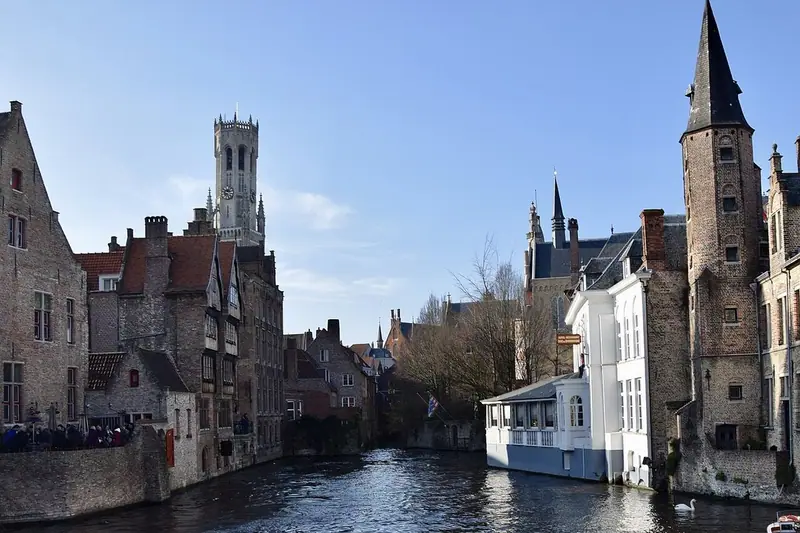 Medieval9 stops · 12th–15th century
Bruges audio guide
A web of canals, cobbled lanes and brick gables, from the Markt and the Belfry to the beguinage by the Minnewater.
 Gothic8 stops · 15th–17th century
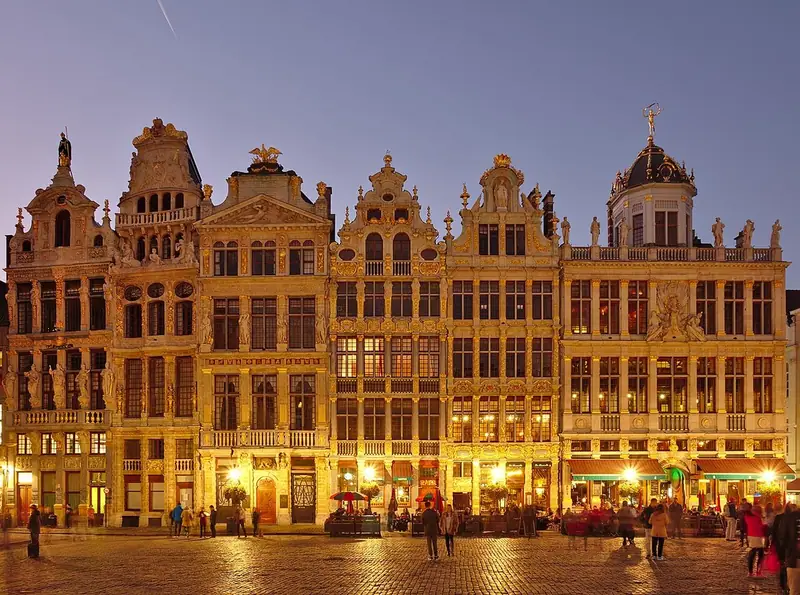
Grand-Place, Brussels audio guide
Stand in one of Europe’s most beautiful squares, framed by the Gothic Town Hall and gilded guild houses, then seek out the Manneken Pis.
 Medieval8 stops · founded 1191; rebuilt from 1405
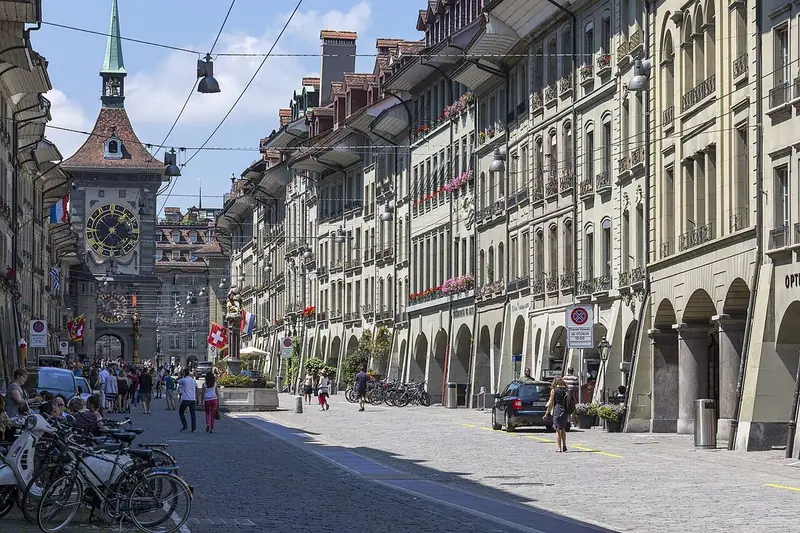
Old City of Bern audio guide
The sandstone arcades of the Swiss capital, past the Zytglogge, the fountains and Bern Minster, down to the river and the bear park.
Every guide, in every country
Ghent and every other guide we publish, including future ones. One payment, no subscription.