Before you start
L’Anse aux Meadows, at the northern tip of Newfoundland’s Great Northern Peninsula, is the only confirmed Norse site in North America, the place where Europeans first settled in the Americas, around a thousand years ago. It was one of the first sites in the world to be inscribed as a UNESCO World Heritage Site, in 1978, and it is cared for by Parks Canada as L’Anse aux Meadows National Historic Site. The site is remote, a long drive from the nearest airports, and it is fully open only in the summer season. A short trail and boardwalk lead from the visitor centre across the meadow to the excavated remains and a reconstructed Norse encampment, where costumed interpreters bring the Viking Age to life. This guide follows that route, from the exhibits to the shore of Epaves Bay.
Use it as a self-guided tour of L’Anse aux Meadows: 7 stops in visit order, each played when you’re ready, at your own pace.
 Free preview · Stop 1
Visitor Centre
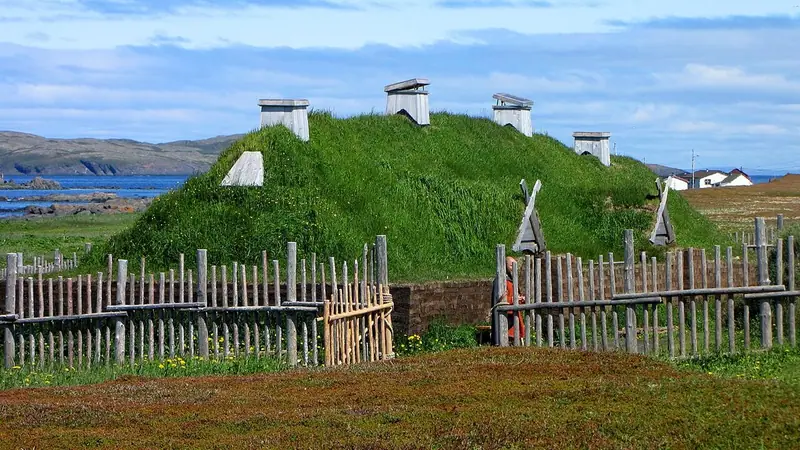
Begin at the visitor centre, set on a rise overlooking the site, where exhibits introduce the Norse world and the discovery of L’Anse aux Meadows. Look for the objects found during excavation, the evidence that proved this was a Norse site: a bronze cloak pin of a type worn in Scandinavia, rivets from boats, and a stone spindle whorl used for spinning wool, which suggests that women were among the settlers. Look too for the butternuts, which do not grow this far north and must have been brought from further south, perhaps from around the Gulf of St Lawrence, showing that the Norse explored more widely. Exhibits tell the story of the Ingstads, who were guided to the site by a local resident, George Decker. From the windows, look out over the meadow and the bay, and imagine Norse ships drawn up on the shore.
Photo: Torbenbrinker · CC BY-SA 3.0 · Wikimedia Commons
What to see at L’Anse aux Meadows: 7 stops, in visit order
- 01
 Visitor CentreClues to VinlandFree preview
- 02
 Black Duck BrookA stream through the meadowIn the guide
- 03
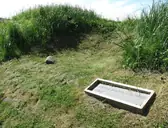 Furnace HutIron from the bogIn the guide
- 04
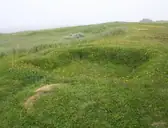 The Excavated HallsOutlines in the turfIn the guide
- 05
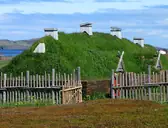 Norse EncampmentA hall rebuiltIn the guide
- 06
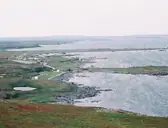 Epaves BayThe Norse landing placeIn the guide
- 07
 The First PeoplesThousands of years beforeIn the guide
Site map of L’Anse aux Meadows
History of L’Anse aux Meadows
The Norse settlement was built by people from Greenland and Iceland, descendants of the Scandinavians who had settled the North Atlantic islands in the ninth and tenth centuries. Icelandic sagas, written down centuries later, tell of voyages led by Leif Eriksson and others to a land they called Vinland. Tree-ring dating of wood cut with metal tools shows that the Norse were here in the year 1021. They stayed only a few years, using the site as a base for exploring further south. Long before and after them, Indigenous peoples used this coast for thousands of years. The site was found in 1960 by the Norwegian explorer Helge Ingstad and excavated by his wife, the archaeologist Anne Stine Ingstad.
L’Anse aux Meadows guide: questions
How many stops does the L’Anse aux Meadows guide have?
7 stops, in visit order: 1. Visitor Centre; 2. Black Duck Brook; 3. Furnace Hut; 4. The Excavated Halls; 5. Norse Encampment; 6. Epaves Bay; 7. The First Peoples.
Can I do a self-guided tour of L’Anse aux Meadows with this guide?
Yes. The guide is made for a self-guided tour: 7 stops in visit order, each with a photo, a story and a voice, so you can explore L’Anse aux Meadows at your own pace, without joining a group. Download it before you go and it works offline.
How long is each guide?
The 7 stops add up to about 5 minutes of listening in total. You play each stop when you’re ready, so you can go at your own pace.
Does the guide work offline?
Yes, once it’s downloaded. The guide is a single self-contained web page (about 6.8 MB) with the photos, text and audio built in. Download it to your phone before you go (Wi-Fi is best); after that it opens in any modern browser on iPhone or Android, with no app, account or mobile signal needed.
Does it use GPS or need my location?
No. The guide doesn’t use GPS and doesn’t know where you are: you play each stop when you reach it. It works on iPhone and Android in any modern browser, and it’s in English.
What’s included?
One self-contained HTML guide: 7 stops in visit order, each with a photo, text and a voice, plus the story of who built the site.
Who built L’Anse aux Meadows?
The Norse settlement was built by people from Greenland and Iceland, descendants of the Scandinavians who had settled the North Atlantic islands in the ninth and tenth centuries. Icelandic sagas, written down centuries later, tell of voyages led by Leif Eriksson and others to a land they called Vinland.
Where is L’Anse aux Meadows?
L’Anse aux Meadows, at the northern tip of Newfoundland’s Great Northern Peninsula, is the only confirmed Norse site in North America, the place where Europeans first settled in the Americas, around a thousand years ago.
Is there a free audio guide to L’Anse aux Meadows?
The first stop, Visitor Centre, is free to read and hear on this page, so you can try the L’Anse aux Meadows audio tour before you buy. The full guide, with all 7 stops, is a one-off purchase: download it once and it’s yours to keep, working offline.
Is the L’Anse aux Meadows guide worth it?
If you’d like to know what you’re looking at, yes. For $10 you get 7 stops in visit order, each with a photo, a short history and a voice you play when you’re ready, plus a site map of the stops, and about 5 minutes of listening in all. It’s short on purpose, so you spend your time looking, not listening. It’s yours to keep, works offline and needs no app. The first stop is free on this page, so you can try it before you buy. If you’d like hours of detail, a guided tour will go deeper.
Audio guide or guided tour?
It depends how you like to visit. This guide lets you explore L’Anse aux Meadows at your own pace, at any time, for a one-off price. A guided tour gives you a live expert you can ask questions, but at fixed times and usually for a higher price. Many people use both: a tour for the big picture, and the guide to read beforehand or to revisit the stops in their own time.
Is this the official L’Anse aux Meadows guide?
No. It’s an independent guide by The Historian Guide, not affiliated with or endorsed by the operator of L’Anse aux Meadows. For tickets and opening hours, check the official site operator before you go.
Does the guide include entry tickets or opening hours?
No. The guide is a digital companion only. Admission to L’Anse aux Meadows is separate, so check the official site operator for current tickets and opening hours before you go.
- Stop 1 · Visitor Centre: Torbenbrinker · CC BY-SA 3.0 · Wikimedia Commons · resized
- Stop 2 · Black Duck Brook: Photo: Gordon Leggett / Wikimedia Commons · CC BY-SA 4.0 · Wikimedia Commons · resized
- Stop 3 · Furnace Hut: Torbenbrinker · CC BY-SA 3.0 · Wikimedia Commons · resized
- Stop 4 · The Excavated Halls: Acunsolo · CC BY-SA 3.0 · Wikimedia Commons · resized
- Stop 5 · Norse Encampment (also the cover): D. Gordon E. Robertson · CC BY-SA 3.0 · Wikimedia Commons · resized
- Stop 6 · Epaves Bay: Gregory Matthews · CC BY-SA 3.0 · Wikimedia Commons · resized
- Stop 7 · The First Peoples: SemanticsDavid · CC BY-SA 3.0 · Wikimedia Commons · resized


All photographs from Wikimedia Commons under the licences shown.
More guides in Canada
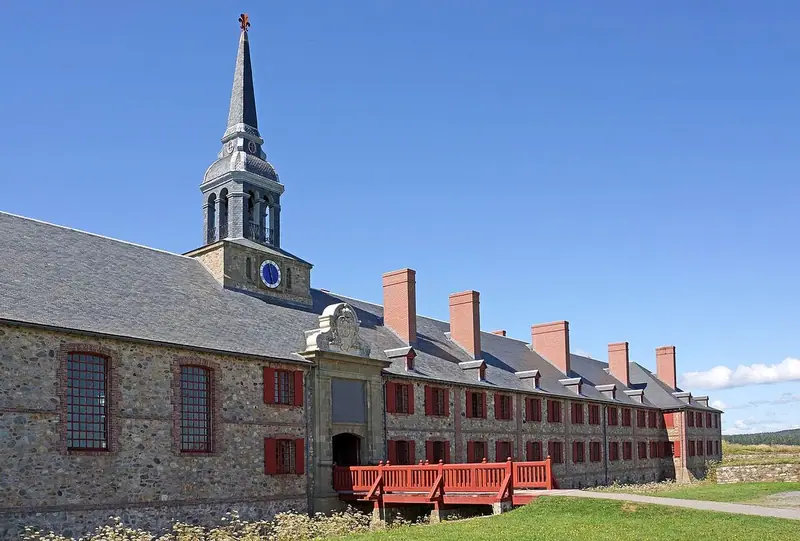 French Colonial8 stops · 1713–1758
Fortress of Louisbourg audio guide
Step into the summer of 1744 in a rebuilt French fortified town on Cape Breton’s Atlantic shore, from the Dauphin Gate to the King’s Bastion.
 French Colonial9 stops · 1608 – 19th century
Old Quebec audio guide
The only city north of Mexico to keep its fortified walls, from Place Royale in the Lower Town up the Breakneck Stairs to the Citadel.
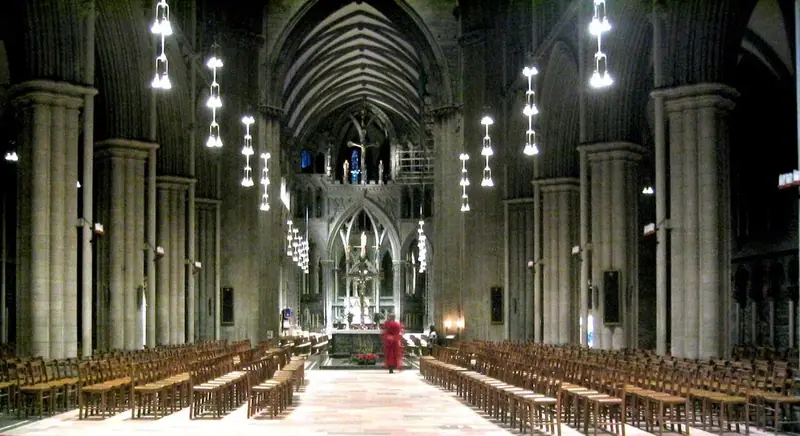 Norse8 stops · 997–1537
Nidaros and Old Trondheim audio guide
From the market square past the royal wooden palace to Nidaros Cathedral, shrine of Saint Olav, then across the Old Town Bridge to Bakklandet.
Every guide, in every country
L’Anse aux Meadows and every other guide we publish, including future ones. One payment, no subscription.