Before you start
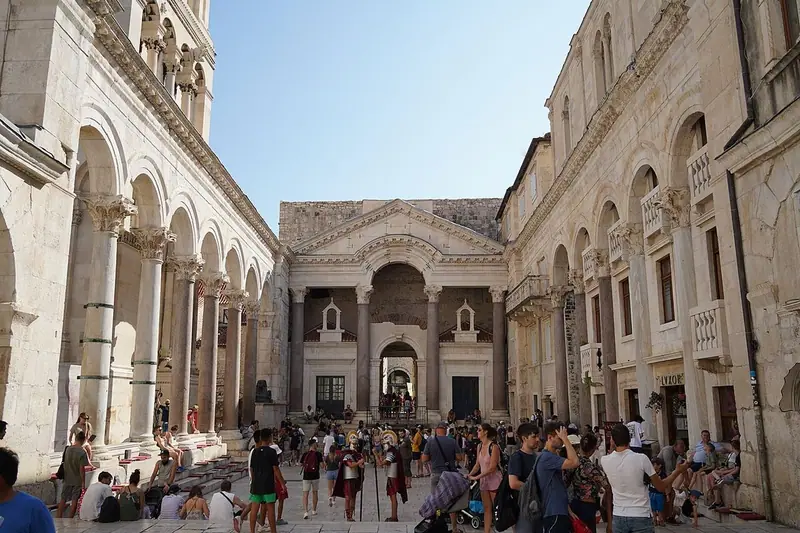
Diocletian’s Palace is the vast stone complex that the Roman emperor Diocletian built on the Adriatic coast as his retirement home, at the end of the third century CE. It is not a ruin in a park: the palace walls enclose about half of the old town of Split, and some three thousand people still live within them, among shops, cafés and houses built into the Roman fabric. In 1979 the palace and the historic centre of Split were listed by UNESCO as a World Heritage Site. The streets are paved with smooth, polished stone that can be slippery, and the main squares are busy in summer. This route enters from the seafront through the southern gate, crosses the cellars to the vestibule, visits the cathedral, the Peristyle and the temple, and ends at the Golden Gate in the north.
Use it as a self-guided tour of Diocletian’s Palace: 7 stops in visit order, each played when you’re ready, at your own pace.
 Free preview · Stop 1
The Bronze Gate
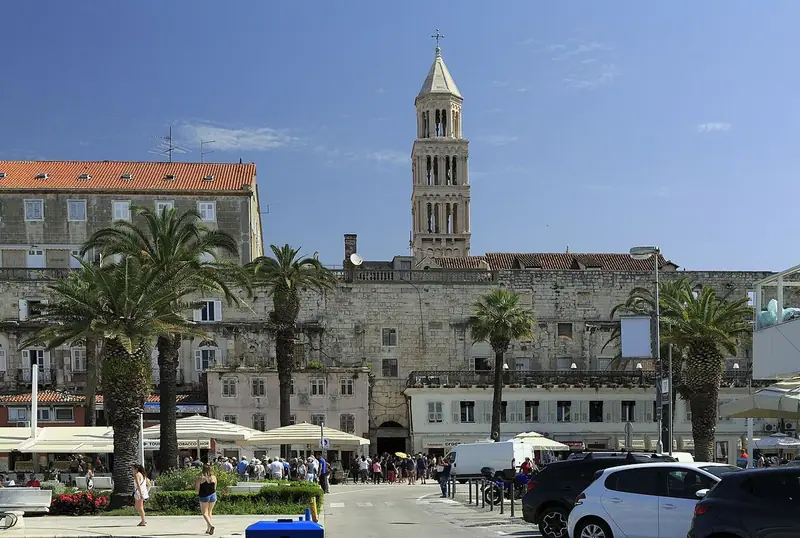
Begin on the Riva, the palm-lined promenade along the harbour, and look at the long southern façade of the palace. When it was built, the sea came right up to, or very close to, this wall, which is why it was the only side without towers or fortifications. Its upper floor once held an elegant arcaded gallery overlooking the water, and you can still pick out the line of arches among the later houses built into the wall. In the middle is the small, plain southern gate, known today as the Bronze Gate. It was simpler than the other three gates, and it is thought that it was either the emperor’s private access to the sea or a service entrance for supplies. Walk through it into the vaulted passage beneath the palace. The cellars open on either side.
Photo: Falk2 · CC BY-SA 4.0 · Wikimedia Commons
What to see at Diocletian’s Palace: 7 stops, in visit order
- 01
 The Bronze GateThe emperor’s door to the seaFree preview
- 02
 The Palace CellarsA mirror of the lost apartmentsIn the guide
- 03
 The VestibuleA domed hall open to the skyIn the guide
- 04
 The Cathedral of Saint DomniusAn emperor’s tomb turned churchIn the guide
- 05
 The PeristyleThe emperor’s ceremonial courtIn the guide
- 06
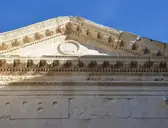 The Temple of JupiterA Roman temple turned baptisteryIn the guide
- 07
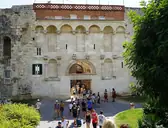 The Golden GateThe road to SalonaIn the guide
Site map of Diocletian’s Palace
History of Diocletian’s Palace
The palace was built by the Roman Empire, which grew from the city of Rome and, from 27 BCE, was ruled by emperors; its western half came to an end in 476 CE, while the eastern half survived as the Byzantine Empire until 1453. Diocletian, born in Dalmatia, became emperor in 284 and divided power among four rulers, the Tetrarchy. Work on the palace probably began around 295, near the provincial capital of Salona, about six kilometres away. Greek masons’ marks suggest that some builders came from the eastern empire, but much of the workforce was probably local, and the white limestone came from the island of Brač. On 1 May 305 Diocletian abdicated, the first Roman emperor to do so voluntarily, and retired here. In the seventh century, refugees from Salona settled inside the walls, and the palace became a town.
Diocletian’s Palace guide: questions
How many stops does the Diocletian’s Palace guide have?
7 stops, in visit order: 1. The Bronze Gate; 2. The Palace Cellars; 3. The Vestibule; 4. The Cathedral of Saint Domnius; 5. The Peristyle; 6. The Temple of Jupiter; 7. The Golden Gate.
Can I do a self-guided tour of Diocletian’s Palace with this guide?
Yes. The guide is made for a self-guided tour: 7 stops in visit order, each with a photo, a story and a voice, so you can explore Diocletian’s Palace at your own pace, without joining a group. Download it before you go and it works offline.
How long is each guide?
The 7 stops add up to about 5 minutes of listening in total. You play each stop when you’re ready, so you can go at your own pace.
Does the guide work offline?
Yes, once it’s downloaded. The guide is a single self-contained web page (about 6.5 MB) with the photos, text and audio built in. Download it to your phone before you go (Wi-Fi is best); after that it opens in any modern browser on iPhone or Android, with no app, account or mobile signal needed.
Does it use GPS or need my location?
No. The guide doesn’t use GPS and doesn’t know where you are: you play each stop when you reach it. It works on iPhone and Android in any modern browser, and it’s in English.
What’s included?
One self-contained HTML guide: 7 stops in visit order, each with a photo, text and a voice, plus the story of who built the site.
Who built Diocletian’s Palace?
The palace was built by the Roman Empire, which grew from the city of Rome and, from 27 BCE, was ruled by emperors; its western half came to an end in 476 CE, while the eastern half survived as the Byzantine Empire until 1453. Diocletian, born in Dalmatia, became emperor in 284 and divided power among four rulers, the Tetrarchy.
Is there a free audio guide to Diocletian’s Palace?
The first stop, The Bronze Gate, is free to read and hear on this page, so you can try the Diocletian’s Palace audio tour before you buy. The full guide, with all 7 stops, is a one-off purchase: download it once and it’s yours to keep, working offline.
Is the Diocletian’s Palace guide worth it?
If you’d like to know what you’re looking at, yes. For $10 you get 7 stops in visit order, each with a photo, a short history and a voice you play when you’re ready, plus a site map of the stops, and about 5 minutes of listening in all. It’s short on purpose, so you spend your time looking, not listening. It’s yours to keep, works offline and needs no app. The first stop is free on this page, so you can try it before you buy. If you’d like hours of detail, a guided tour will go deeper.
Audio guide or guided tour?
It depends how you like to visit. This guide lets you explore Diocletian’s Palace at your own pace, at any time, for a one-off price. A guided tour gives you a live expert you can ask questions, but at fixed times and usually for a higher price. Many people use both: a tour for the big picture, and the guide to read beforehand or to revisit the stops in their own time.
Is this the official Diocletian’s Palace guide?
No. It’s an independent guide by The Historian Guide, not affiliated with or endorsed by the operator of Diocletian’s Palace. For tickets and opening hours, check the official site operator before you go.
Does the guide include entry tickets or opening hours?
No. The guide is a digital companion only. Admission to Diocletian’s Palace is separate, so check the official site operator for current tickets and opening hours before you go.
- Stop 1 · The Bronze Gate: Falk2 · CC BY-SA 4.0 · Wikimedia Commons · resized
- Stop 2 · The Palace Cellars: dronepicr · CC BY 2.0 · Wikimedia Commons · resized
- Stop 3 · The Vestibule: Jules Verne Times Two / www.julesvernex2.com · CC BY-SA 4.0 · Wikimedia Commons · resized
- Stop 4 · The Cathedral of Saint Domnius: Mattias Hill · CC BY-SA 3.0 · Wikimedia Commons · resized
- Stop 5 · The Peristyle (also the cover): TimeTravelRome · CC BY 2.0 · Wikimedia Commons · resized
- Stop 6 · The Temple of Jupiter: Carole Raddato from FRANKFURT, Germany · CC BY-SA 2.0 · Wikimedia Commons · resized
- Stop 7 · The Golden Gate: TimeTravelRome · CC BY 2.0 · Wikimedia Commons · resized


All photographs from Wikimedia Commons under the licences shown.
More guides in Croatia
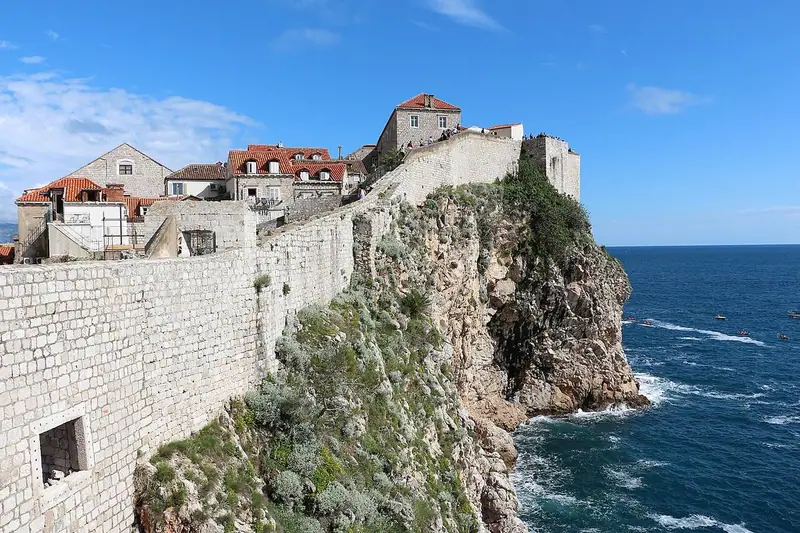 Republic of Ragusa8 stops · 1358–1808 CE
Dubrovnik Old Town audio guide
Enter by the Pile Gate and walk the Stradun of the old merchant republic of Ragusa, then circle its limestone walls above the Adriatic.
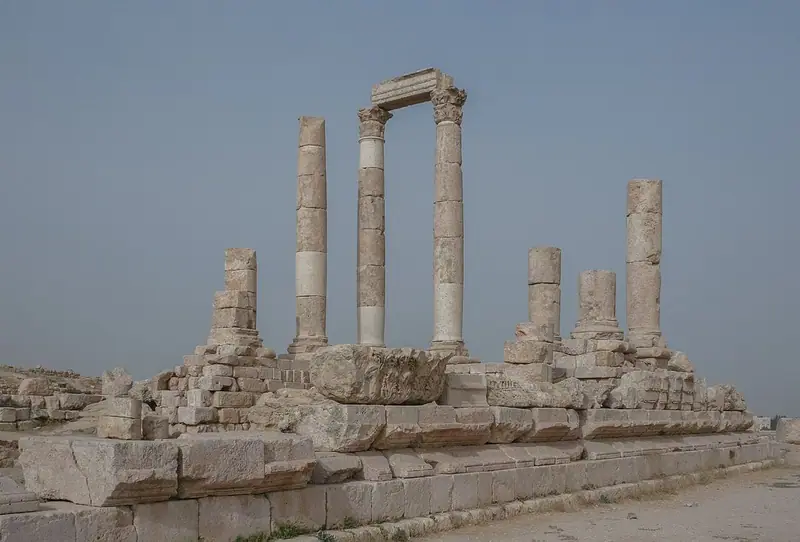 Roman7 stops · 2nd–8th century CE
Amman Citadel and Roman Theatre audio guide
From the Temple of Hercules and its colossal hand to the Umayyad palace, then down to the Roman Theatre carved into the hill.
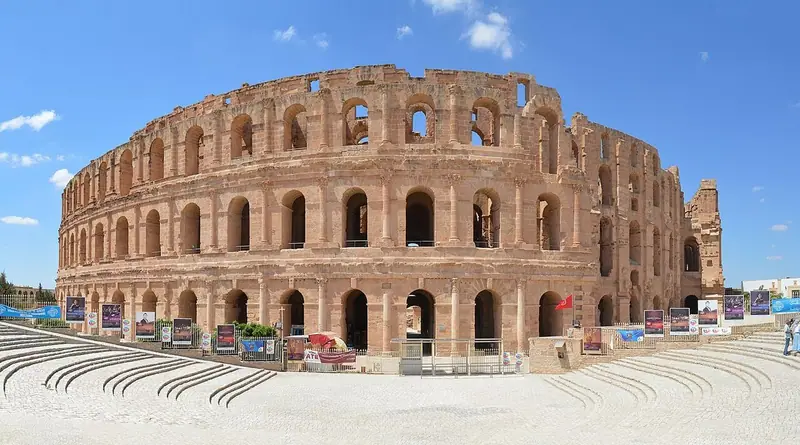 Roman8 stops · 3rd century CE
Amphitheatre of El Jem audio guide
Stand in the arena of one of the largest and best preserved amphitheatres of the Roman world, built for the town of Thysdrus and its thirty-five thousand spectators.
Every guide, in every country
Diocletian’s Palace and every other guide we publish, including future ones. One payment, no subscription.