Before you start
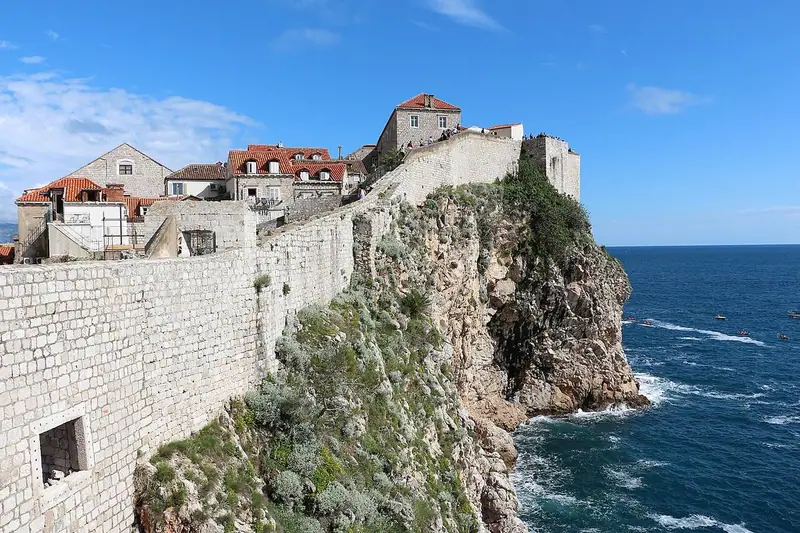
Dubrovnik’s Old Town is a walled city of pale limestone on the southern Adriatic coast of Croatia. For centuries it was the capital of the Republic of Ragusa, a small but wealthy merchant state that kept its independence through trade and diplomacy. Most of what you see was rebuilt after a devastating earthquake in 1667, inside walls that largely survived it. The town was badly damaged by shelling during the siege of 1991 and 1992 and has since been carefully restored. In 1979 the Old City of Dubrovnik was listed by UNESCO as a World Heritage Site. The streets are traffic-free, but many side lanes are steep stairways. This route enters through the Pile Gate, follows the Stradun to the Luža Square and the Rector’s Palace, and ends on the city walls.
Use it as a self-guided tour of Dubrovnik Old Town: 8 stops in visit order, each played when you’re ready, at your own pace.
 Free preview · Stop 1
The Pile Gate
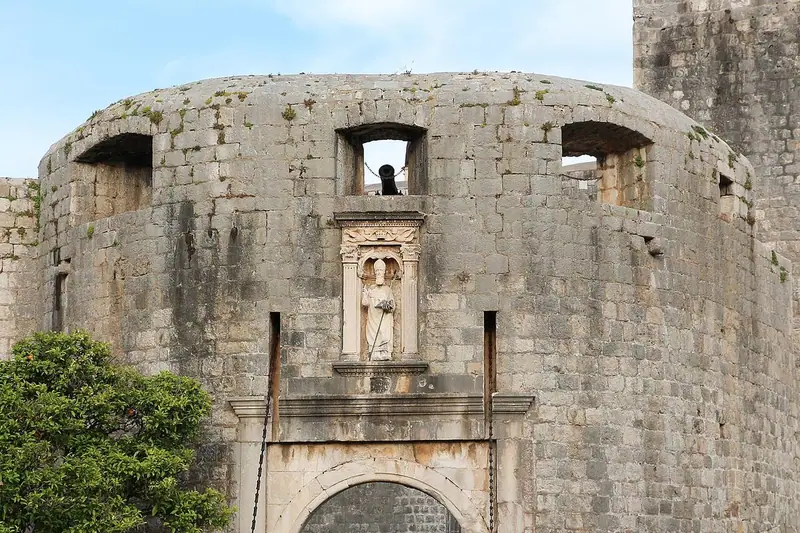
Begin at the Pile Gate, the main western entrance to the Old Town. Walk across the stone bridge, designed by the architect Paskoje Miličević in 1471, and then over the wooden drawbridge, which spans the old moat, now a garden. In the days of the republic, the drawbridge was raised every night in a ceremony in which the keys of the city were handed to the rector. Above the arch of the outer gate stands a statue of Saint Blaise, the patron saint of Dubrovnik, holding a model of the city. Pass through the outer gate and then the Gothic inner gate: like the other land gates, the entrance was designed so that no one could walk straight in, but had to pass through several doors along a winding route. Near the inner gate is one of the staircases up to the walls, where this walk will end.
Photo: Bernard Gagnon · CC BY-SA 4.0 · Wikimedia Commons
What to see at Dubrovnik Old Town: 8 stops, in visit order
- 01
 The Pile GateThe western entranceFree preview
- 02
 Onofrio’s Great FountainWater for the cityIn the guide
- 03
 The Franciscan FriaryCloister and an old pharmacyIn the guide
- 04
 The StradunThe main streetIn the guide
- 05
 The Luža SquareOrlando, the bell tower and the SponzaIn the guide
- 06
 The Church of Saint BlaiseThe city’s patron saintIn the guide
- 07
 The Rector’s PalaceSeat of the republicIn the guide
- 08
 The City WallsA walk around the townIn the guide
Site map of Dubrovnik Old Town
History of Dubrovnik Old Town
Dubrovnik was built by its own citizens, known in Latin and Italian as Ragusa. The town grew from a refuge settled in the early Middle Ages, partly by people fleeing the destruction of the Roman town of Epidaurum, today’s Cavtat. It was ruled for long periods by Byzantium and then by Venice, from 1205 to 1358. In 1358 it passed under the nominal rule of the king of Hungary and Croatia and became, in practice, a self-governing republic, which lasted until 1808, when it was abolished by Napoleon’s forces. Governed by a council of noble families, with a rector elected for one month at a time, the republic grew rich through shipping and through trade between the Ottoman Empire and Italy. Its motto was Libertas, liberty.
Dubrovnik Old Town guide: questions
How many stops does the Dubrovnik Old Town guide have?
8 stops, in visit order: 1. The Pile Gate; 2. Onofrio’s Great Fountain; 3. The Franciscan Friary; 4. The Stradun; 5. The Luža Square; 6. The Church of Saint Blaise; 7. The Rector’s Palace; 8. The City Walls.
Can I do a self-guided tour of Dubrovnik Old Town with this guide?
Yes. The guide is made for a self-guided tour: 8 stops in visit order, each with a photo, a story and a voice, so you can explore Dubrovnik Old Town at your own pace, without joining a group. Download it before you go and it works offline.
How long is each guide?
The 8 stops add up to about 6 minutes of listening in total. You play each stop when you’re ready, so you can go at your own pace.
Does the guide work offline?
Yes, once it’s downloaded. The guide is a single self-contained web page (about 7.7 MB) with the photos, text and audio built in. Download it to your phone before you go (Wi-Fi is best); after that it opens in any modern browser on iPhone or Android, with no app, account or mobile signal needed.
Does it use GPS or need my location?
No. The guide doesn’t use GPS and doesn’t know where you are: you play each stop when you reach it. It works on iPhone and Android in any modern browser, and it’s in English.
What’s included?
One self-contained HTML guide: 8 stops in visit order, each with a photo, text and a voice, plus the story of who built the site.
Who built Dubrovnik Old Town?
Dubrovnik was built by its own citizens, known in Latin and Italian as Ragusa. The town grew from a refuge settled in the early Middle Ages, partly by people fleeing the destruction of the Roman town of Epidaurum, today’s Cavtat.
Where is Dubrovnik Old Town?
Dubrovnik’s Old Town is a walled city of pale limestone on the southern Adriatic coast of Croatia.
Is there a free audio guide to Dubrovnik Old Town?
The first stop, The Pile Gate, is free to read and hear on this page, so you can try the Dubrovnik Old Town audio tour before you buy. The full guide, with all 8 stops, is a one-off purchase: download it once and it’s yours to keep, working offline.
Is the Dubrovnik Old Town guide worth it?
If you’d like to know what you’re looking at, yes. For $10 you get 8 stops in visit order, each with a photo, a short history and a voice you play when you’re ready, plus a site map of the stops, and about 6 minutes of listening in all. It’s short on purpose, so you spend your time looking, not listening. It’s yours to keep, works offline and needs no app. The first stop is free on this page, so you can try it before you buy. If you’d like hours of detail, a guided tour will go deeper.
Audio guide or guided tour?
It depends how you like to visit. This guide lets you explore Dubrovnik Old Town at your own pace, at any time, for a one-off price. A guided tour gives you a live expert you can ask questions, but at fixed times and usually for a higher price. Many people use both: a tour for the big picture, and the guide to read beforehand or to revisit the stops in their own time.
Is this the official Dubrovnik Old Town guide?
No. It’s an independent guide by The Historian Guide, not affiliated with or endorsed by the operator of Dubrovnik Old Town. For tickets and opening hours, check the official site operator before you go.
Does the guide include entry tickets or opening hours?
No. The guide is a digital companion only. Admission to Dubrovnik Old Town is separate, so check the official site operator for current tickets and opening hours before you go.
- Stop 1 · The Pile Gate: Bernard Gagnon · CC BY-SA 4.0 · Wikimedia Commons · resized
- Stop 2 · Onofrio’s Great Fountain: Jerzy Strzelecki · CC BY-SA 3.0 · Wikimedia Commons · resized
- Stop 3 · The Franciscan Friary: JERRYE AND ROY KLOTZ MD · CC BY-SA 3.0 · Wikimedia Commons · resized
- Stop 4 · The Stradun: Andrzej Harassek · CC BY-SA 3.0 · Wikimedia Commons · resized
- Stop 5 · The Luža Square: Jerzy Strzelecki · CC BY-SA 3.0 · Wikimedia Commons · resized
- Stop 6 · The Church of Saint Blaise: Richard Mortel from Riyadh, Saudi Arabia · CC BY 2.0 · Wikimedia Commons · resized
- Stop 7 · The Rector’s Palace: Jerzy Strzelecki · CC BY-SA 3.0 · Wikimedia Commons · resized
- Stop 8 · The City Walls (also the cover): Bernard Gagnon · CC BY-SA 4.0 · Wikimedia Commons · resized


All photographs from Wikimedia Commons under the licences shown.
More guides in Croatia
 Roman7 stops · c. 295–305 CE
Diocletian’s Palace audio guide
The retirement palace of the emperor Diocletian, whose walls still enclose half of old Split, from the Bronze Gate cellars to the Peristyle.
 Ancient Egyptian8 stops · 13th century BCE
Abu Simbel audio guide
Ramesses II’s colossal temple façade, the Temple of Nefertari, and how both were rescued from the waters of Lake Nasser.
 Ga7 stops · 1649–1957
Old Accra audio guide
From the old forts and lighthouse of Jamestown, through the Ga fishing quarter, to the monuments of Ghana’s independence and Osu Castle.
Every guide, in every country
Dubrovnik Old Town and every other guide we publish, including future ones. One payment, no subscription.