Before you start
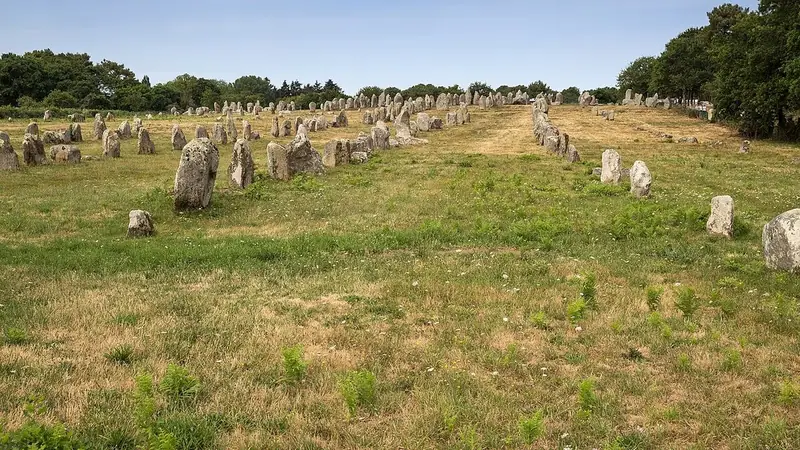
On the southern coast of Brittany, between the Quiberon peninsula and the Gulf of Morbihan, lies one of the greatest concentrations of prehistoric monuments in the world. Here, over more than two thousand years, from around 5000 to 2300 BCE, Neolithic farming communities raised thousands of standing stones in long rows, built great burial mounds and passage tombs, and carved mysterious symbols on the rock. The rows of Carnac alone include some three thousand stones, stretching for about four kilometres across the countryside. UNESCO inscribed the Megaliths of Carnac and of the Shores of Morbihan as a World Heritage Site in 2025. This guide begins in Carnac at the Saint-Michel mound and the museum of prehistory, follows the great stone rows eastwards, and ends at the giant menhir of Locmariaquer and the decorated tomb of Gavrinis.
Use it as a self-guided tour of the Carnac Megaliths: 10 stops in visit order, each played when you’re ready, at your own pace.
 Free preview · Stop 1
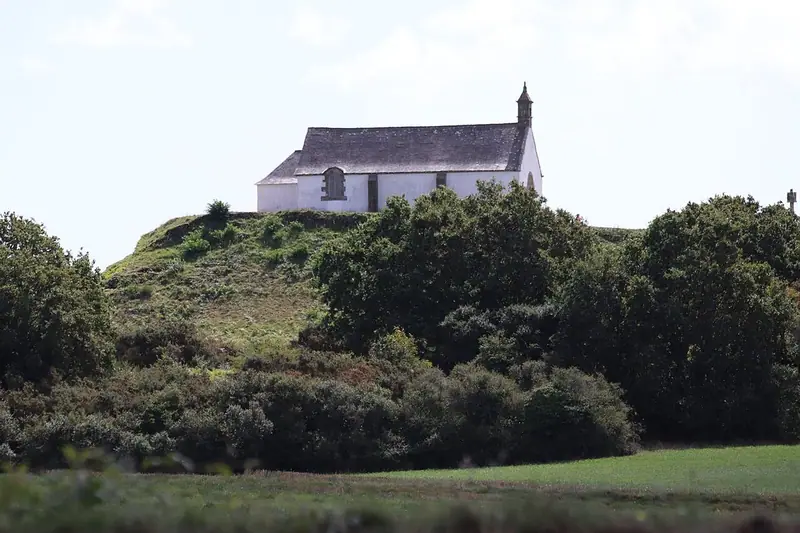
The Saint-Michel Tumulus
Begin on the edge of Carnac at the Saint-Michel tumulus, a huge mound of stones and earth about 125 metres long and 12 metres high, crowned by a small chapel dedicated to Saint Michael. It belongs to a type of monument found only in this region, the great Carnac mounds, built in the fifth millennium BCE to cover the burial chambers of a powerful elite. When the mound was excavated by tunnelling in 1862, archaeologists found a central chamber containing polished axes of jadeite, a rare green stone quarried high in the Alps of north-western Italy, and beads of variscite from the Iberian peninsula. These precious objects, carried for well over a thousand kilometres, show how far the networks of Neolithic Europe reached. The chapel on top was rebuilt in the twentieth century. From the summit you can see over Carnac to the sea and the Quiberon peninsula.
Photo: Lionel Allorge · CC BY-SA 3.0 · Wikimedia Commons
What to see at the Carnac Megaliths: 10 stops, in visit order
- 01
 The Saint-Michel TumulusA giant’s moundFree preview
- 02
 The Museum of PrehistoryTreasures from the tombsIn the guide
- 03
 The Ménec AlignmentsEleven rows of stonesIn the guide
- 04
 The Kermario AlignmentsThe house of the deadIn the guide
- 05
 The Kercado TumulusA passage tomb in the woodsIn the guide
- 06
 The Manio GiantA lone standing stoneIn the guide
- 07
 The Kerlescan AlignmentsThe best preserved rowsIn the guide
- 08
 The Broken Menhir of Er GrahThe largest stone ever raisedIn the guide
- 09
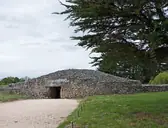 The Table des MarchandsAn engraved stone roofIn the guide
- 10
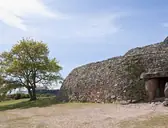 The Cairn of GavrinisThe masterpiece of megalithic artIn the guide
Site map of the Carnac Megaliths
History of the Carnac Megaliths
The monuments were built by the first farming communities of Brittany, who arrived in the area in the sixth millennium BCE, bringing crops and domestic animals. They had no metal tools and no written language, but they were able to quarry, move and raise blocks of granite weighing many tonnes. Around 4700 BCE, powerful groups built giant mounds and raised huge carved stones, and buried their dead with polished axes of jade brought from the Alps. Later generations built passage tombs and the long rows of standing stones. No one knows for certain why the rows were built, and theories have ranged from ritual processions to astronomy; as UNESCO notes, their purpose cannot yet be explained with certainty. In the nineteenth century, the Scottish antiquarian James Miln and his assistant, the local archaeologist Zacharie Le Rouzic, began the scientific study of the stones.
Carnac Megaliths guide: questions
How many stops does the Carnac Megaliths guide have?
10 stops, in visit order: 1. The Saint-Michel Tumulus; 2. The Museum of Prehistory; 3. The Ménec Alignments; 4. The Kermario Alignments; 5. The Kercado Tumulus; 6. The Manio Giant; 7. The Kerlescan Alignments; 8. The Broken Menhir of Er Grah; 9. The Table des Marchands; 10. The Cairn of Gavrinis.
Can I do a self-guided tour of the Carnac Megaliths with this guide?
Yes. The guide is made for a self-guided tour: 10 stops in visit order, each with a photo, a story and a voice, so you can explore the Carnac Megaliths at your own pace, without joining a group. Download it before you go and it works offline.
How long do you need at the Carnac Megaliths?
We suggest allowing A full day. The 10 stops add up to about 8 minutes of listening, and you play each one when you’re ready, so you can linger wherever you like.
How long is each guide?
The 10 stops add up to about 8 minutes of listening in total. You play each stop when you’re ready, so you can go at your own pace.
Does the guide work offline?
Yes, once it’s downloaded. The guide is a single self-contained web page (about 9.8 MB) with the photos, text and audio built in. Download it to your phone before you go (Wi-Fi is best); after that it opens in any modern browser on iPhone or Android, with no app, account or mobile signal needed.
Does it use GPS or need my location?
No. The guide doesn’t use GPS and doesn’t know where you are: you play each stop when you reach it. It works on iPhone and Android in any modern browser, and it’s in English.
What’s included?
One self-contained HTML guide: 10 stops in visit order, each with a photo, text and a voice, plus the story of who built the site.
Who built the Carnac Megaliths?
The monuments were built by the first farming communities of Brittany, who arrived in the area in the sixth millennium BCE, bringing crops and domestic animals. They had no metal tools and no written language, but they were able to quarry, move and raise blocks of granite weighing many tonnes.
Is there a free audio guide to the Carnac Megaliths?
The first stop, The Saint-Michel Tumulus, is free to read and hear on this page, so you can try the Carnac Megaliths audio tour before you buy. The full guide, with all 10 stops, is a one-off purchase: download it once and it’s yours to keep, working offline.
Is the Carnac Megaliths guide worth it?
If you’d like to know what you’re looking at, yes. For $10 you get 10 stops in visit order, each with a photo, a short history and a voice you play when you’re ready, plus a site map of the stops, and about 8 minutes of listening in all. It’s short on purpose, so you spend your time looking, not listening. It’s yours to keep, works offline and needs no app. The first stop is free on this page, so you can try it before you buy. If you’d like hours of detail, a guided tour will go deeper.
Audio guide or guided tour?
It depends how you like to visit. This guide lets you explore the Carnac Megaliths at your own pace, at any time, for a one-off price. A guided tour gives you a live expert you can ask questions, but at fixed times and usually for a higher price. Many people use both: a tour for the big picture, and the guide to read beforehand or to revisit the stops in their own time.
Is this the official Carnac Megaliths guide?
No. It’s an independent guide by The Historian Guide, not affiliated with or endorsed by the operator of the Carnac Megaliths. For tickets and opening hours, check the official site operator before you go.
Does the guide include entry tickets or opening hours?
No. The guide is a digital companion only. Admission to the Carnac Megaliths is separate, so check the official site operator for current tickets and opening hours before you go.
- Stop 1 · The Saint-Michel Tumulus: Lionel Allorge · CC BY-SA 3.0 · Wikimedia Commons · resized
- Stop 2 · The Museum of Prehistory: Peter Potrowl · CC BY-SA 4.0 · Wikimedia Commons · resized
- Stop 3 · The Ménec Alignments: Photo: Myrabella / Wikimedia Commons · CC BY-SA 3.0 · Wikimedia Commons · resized
- Stop 4 · The Kermario Alignments (also the cover): Unukorno · CC BY 4.0 · Wikimedia Commons · resized
- Stop 5 · The Kercado Tumulus: Michael Kranewitter · CC BY-SA 3.0 · Wikimedia Commons · resized
- Stop 6 · The Manio Giant: François de Dijon · CC BY-SA 4.0 · Wikimedia Commons · resized
- Stop 7 · The Kerlescan Alignments: Photo: Myrabella / Wikimedia Commons · CC BY-SA 3.0 · Wikimedia Commons · resized
- Stop 8 · The Broken Menhir of Er Grah: Broken_menhir.jpg: Bjørn som tegner derivative work: Myrabella (talk) · CC BY-SA 3.0 · Wikimedia Commons · resized
- Stop 9 · The Table des Marchands: Photo: Myrabella / Wikimedia Commons · CC BY-SA 3.0 · Wikimedia Commons · resized
- Stop 10 · The Cairn of Gavrinis: Photo: Myrabella / Wikimedia Commons · CC BY-SA 3.0 · Wikimedia Commons · resized


All photographs from Wikimedia Commons under the licences shown.
More guides in France
 Napoleonic France8 stops · Napoleonic era
Arc de Triomphe audio guide
Cross beneath the traffic to Napoleon’s arch, read its carved victories and the names of its generals, then climb to the rooftop terrace.
 Gothic8 stops · 12th–13th century CE
Chartres Cathedral audio guide
Step through the Royal Portal into a Gothic cathedral rebuilt after the fire of 1194, with its labyrinth and the deep Chartres blue of its glass.
 Renaissance8 stops · from 1519 CE
Château de Chambord audio guide
Climb the double-helix staircase of François I’s great hunting château to roof terraces crowded with chimneys and turrets, above a vast walled forest park.
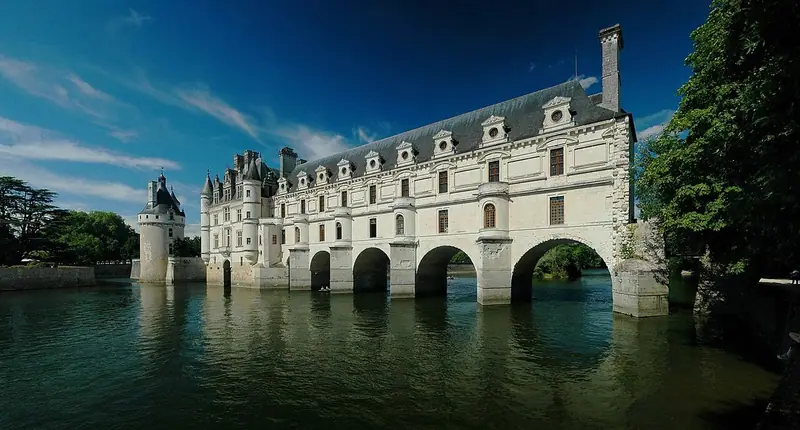 Renaissance8 stops · 1513–1521 CE
Château de Chenonceau audio guide
Cross the River Cher on the long gallery of the château built under Katherine Briçonnet’s eye and later home to Diane de Poitiers.
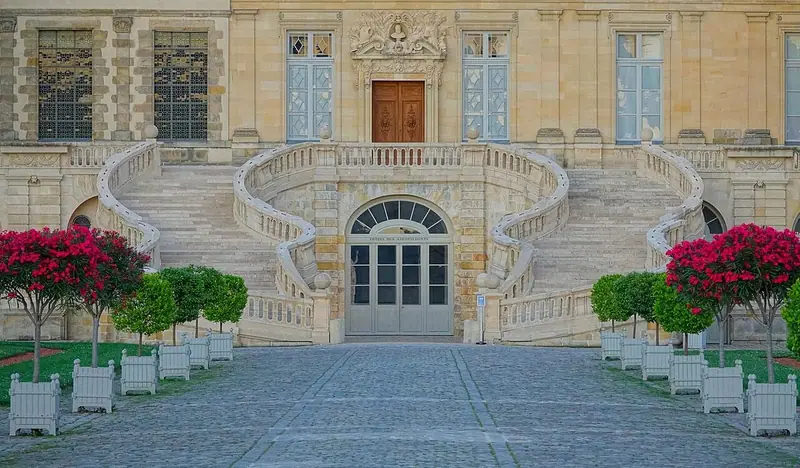 Renaissance8 stops · from 1528 CE
Château de Fontainebleau audio guide
From the Courtyard of Farewells through François I’s Renaissance gallery to the throne room and Napoleon’s apartments.
 Medieval7 stops · 12th–13th century CE
Cité de Carcassonne audio guide
Enter by the Porte Narbonnaise and walk the lices and ramparts of a double-walled medieval town above the River Aude.
Every guide, in every country
Carnac Megaliths and every other guide we publish, including future ones. One payment, no subscription.