Before you start
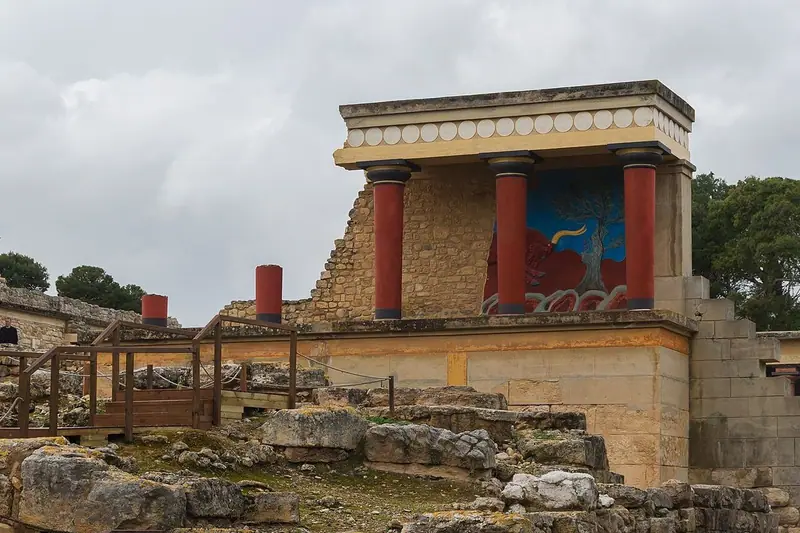
Knossos lies on a low hill in the valley of the Kairatos stream, about five kilometres south of the centre of Heraklion, the capital of Crete. It was the largest Bronze Age site on the island and the heart of Minoan Crete, a sprawling palace of courts, corridors, light wells, workshops and storerooms that later Greeks remembered as the labyrinth of King Minos. It is cared for by the Hellenic Ministry of Culture and, with other Minoan palace sites, was inscribed as a UNESCO World Heritage Site in 2025. This guide follows the usual visitor route: from the West Court through the South Propylaeum to the Central Court, the Throne Room, the Grand Staircase and royal apartments, the North Entrance with its charging bull, and finally the Theatral Area and Royal Road.
Use it as a self-guided tour of Knossos: 7 stops in visit order, each played when you’re ready, at your own pace.
 Free preview · Stop 1
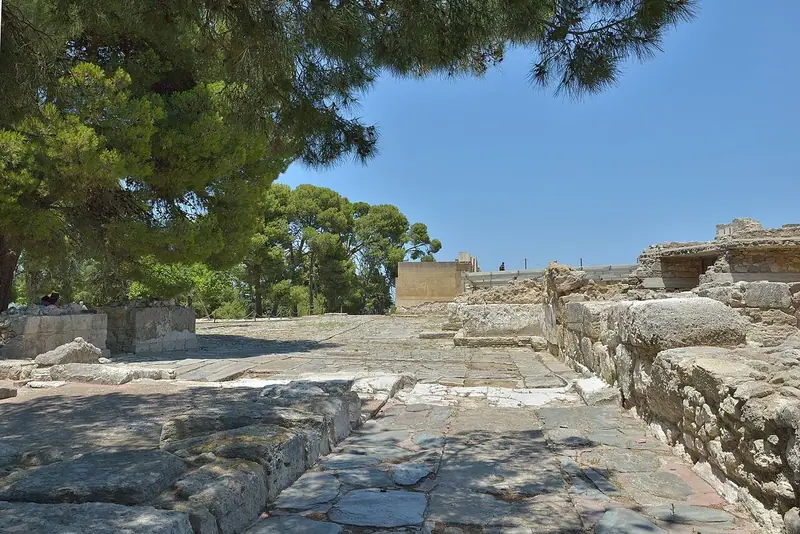
West Court
Your visit begins in the West Court, the broad paved square in front of the palace’s western façade. Look down and you will see raised walkways crossing the paving; these are thought to have guided processions towards the palace entrances. Set into the ground are three large round pits, known as kouloures. Their purpose is debated: they may have been granaries, or pits for rubbish or offerings, and they were later paved over. On your right rises the west façade, built of large blocks of gypsum and limestone. Behind it lay long storerooms where enormous clay jars, called pithoi, held olive oil, wine and grain. Before you stands the bronze bust of Sir Arthur Evans, the British archaeologist who excavated the palace from 1900. Take a moment to imagine the court crowded for a festival.
Photo: Wolfgang Moroder · CC BY-SA 3.0 · Wikimedia Commons
What to see at Knossos: 7 stops, in visit order
- 01
 West CourtDytikí AvlíFree preview
- 02
 South PropylaeumNótia PropýlaiaIn the guide
- 03
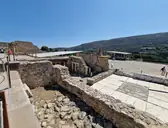 Central CourtKentrikí AvlíIn the guide
- 04
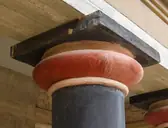 Throne RoomAíthousa tou ThrónouIn the guide
- 05
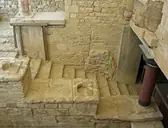 Grand Staircase and Royal ApartmentsMegáli KlímakaIn the guide
- 06
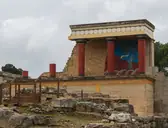 North EntranceVóreia EísodosIn the guide
- 07
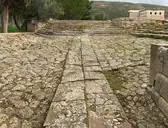 Theatral Area and Royal RoadTheatrikós ChórosIn the guide
Site map of Knossos
History of Knossos
Knossos was built by the Minoans, the Bronze Age people of Crete, whose civilisation lasted from about 3000 to 1100 BCE; the name ‘Minoan’ was coined by the archaeologist Arthur Evans after the legendary king Minos. The hill had been lived on since the Neolithic, from about 7000 BCE. The first palace rose around 1900 BCE and, after earthquake damage, was rebuilt grander still around 1700 BCE. The Minoans wrote in Linear A, which is still undeciphered. From around 1450 BCE, Mycenaean Greeks from the mainland controlled Knossos, keeping records in Linear B, an early form of Greek, and the palace was finally destroyed around 1350 to 1300 BCE, though the area remained inhabited. Greek and Roman towns later grew nearby.
The full history continues in the guide.
Knossos guide: questions
How many stops does the Knossos guide have?
7 stops, in visit order: 1. West Court; 2. South Propylaeum; 3. Central Court; 4. Throne Room; 5. Grand Staircase and Royal Apartments; 6. North Entrance; 7. Theatral Area and Royal Road.
Can I do a self-guided tour of Knossos with this guide?
Yes. The guide is made for a self-guided tour: 7 stops in visit order, each with a photo, a story and a voice, so you can explore Knossos at your own pace, without joining a group. Download it before you go and it works offline.
How long is each guide?
The 7 stops add up to about 7 minutes of listening in total. You play each stop when you’re ready, so you can go at your own pace.
Does the guide work offline?
Yes, once it’s downloaded. The guide is a single self-contained web page (about 7.9 MB) with the photos, text and audio built in. Download it to your phone before you go (Wi-Fi is best); after that it opens in any modern browser on iPhone or Android, with no app, account or mobile signal needed.
Does it use GPS or need my location?
No. The guide doesn’t use GPS and doesn’t know where you are: you play each stop when you reach it. It works on iPhone and Android in any modern browser, and it’s in English.
What’s included?
One self-contained HTML guide: 7 stops in visit order, each with a photo, text and a voice, plus the story of who built the site.
Who built Knossos?
Knossos was built by the Minoans, the Bronze Age people of Crete, whose civilisation lasted from about 3000 to 1100 BCE; the name ‘Minoan’ was coined by the archaeologist Arthur Evans after the legendary king Minos. The hill had been lived on since the Neolithic, from about 7000 BCE.
Where is Knossos?
Knossos lies on a low hill in the valley of the Kairatos stream, about five kilometres south of the centre of Heraklion, the capital of Crete.
Is there a free audio guide to Knossos?
The first stop, West Court, is free to read and hear on this page, so you can try the Knossos audio tour before you buy. The full guide, with all 7 stops, is a one-off purchase: download it once and it’s yours to keep, working offline.
Is the Knossos guide worth it?
If you’d like to know what you’re looking at, yes. For $10 you get 7 stops in visit order, each with a photo, a short history and a voice you play when you’re ready, plus a site map of the stops, and about 7 minutes of listening in all. It’s short on purpose, so you spend your time looking, not listening. It’s yours to keep, works offline and needs no app. The first stop is free on this page, so you can try it before you buy. If you’d like hours of detail, a guided tour will go deeper.
Audio guide or guided tour?
It depends how you like to visit. This guide lets you explore Knossos at your own pace, at any time, for a one-off price. A guided tour gives you a live expert you can ask questions, but at fixed times and usually for a higher price. Many people use both: a tour for the big picture, and the guide to read beforehand or to revisit the stops in their own time.
Is this the official Knossos guide?
No. It’s an independent guide by The Historian Guide, not affiliated with or endorsed by the operator of Knossos. For tickets and opening hours, check the official site operator before you go.
Does the guide include entry tickets or opening hours?
No. The guide is a digital companion only. Admission to Knossos is separate, so check the official site operator for current tickets and opening hours before you go.
- Stop 1 · West Court: Wolfgang Moroder · CC BY-SA 3.0 · Wikimedia Commons · resized
- Stop 2 · South Propylaeum: Jebulon · CC0 · Wikimedia Commons · resized
- Stop 3 · Central Court: Rigorius · CC BY-SA 4.0 · Wikimedia Commons · resized
- Stop 4 · Throne Room: Jebulon · CC0 · Wikimedia Commons · resized
- Stop 5 · Grand Staircase and Royal Apartments: Stefan Bellini · CC0 · Wikimedia Commons · resized
- Stop 6 · North Entrance (also the cover): Jebulon · CC0 · Wikimedia Commons · resized
- Stop 7 · Theatral Area and Royal Road: Jebulon · CC0 · Wikimedia Commons · resized


All photographs from Wikimedia Commons under the licences shown.
More guides in Greece
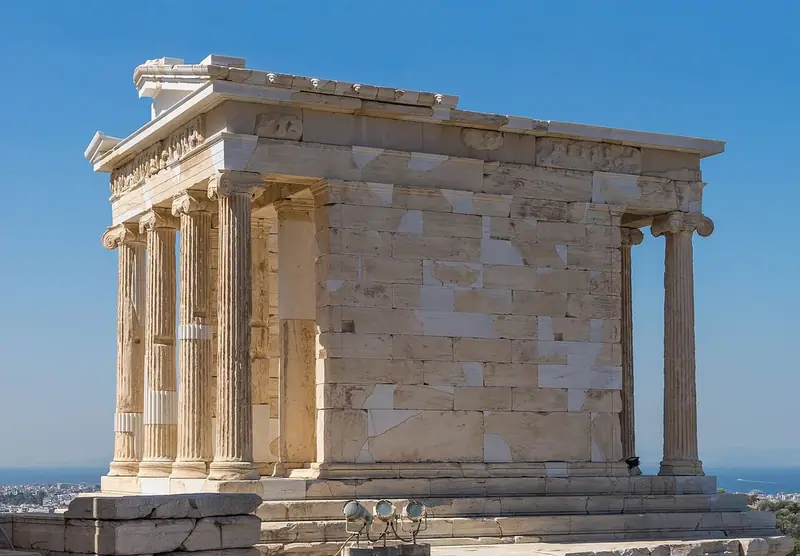 Greek7 stops · 5th century BCE
Acropolis of Athens audio guide
Climb through the Propylaia to the Parthenon and the Erechtheion, on the rock that has crowned Athens for three thousand years.
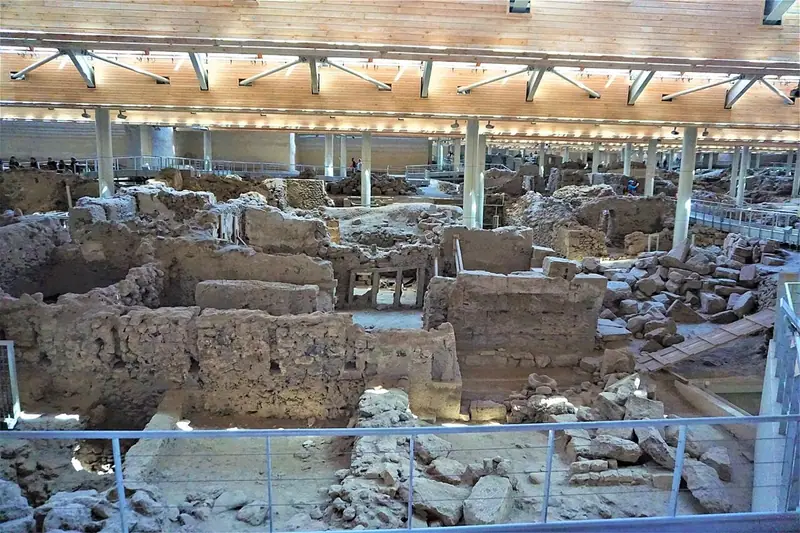 Minoan7 stops · c. 2000–1600 BCE
Akrotiri audio guide
The streets of a Bronze Age town buried by Santorini’s volcano, preserved beneath a great modern roof.
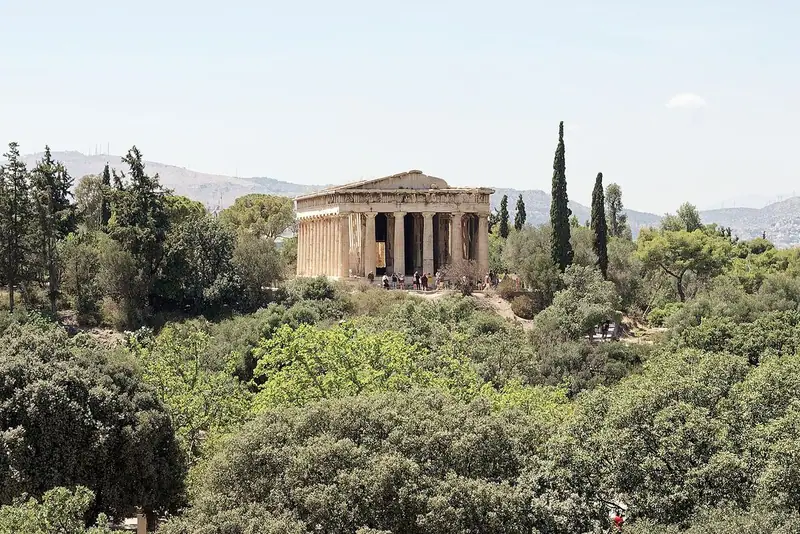 Greek7 stops · 6th century BCE – 2nd century CE
Ancient Agora of Athens audio guide
The market square where Athenians shopped, voted and argued, overlooked by the Temple of Hephaestus.
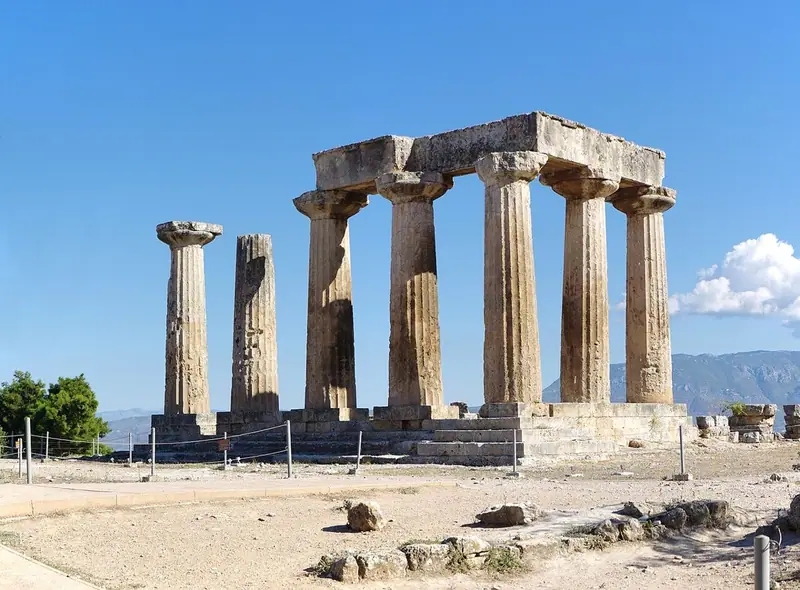 Roman7 stops · 6th century BCE – 4th century CE
Ancient Corinth audio guide
The Temple of Apollo, the Roman forum and the Bema, with the great rock of Acrocorinth above.
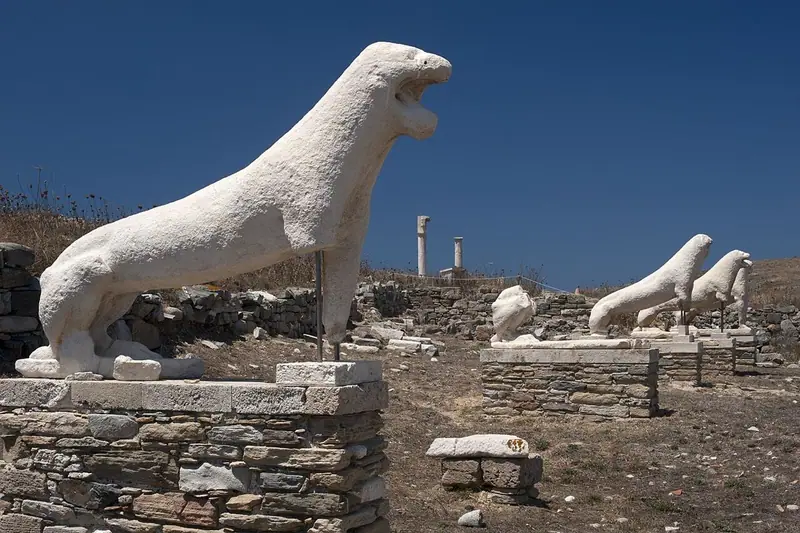 Greek7 stops · c. 800 BCE – 1st century BCE
Delos audio guide
The sacred island of Apollo: the Terrace of the Lions, mosaic-floored houses and the climb up Mount Kynthos.
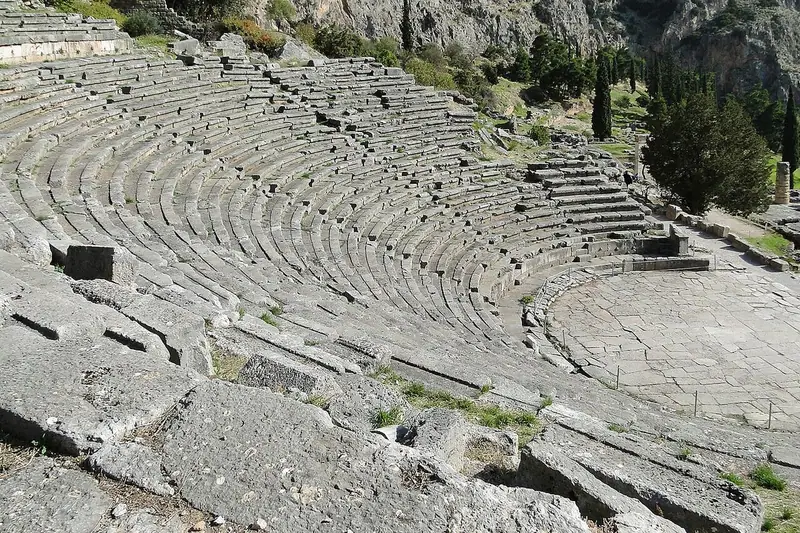 Greek8 stops · 8th century BCE – 4th century CE
Delphi audio guide
Up the Sacred Way past the treasuries to Apollo’s temple, the theatre and the stadium, high on the slopes of Parnassus.
Every guide, in every country
Knossos and every other guide we publish, including future ones. One payment, no subscription.