Before you start
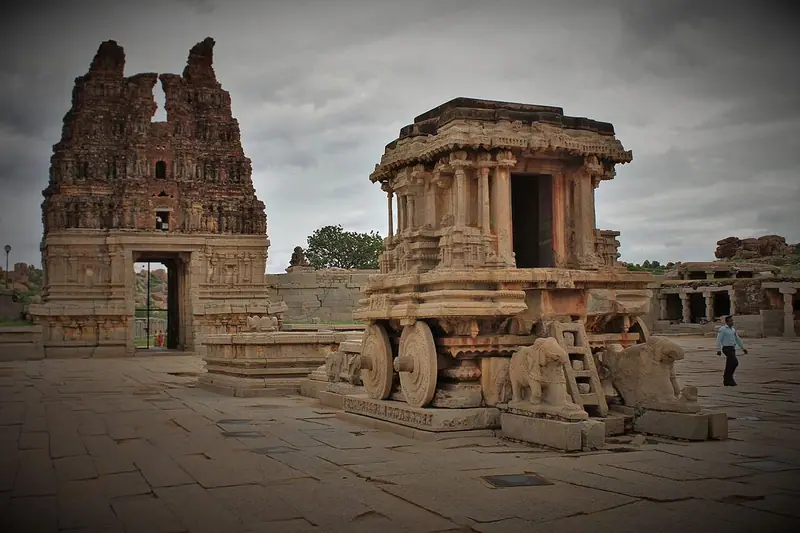
Hampi lies on the south bank of the Tungabhadra river in central Karnataka, in a dramatic landscape of granite boulders, hills, banana plantations and rice fields. Among the boulders are the ruins of Vijayanagara, the City of Victory, once one of the largest and richest cities in the world: more than 1,600 surviving remains of temples, palaces, gateways, baths, markets and waterworks spread over more than forty square kilometres. Hampi has been a UNESCO World Heritage Site since 1986 and is cared for by the Archaeological Survey of India and the Karnataka state government. The site is too big to walk in one go, so most visitors combine walking with bicycles, electric buggies or auto-rickshaws. This guide follows a classic route: from the living Virupaksha temple through the sacred centre on Hemakuta Hill, south to the royal centre, and then east to the Vittala temple.
Use it as a self-guided tour of Hampi: 8 stops in visit order, each played when you’re ready, at your own pace.
 Free preview · Stop 1
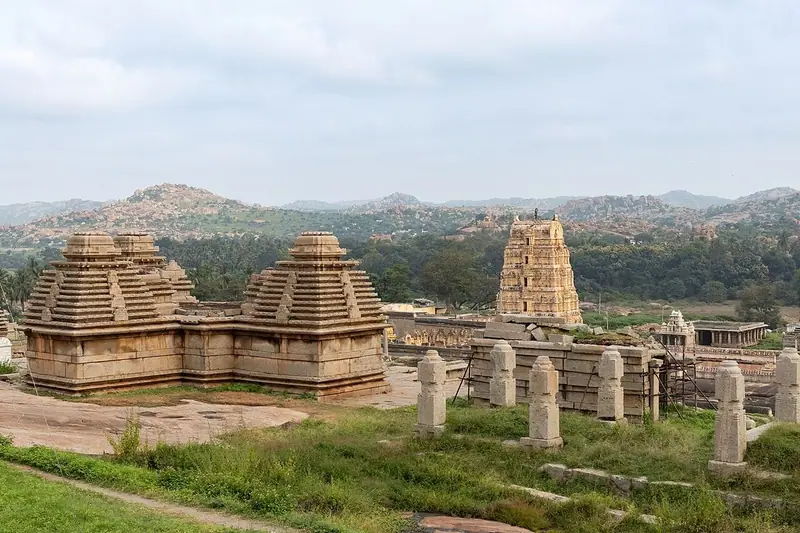
Virupaksha Temple
Start in Hampi village at the Virupaksha temple, the oldest and most sacred shrine here, dedicated to Shiva as Virupaksha, consort of the local goddess Pampa. Worship has continued here without a break since long before the empire, and it is still busy with pilgrims. Approach along the old Hampi Bazaar, a long street lined with stone pavilions, and look up at the great eastern gateway tower, the gopura, which dominates the village. Remove your shoes at the entrance. Inside, you pass through courtyards to the pillared halls and sanctum. Look for the hall built by Krishnadevaraya, with pillars carved with rearing mythical lions called yalis, and the painted ceiling showing scenes from Hindu epics. In a dark chamber behind the sanctum, a small opening projects an upside-down image of the gopura on to the wall, like a pinhole camera.
Photo: iMahesh · CC BY-SA 4.0 · Wikimedia Commons
What to see at Hampi: 8 stops, in visit order
- 01
 Virupaksha TempleThe living templeFree preview
- 02
 Hemakuta HillThe early templesIn the guide
- 03
 Sasivekalu and Kadalekalu GaneshaTwo monolithic GaneshasIn the guide
- 04
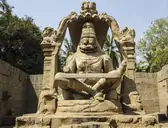 Lakshmi NarasimhaThe man-lion godIn the guide
- 05
 Mahanavami Dibba and the Stepped TankThe royal centreIn the guide
- 06
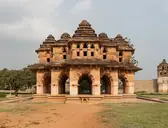 Lotus MahalThe zenana enclosureIn the guide
- 07
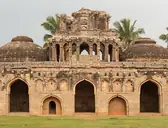 Elephant StablesEleven domed chambersIn the guide
- 08
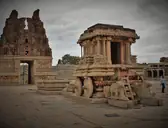 Vittala TempleThe stone chariot and musical pillarsIn the guide
Site map of Hampi
History of Hampi
Hampi was the capital of the Vijayanagara Empire, the last great Hindu kingdom of southern India. According to tradition, it was founded in 1336 by two brothers, Harihara and Bukka, of the Sangama dynasty, and it grew to rule most of the peninsula south of the Krishna river. Four dynasties ruled in turn, and the empire reached its peak under Krishnadevaraya, who reigned from 1509 to 1529. Hampi itself was already a sacred place long before: the Virupaksha temple and the goddess Pampa were worshipped here centuries earlier. In 1565 an alliance of the Deccan sultanates defeated Vijayanagara’s army at the Battle of Talikota, and the city was sacked and abandoned. The empire survived, much reduced, under the Aravidu dynasty, ruling from capitals further south until the middle of the seventeenth century.
Hampi guide: questions
How many stops does the Hampi guide have?
8 stops, in visit order: 1. Virupaksha Temple; 2. Hemakuta Hill; 3. Sasivekalu and Kadalekalu Ganesha; 4. Lakshmi Narasimha; 5. Mahanavami Dibba and the Stepped Tank; 6. Lotus Mahal; 7. Elephant Stables; 8. Vittala Temple.
Can I do a self-guided tour of Hampi with this guide?
Yes. The guide is made for a self-guided tour: 8 stops in visit order, each with a photo, a story and a voice, so you can explore Hampi at your own pace, without joining a group. Download it before you go and it works offline.
How long is each guide?
The 8 stops add up to about 8 minutes of listening in total. You play each stop when you’re ready, so you can go at your own pace.
Does the guide work offline?
Yes, once it’s downloaded. The guide is a single self-contained web page (about 8.3 MB) with the photos, text and audio built in. Download it to your phone before you go (Wi-Fi is best); after that it opens in any modern browser on iPhone or Android, with no app, account or mobile signal needed.
Does it use GPS or need my location?
No. The guide doesn’t use GPS and doesn’t know where you are: you play each stop when you reach it. It works on iPhone and Android in any modern browser, and it’s in English.
What’s included?
One self-contained HTML guide: 8 stops in visit order, each with a photo, text and a voice, plus the story of who built the site.
Who built Hampi?
Hampi was the capital of the Vijayanagara Empire, the last great Hindu kingdom of southern India. According to tradition, it was founded in 1336 by two brothers, Harihara and Bukka, of the Sangama dynasty, and it grew to rule most of the peninsula south of the Krishna river.
Where is Hampi?
Hampi lies on the south bank of the Tungabhadra river in central Karnataka, in a dramatic landscape of granite boulders, hills, banana plantations and rice fields.
Is there a free audio guide to Hampi?
The first stop, Virupaksha Temple, is free to read and hear on this page, so you can try the Hampi audio tour before you buy. The full guide, with all 8 stops, is a one-off purchase: download it once and it’s yours to keep, working offline.
Is the Hampi guide worth it?
If you’d like to know what you’re looking at, yes. For $10 you get 8 stops in visit order, each with a photo, a short history and a voice you play when you’re ready, plus a site map of the stops, and about 8 minutes of listening in all. It’s short on purpose, so you spend your time looking, not listening. It’s yours to keep, works offline and needs no app. The first stop is free on this page, so you can try it before you buy. If you’d like hours of detail, a guided tour will go deeper.
Audio guide or guided tour?
It depends how you like to visit. This guide lets you explore Hampi at your own pace, at any time, for a one-off price. A guided tour gives you a live expert you can ask questions, but at fixed times and usually for a higher price. Many people use both: a tour for the big picture, and the guide to read beforehand or to revisit the stops in their own time.
Is this the official Hampi guide?
No. It’s an independent guide by The Historian Guide, not affiliated with or endorsed by the operator of Hampi. For tickets and opening hours, check the official site operator before you go.
Does the guide include entry tickets or opening hours?
No. The guide is a digital companion only. Admission to Hampi is separate, so check the official site operator for current tickets and opening hours before you go.
- Stop 1 · Virupaksha Temple: iMahesh · CC BY-SA 4.0 · Wikimedia Commons · resized
- Stop 2 · Hemakuta Hill: Ingo Mehling · CC BY-SA 4.0 · Wikimedia Commons · resized
- Stop 3 · Sasivekalu and Kadalekalu Ganesha: Vipulvaibhav5 · CC BY-SA 4.0 · Wikimedia Commons · resized
- Stop 4 · Lakshmi Narasimha: Indrajit Das · CC BY-SA 3.0 · Wikimedia Commons · resized
- Stop 5 · Mahanavami Dibba and the Stepped Tank: Venkygrams · CC BY-SA 4.0 · Wikimedia Commons · resized
- Stop 6 · Lotus Mahal: iMahesh · CC BY-SA 4.0 · Wikimedia Commons · resized
- Stop 7 · Elephant Stables: iMahesh · CC BY-SA 4.0 · Wikimedia Commons · resized
- Stop 8 · Vittala Temple (also the cover): Ajayreddykalavalli · CC BY-SA 4.0 · Wikimedia Commons · resized


All photographs from Wikimedia Commons under the licences shown.
More guides in India
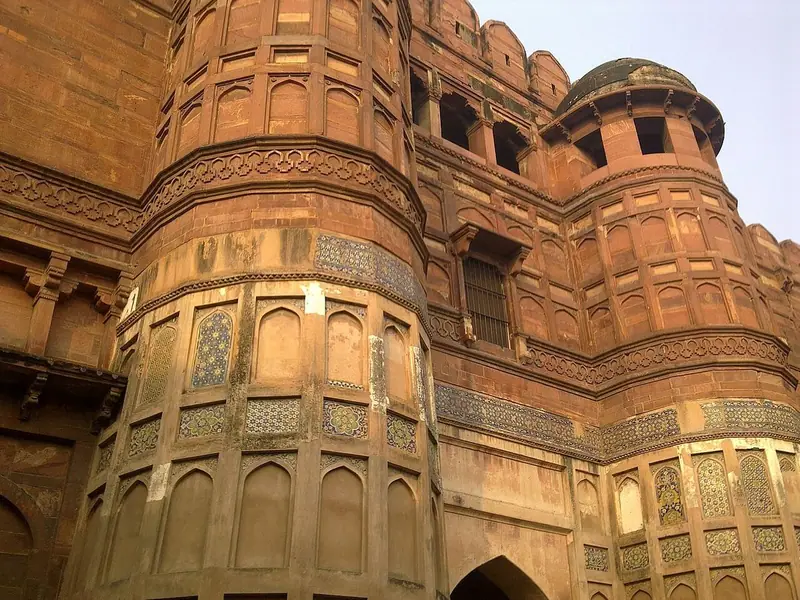 Mughal7 stops · 1565–1640s
Agra Fort audio guide
Red sandstone ramparts and marble palaces, with the Taj Mahal in view from the riverside terraces.
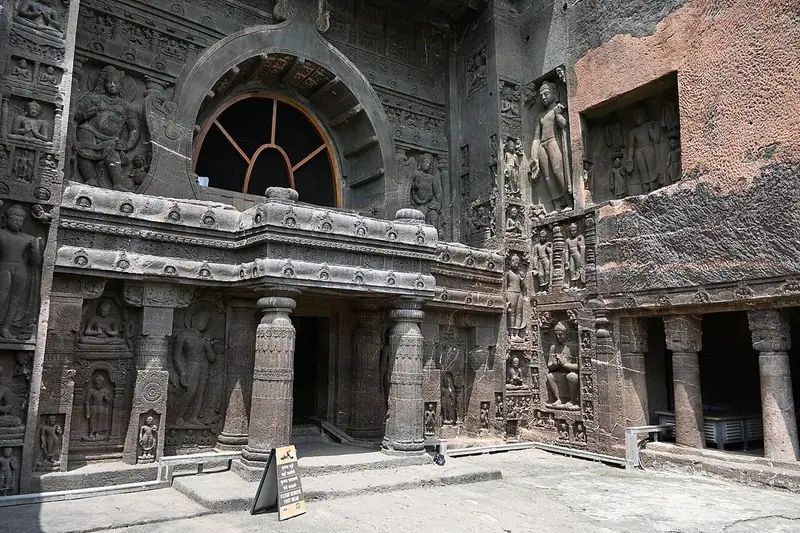 Deccan8 stops · 2nd century BCE – 5th century CE
Ajanta Caves audio guide
Thirty caves cut into a curving cliff above the Waghora river, their prayer halls and monasteries painted and carved by Buddhist monks and their patrons.
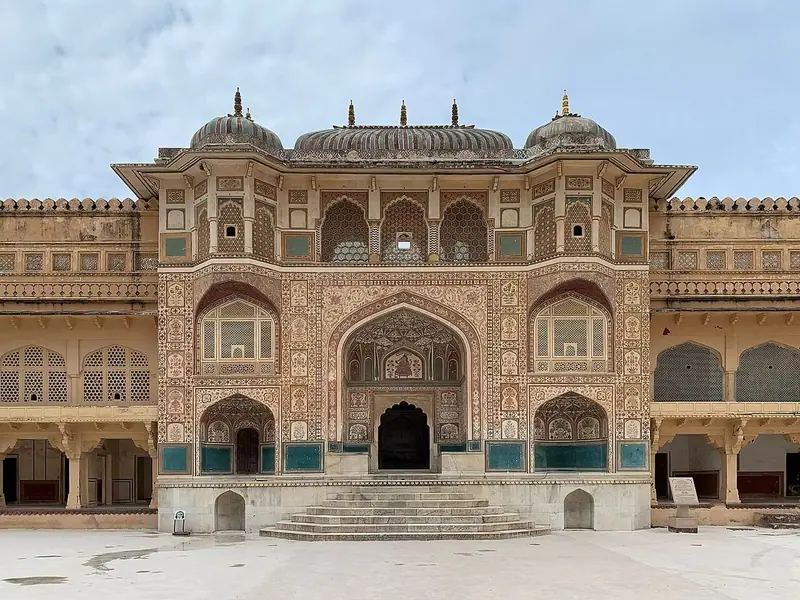 Rajput8 stops · 1592–18th century
Amber Fort audio guide
Up from Maota Lake through the great gates and courtyards to the Sheesh Mahal, palace of the Kachhwaha Rajputs.
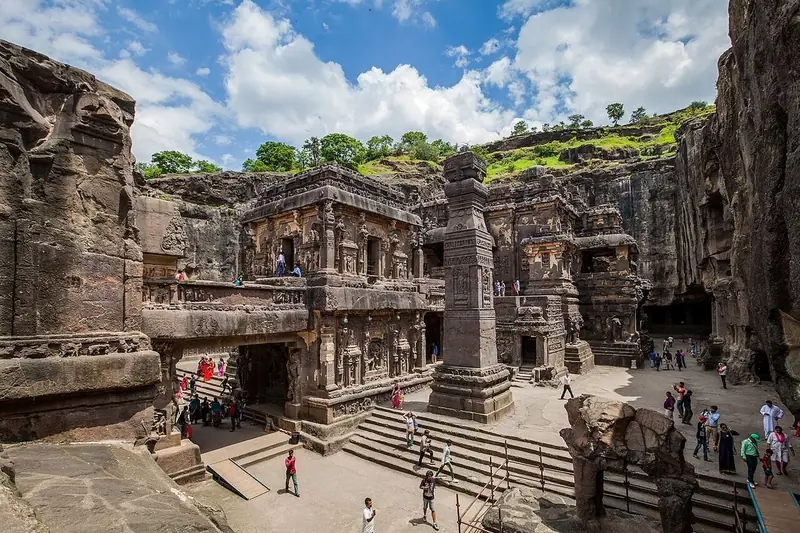 Deccan8 stops · c. 600–1000 CE
Ellora Caves audio guide
Thirty-four Buddhist, Hindu and Jain caves cut into a basalt escarpment, crowned by the Kailasa Temple.
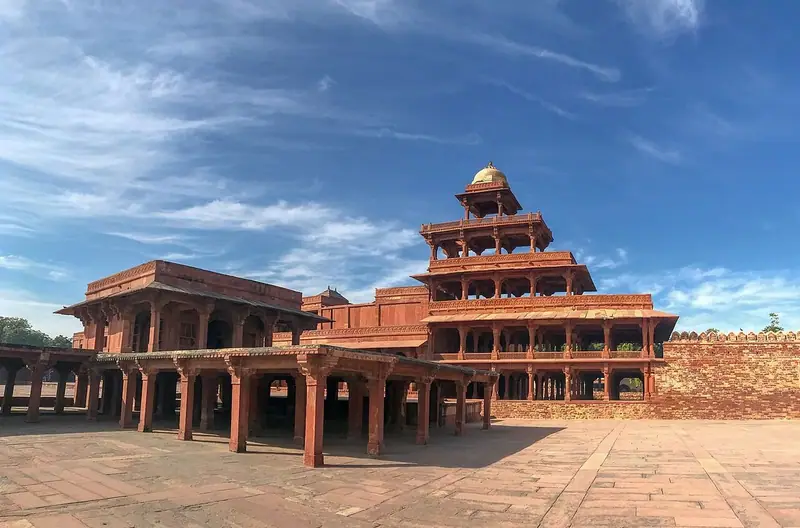 Mughal8 stops · 1571–1585
Fatehpur Sikri audio guide
Akbar’s short-lived red sandstone capital: the Panch Mahal, the Diwan-i-Khas and the tomb of Salim Chishti.
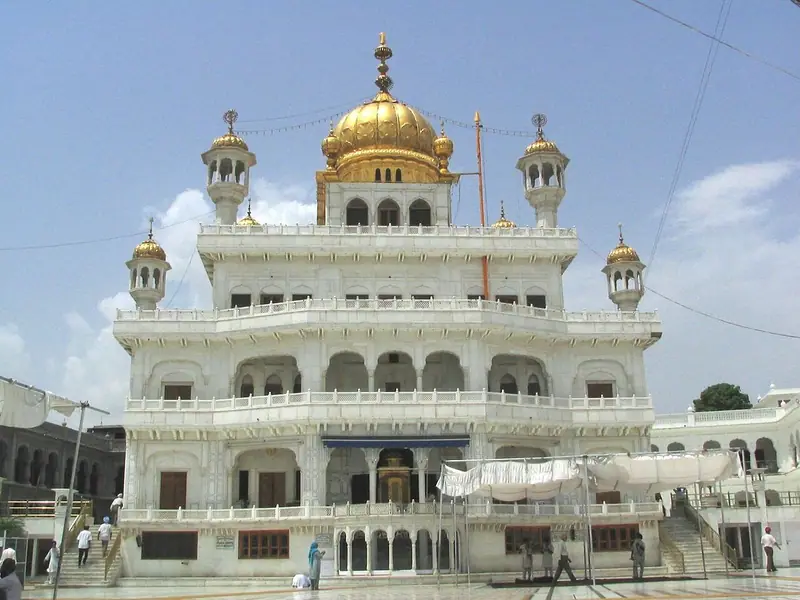 Sikh9 stops · Sikh Gurus and Sikh Empire
The Golden Temple audio guide
Follow the marble path around the sacred pool, cross the causeway to the gilded Harmandir Sahib, and share a meal at the Guru ka Langar.
Every guide, in every country
Hampi and every other guide we publish, including future ones. One payment, no subscription.