Before you start
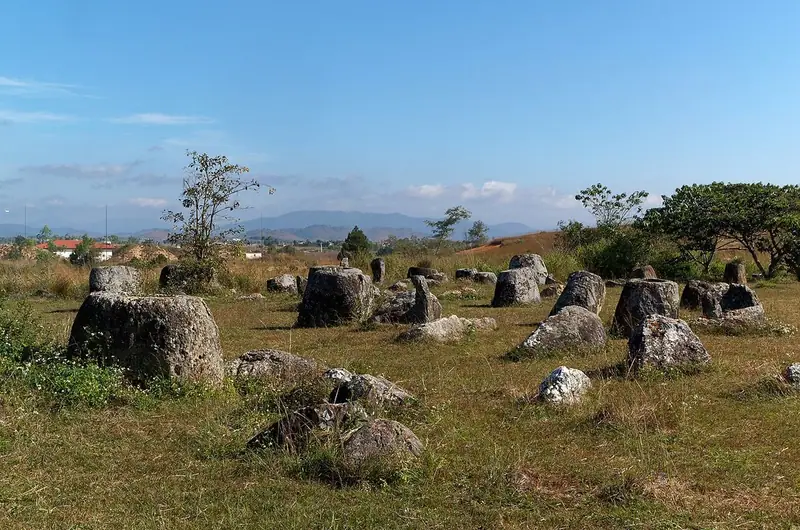
The Plain of Jars lies on the Xiangkhouang Plateau in northern Laos, at the northern end of the Annamite mountains, around the town of Phonsavan. Thousands of carved stone jars stand in clusters on the hill slopes and ridges around the central plain, from a single jar to several hundred at a site. More than 2,100 jars have been documented, and in 2019 UNESCO inscribed fifteen of the sites as a World Heritage Site. Site 1, the largest and most visited, is a short drive from Phonsavan; Sites 2 and 3 lie further south, along country roads that can be difficult after rain. At every site, keep within the paths marked by small stones, as the land around has not all been cleared of wartime ordnance. The plateau is high and mornings can be cool, so bring a layer. The route begins with the marker stones, explores Site 1, and ends at Sites 2 and 3.
Use it as a self-guided tour of the Plain of Jars: 7 stops in visit order, each played when you’re ready, at your own pace.
 Free preview · Stop 1
The Marker Stones
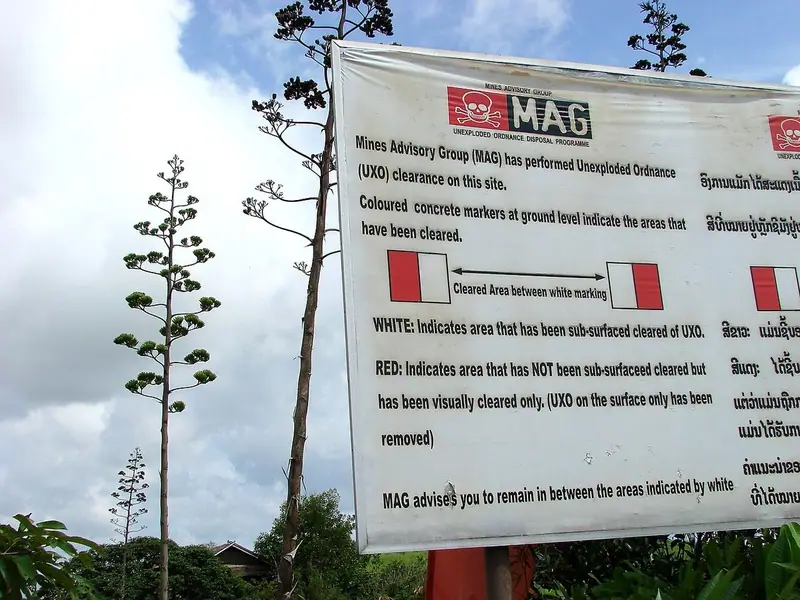
Begin by looking down at the small painted blocks that line the paths at every jar site. From 1964 to 1969, in what became known as the Secret War in Laos, the United States Air Force bombed the plain intensively, aiming at North Vietnamese and Pathet Lao troops. Roughly 270 million cluster bomblets were dropped on the area, and about 80 million of them did not go off. The Mines Advisory Group, MAG, began work in Laos in 1994. Working with UNESCO and funded by New Zealand, it cleared the three most visited jar sites in 2004 and 2005, and further clearance in 2007 opened four more. Look at the marker stones: the white side faces ground that has been cleared, and the red side ground that has not. Fewer than one in ten of the jars have been closely investigated, partly because of the remaining ordnance.
Photo: Adam Jones · CC BY-SA 3.0 · Wikimedia Commons
What to see at the Plain of Jars: 7 stops, in visit order
- 01
 The Marker StonesA landscape cleared of bombsFree preview
- 02
 Site 1: The Jar FieldHundreds of jars on a hillsideIn the guide
- 03
 Site 1: The Great JarsGiants and rice wineIn the guide
- 04
 Site 1: The CaveA crematorium in the rockIn the guide
- 05
 Site 1: Lids and BurialsWhat the jars were forIn the guide
- 06
 Site 2: Jars in the WoodsShade on a hilltopIn the guide
- 07
 Site 3: Among the Rice FieldsA path through the valleyIn the guide
Site map of the Plain of Jars
History of the Plain of Jars
The jars were made by an Iron Age people about whom little is known. UNESCO dates the sites from about 500 BCE to 500 CE, and possibly as late as 800 CE; luminescence dating suggests that some jars were set in place much earlier, and burials around them continued for many centuries. Some scholars suggest a link with the Austroasiatic-speaking peoples of Laos, such as the Khmu, but this is not certain. The plateau sits at a crossroads between two great cultural systems of Iron Age South-East Asia, along the Mekong to the west and the Red River and the Gulf of Tonkin to the east, and the jar sites seem to follow ancient overland routes. The province also has rich deposits of iron ore. The jars were described by the surveyor James McCarthy in 1884, and in the 1930s the French archaeologist Madeleine Colani studied them and concluded that they were connected with burial.
Plain of Jars guide: questions
How many stops does the Plain of Jars guide have?
7 stops, in visit order: 1. The Marker Stones; 2. Site 1: The Jar Field; 3. Site 1: The Great Jars; 4. Site 1: The Cave; 5. Site 1: Lids and Burials; 6. Site 2: Jars in the Woods; 7. Site 3: Among the Rice Fields.
Can I do a self-guided tour of the Plain of Jars with this guide?
Yes. The guide is made for a self-guided tour: 7 stops in visit order, each with a photo, a story and a voice, so you can explore the Plain of Jars at your own pace, without joining a group. Download it before you go and it works offline.
How long do you need at the Plain of Jars?
We suggest allowing A full day. The 7 stops add up to about 5 minutes of listening, and you play each one when you’re ready, so you can linger wherever you like.
How long is each guide?
The 7 stops add up to about 5 minutes of listening in total. You play each stop when you’re ready, so you can go at your own pace.
Does the guide work offline?
Yes, once it’s downloaded. The guide is a single self-contained web page (about 7.1 MB) with the photos, text and audio built in. Download it to your phone before you go (Wi-Fi is best); after that it opens in any modern browser on iPhone or Android, with no app, account or mobile signal needed.
Does it use GPS or need my location?
No. The guide doesn’t use GPS and doesn’t know where you are: you play each stop when you reach it. It works on iPhone and Android in any modern browser, and it’s in English.
What’s included?
One self-contained HTML guide: 7 stops in visit order, each with a photo, text and a voice, plus the story of who built the site.
Who built the Plain of Jars?
The jars were made by an Iron Age people about whom little is known. UNESCO dates the sites from about 500 BCE to 500 CE, and possibly as late as 800 CE; luminescence dating suggests that some jars were set in place much earlier, and burials around them continued for many centuries.
Where is the Plain of Jars?
The Plain of Jars lies on the Xiangkhouang Plateau in northern Laos, at the northern end of the Annamite mountains, around the town of Phonsavan.
Is there a free audio guide to the Plain of Jars?
The first stop, The Marker Stones, is free to read and hear on this page, so you can try the Plain of Jars audio tour before you buy. The full guide, with all 7 stops, is a one-off purchase: download it once and it’s yours to keep, working offline.
Is the Plain of Jars guide worth it?
If you’d like to know what you’re looking at, yes. For $10 you get 7 stops in visit order, each with a photo, a short history and a voice you play when you’re ready, plus a site map of the stops, and about 5 minutes of listening in all. It’s short on purpose, so you spend your time looking, not listening. It’s yours to keep, works offline and needs no app. The first stop is free on this page, so you can try it before you buy. If you’d like hours of detail, a guided tour will go deeper.
Audio guide or guided tour?
It depends how you like to visit. This guide lets you explore the Plain of Jars at your own pace, at any time, for a one-off price. A guided tour gives you a live expert you can ask questions, but at fixed times and usually for a higher price. Many people use both: a tour for the big picture, and the guide to read beforehand or to revisit the stops in their own time.
Is this the official Plain of Jars guide?
No. It’s an independent guide by The Historian Guide, not affiliated with or endorsed by the operator of the Plain of Jars. For tickets and opening hours, check the official site operator before you go.
Does the guide include entry tickets or opening hours?
No. The guide is a digital companion only. Admission to the Plain of Jars is separate, so check the official site operator for current tickets and opening hours before you go.
- Stop 1 · The Marker Stones: Adam Jones Adam63 · CC BY-SA 3.0 · Wikimedia Commons · resized
- Stop 2 · Site 1: The Jar Field (also the cover): Jakub Hałun · CC BY-SA 4.0 · Wikimedia Commons · resized
- Stop 3 · Site 1: The Great Jars: Chaoborus · CC BY-SA 3.0 · Wikimedia Commons · resized
- Stop 4 · Site 1: The Cave: Stefan Fussan · CC BY 4.0 · Wikimedia Commons · resized
- Stop 5 · Site 1: Lids and Burials: Emmanuel Campos · CC BY-SA 3.0 · Wikimedia Commons · resized
- Stop 6 · Site 2: Jars in the Woods: Stefan Fussan · CC BY-SA 4.0 · Wikimedia Commons · resized
- Stop 7 · Site 3: Among the Rice Fields: Stefan Fussan · CC BY-SA 4.0 · Wikimedia Commons · resized


All photographs from Wikimedia Commons under the licences shown.
More guides in Laos
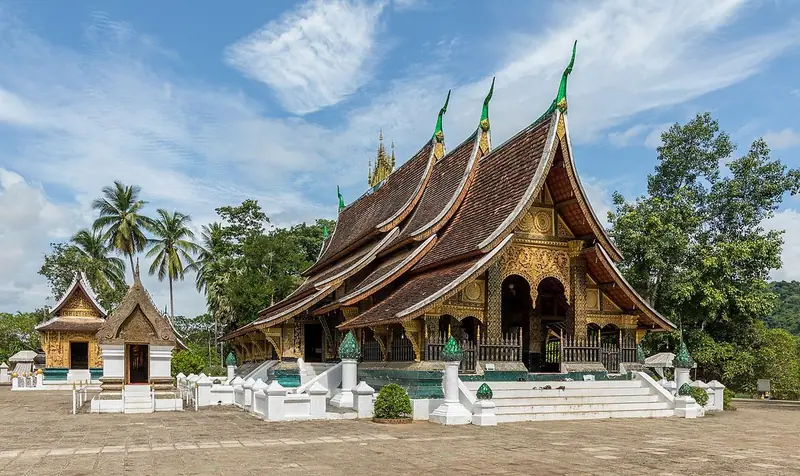 Lao8 stops · 14th–20th century
Luang Prabang audio guide
A peninsula of gilded temples and saffron-robed monks where the Nam Khan meets the Mekong, from Mount Phousi to Wat Xieng Thong.
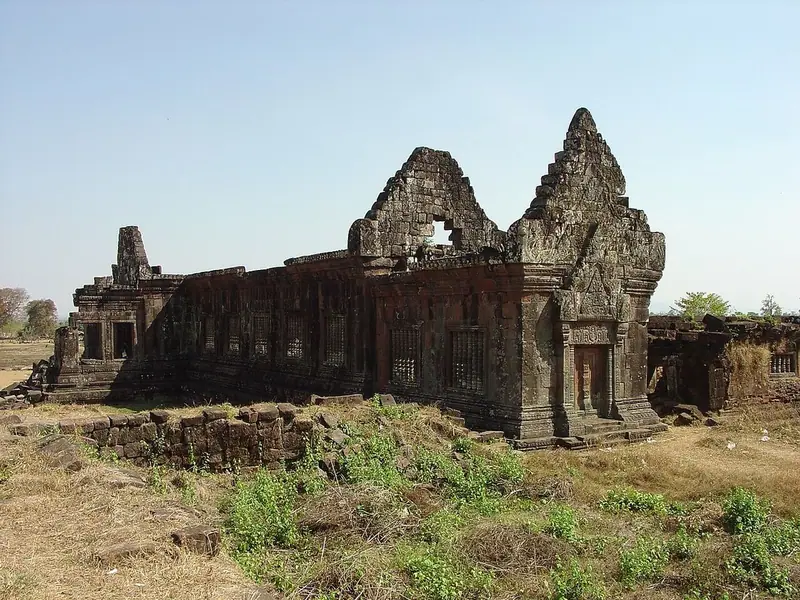 Khmer7 stops · 7th–12th century
Vat Phou audio guide
Follow the long processional way from the great reservoir up the stairway to a Khmer sanctuary and its sacred spring, older than Angkor Wat.
 Lao7 stops · 1560–1828
Vientiane audio guide
From the Mekong riverbank to the royal temples of Lan Xang, the Black Stupa and the Victory Gate, ending at the golden That Luang.
Every guide, in every country
Plain of Jars and every other guide we publish, including future ones. One payment, no subscription.