Before you start
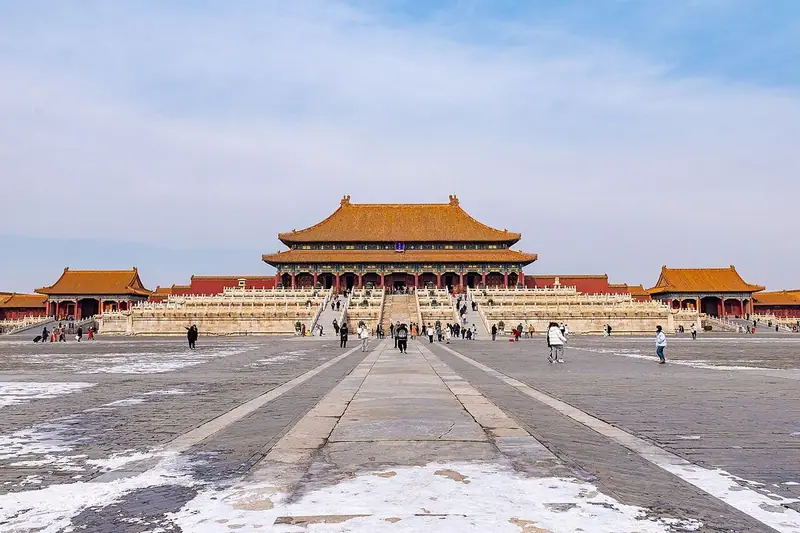
The Forbidden City, at the heart of Beijing, was the imperial palace of China for five centuries, and is today the Palace Museum. Surrounded by a high wall and a broad moat, it covers some 72 hectares and contains hundreds of halls, gates and courtyards, roofed in golden-yellow glazed tiles, the colour reserved for the emperor. Its plan follows a strict central axis running from south to north, with the great ceremonial halls of the Outer Court at the front and the private quarters of the Inner Court behind, a layout UNESCO calls the supreme model of ancient Chinese palace design. The Forbidden City has been a UNESCO World Heritage Site since 1987, and the museum’s collections number more than a million objects. Visitors enter from the south and leave from the north, and this guide follows that route along the central axis, from the Meridian Gate to the Gate of Divine Might.
Use it as a self-guided tour of the Forbidden City: 8 stops in visit order, each played when you’re ready, at your own pace.
 Free preview · Stop 1
Meridian Gate
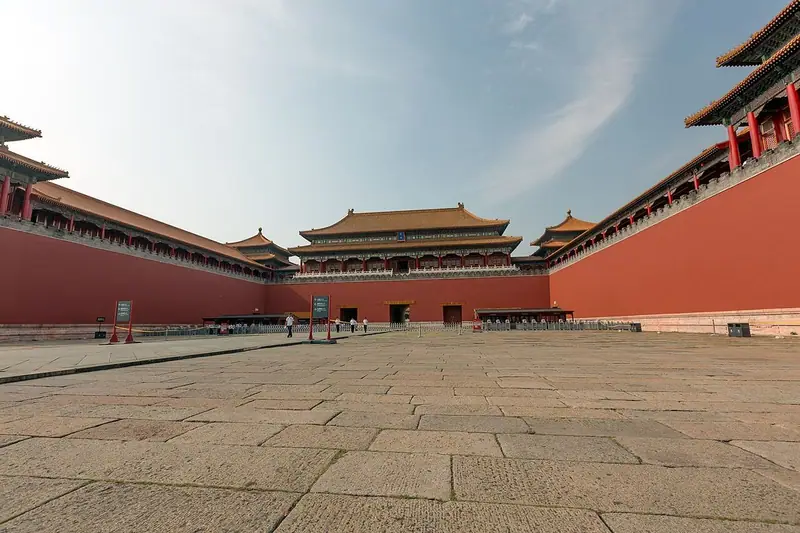
Begin in front of the Meridian Gate, the main entrance to the palace and the largest gate in the Forbidden City. Its massive red walls form a U shape, embracing the square in front of you, with pavilions at each corner and a great hall above the central passage. From this gate the emperor announced the new calendar each year and reviewed his armies returning from war. Look at the three openings in the front of the gate. The central one was reserved for the emperor alone, with rare exceptions: the empress passed through it once, on her wedding day, and the top three scholars of the palace examinations walked out through it after their results were announced. Officials used the side openings. As you pass through, notice the thickness of the walls, and imagine the sense of entering a different world.
Photo: Morio · CC BY-SA 4.0 · Wikimedia Commons
What to see at the Forbidden City: 8 stops, in visit order
- 01
 Meridian GateThe southern entranceFree preview
- 02
 Gate of Supreme HarmonyBridges and bronze lionsIn the guide
- 03
 Hall of Supreme HarmonyThe throne hallIn the guide
- 04
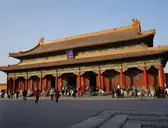 Halls of HarmonyCentral and Preserving HarmonyIn the guide
- 05
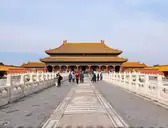 Palace of Heavenly PurityThe emperor’s residenceIn the guide
- 06
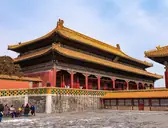 Palace of Earthly TranquillitySeals and the empressIn the guide
- 07
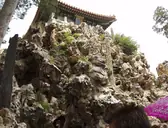 Imperial GardenCypresses and rockeriesIn the guide
- 08
 Gate of Divine MightThe northern exitIn the guide
Site map of the Forbidden City
History of the Forbidden City
The palace was built by the Ming dynasty, which ruled China from 1368 to 1644, and was later occupied by the Qing dynasty, which ruled from 1644 to 1912. The Ming was founded by Zhu Yuanzhang, the Hongwu Emperor, with his capital at Nanjing. His son Zhu Di, the Yongle Emperor, moved the capital to Beijing and built the palace between 1406 and 1420. In 1644 rebels captured Beijing and the last Ming emperor died; the Manchus then entered the city and founded the Qing, keeping the palace as their seat of power and rebuilding many of its halls. UNESCO records that fourteen Ming and ten Qing emperors were enthroned here. The Qing dynasty ended with the abdication of the child emperor Puyi in 1912, though he lived on in the Inner Court until 1924.
The full history continues in the guide.
The Forbidden City guide: questions
How many stops does the Forbidden City guide have?
8 stops, in visit order: 1. Meridian Gate; 2. Gate of Supreme Harmony; 3. Hall of Supreme Harmony; 4. Halls of Harmony; 5. Palace of Heavenly Purity; 6. Palace of Earthly Tranquillity; 7. Imperial Garden; 8. Gate of Divine Might.
Can I do a self-guided tour of the Forbidden City with this guide?
Yes. The guide is made for a self-guided tour: 8 stops in visit order, each with a photo, a story and a voice, so you can explore the Forbidden City at your own pace, without joining a group. Download it before you go and it works offline.
How long is each guide?
The 8 stops add up to about 8 minutes of listening in total. You play each stop when you’re ready, so you can go at your own pace.
Does the guide work offline?
Yes, once it’s downloaded. The guide is a single self-contained web page (about 8.1 MB) with the photos, text and audio built in. Download it to your phone before you go (Wi-Fi is best); after that it opens in any modern browser on iPhone or Android, with no app, account or mobile signal needed.
Does it use GPS or need my location?
No. The guide doesn’t use GPS and doesn’t know where you are: you play each stop when you reach it. It works on iPhone and Android in any modern browser, and it’s in English.
What’s included?
One self-contained HTML guide: 8 stops in visit order, each with a photo, text and a voice, plus the story of who built the site.
Who built the Forbidden City?
The palace was built by the Ming dynasty, which ruled China from 1368 to 1644, and was later occupied by the Qing dynasty, which ruled from 1644 to 1912. The Ming was founded by Zhu Yuanzhang, the Hongwu Emperor, with his capital at Nanjing.
Where is the Forbidden City?
The Forbidden City, at the heart of Beijing, was the imperial palace of China for five centuries, and is today the Palace Museum.
Is there a free audio guide to the Forbidden City?
The first stop, Meridian Gate, is free to read and hear on this page, so you can try the Forbidden City audio tour before you buy. The full guide, with all 8 stops, is a one-off purchase: download it once and it’s yours to keep, working offline.
Is the Forbidden City guide worth it?
If you’d like to know what you’re looking at, yes. For $10 you get 8 stops in visit order, each with a photo, a short history and a voice you play when you’re ready, plus a site map of the stops, and about 8 minutes of listening in all. It’s short on purpose, so you spend your time looking, not listening. It’s yours to keep, works offline and needs no app. The first stop is free on this page, so you can try it before you buy. If you’d like hours of detail, a guided tour will go deeper.
Audio guide or guided tour?
It depends how you like to visit. This guide lets you explore the Forbidden City at your own pace, at any time, for a one-off price. A guided tour gives you a live expert you can ask questions, but at fixed times and usually for a higher price. Many people use both: a tour for the big picture, and the guide to read beforehand or to revisit the stops in their own time.
Is this the official Forbidden City guide?
No. It’s an independent guide by The Historian Guide, not affiliated with or endorsed by the operator of the Forbidden City. For tickets and opening hours, check the official site operator before you go.
Does the guide include entry tickets or opening hours?
No. The guide is a digital companion only. Admission to the Forbidden City is separate, so check the official site operator for current tickets and opening hours before you go.
- Stop 1 · Meridian Gate: Morio · CC BY-SA 4.0 · Wikimedia Commons · resized
- Stop 2 · Gate of Supreme Harmony: 維基小霸王 · CC BY-SA 4.0 · Wikimedia Commons · resized
- Stop 3 · Hall of Supreme Harmony (also the cover): N509FZ · CC BY-SA 4.0 · Wikimedia Commons · resized
- Stop 4 · Halls of Harmony: Jan Bockaert · CC BY-SA 2.0 · Wikimedia Commons · resized
- Stop 5 · Palace of Heavenly Purity: N509FZ · CC BY-SA 4.0 · Wikimedia Commons · resized
- Stop 6 · Palace of Earthly Tranquillity: N509FZ · CC BY-SA 4.0 · Wikimedia Commons · resized
- Stop 7 · Imperial Garden: Dquai · CC BY-SA 4.0 · Wikimedia Commons · resized
- Stop 8 · Gate of Divine Might: Luka Peternel · CC BY-SA 4.0 · Wikimedia Commons · resized


All photographs from Wikimedia Commons under the licences shown.
More guides in China
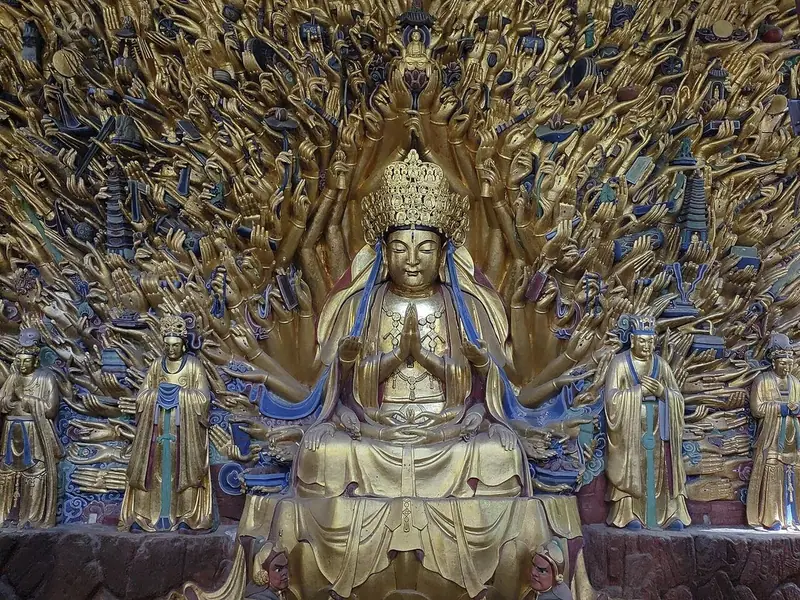 Song9 stops · 892 – c. 1249 CE
Dazu Rock Carvings audio guide
Buddhist cliff carvings of the Tang and Song: the niches of Beishan and the great horseshoe of Baodingshan, with its Wheel of Rebirth, Thousand-Armed Guanyin and Reclining Buddha.
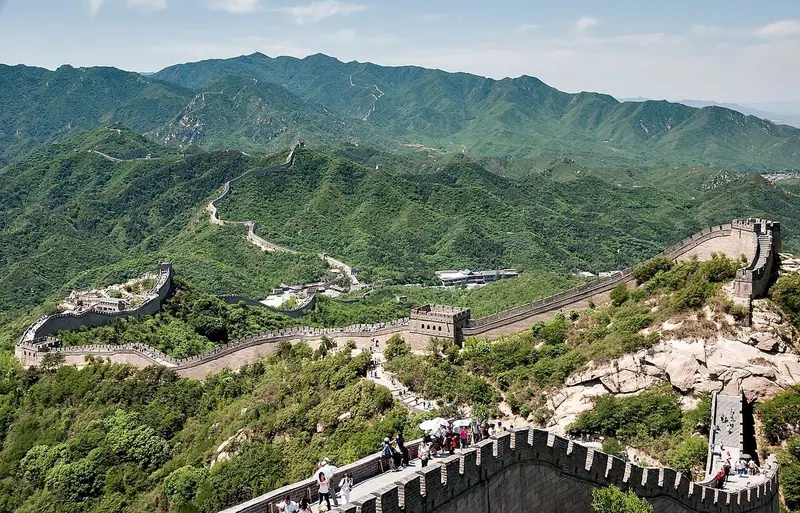 Ming6 stops · 1368–1644 CE
Great Wall at Badaling audio guide
Climb the grey brick battlements and watchtowers of the Great Wall as it rides the mountain crests on either side of the Badaling pass.
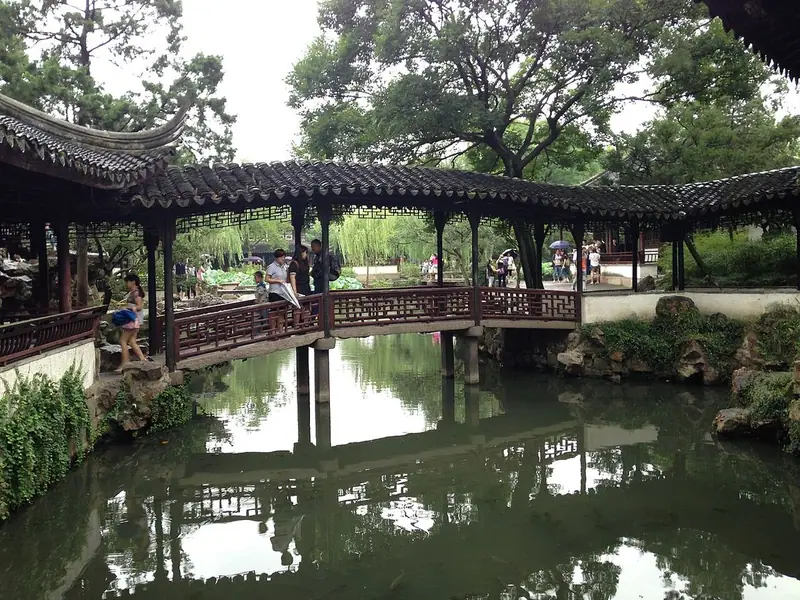 Ming7 stops · from c. 1510 CE
Humble Administrator’s Garden audio guide
Suzhou’s largest classical garden, a landscape in miniature of ponds, islands, bridges and pavilions, each framing a composed view.
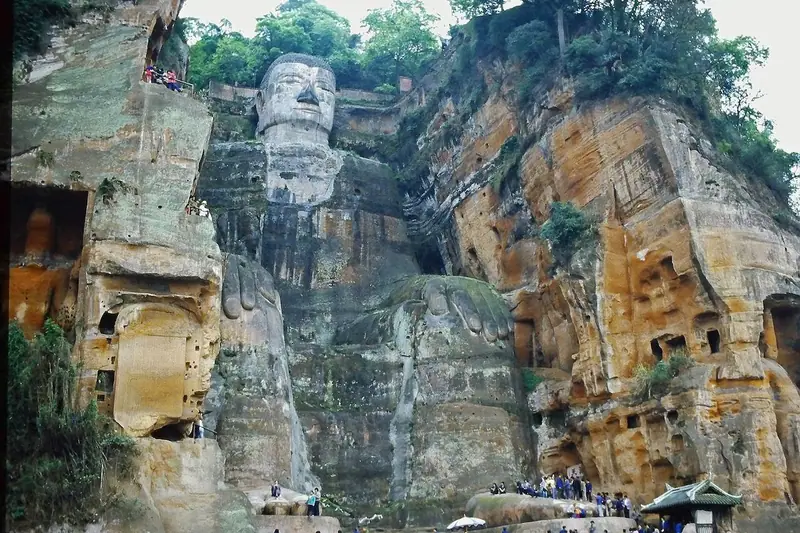 Tang6 stops · early 8th century – 803 CE
Leshan Giant Buddha audio guide
Climb down the Nine-Turn Plank Road beside the 71-metre Giant Buddha, carved into a red sandstone cliff where three rivers meet.
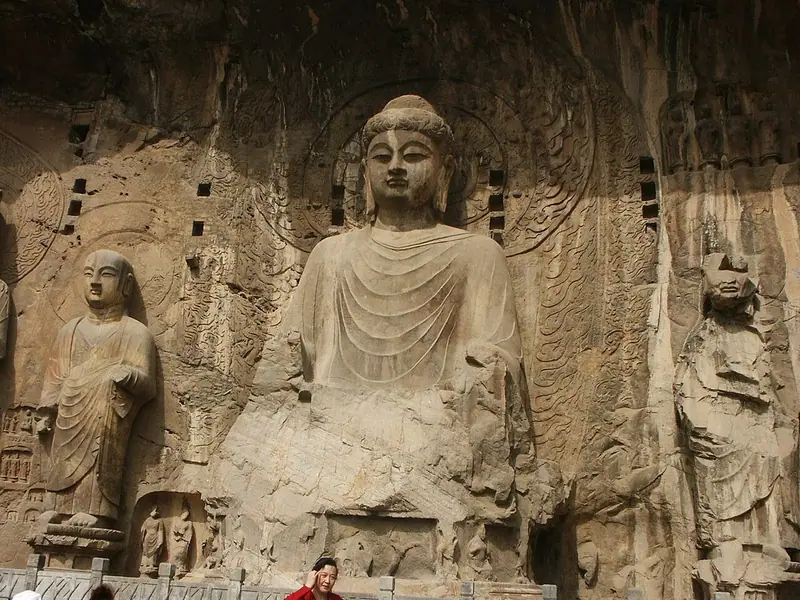 Tang7 stops · 494–907 CE
Longmen Grottoes audio guide
Follow the Yi River past limestone cliffs honeycombed with Buddhist caves and niches to the colossal statues of the Fengxian Temple.
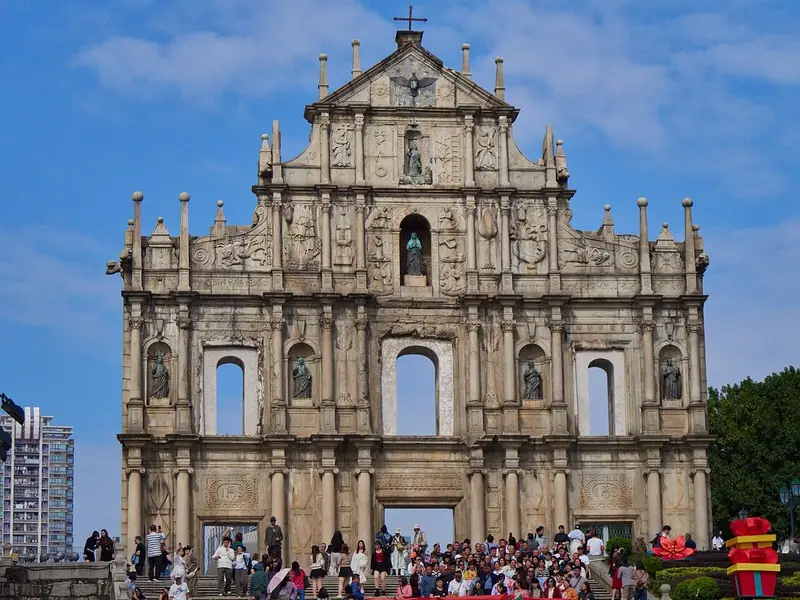 Portuguese9 stops · 1557 – 1999 (Portuguese administration)
Macao audio guide
Chinese temples and Portuguese churches, squares and fortresses side by side in a port under Portuguese administration for more than four centuries.
Every guide, in every country
The Forbidden City and every other guide we publish, including future ones. One payment, no subscription.