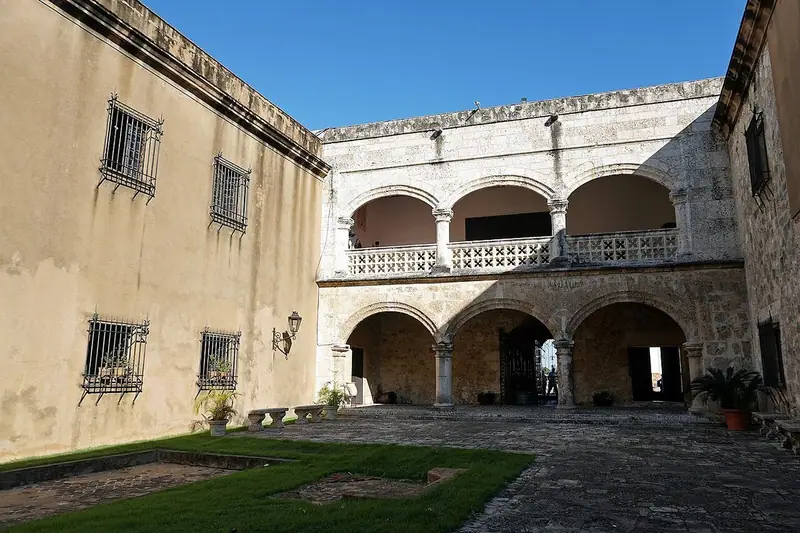
Before you start
The Ciudad Colonial, or Colonial City, is the oldest part of Santo Domingo, capital of the Dominican Republic, on the west bank of the Ozama River where it meets the Caribbean Sea. Founded at the very start of Spanish rule in the Americas, it has many of the oldest surviving European buildings in the New World: the first cathedral, fortress, palaces and monastery. It was inscribed as a UNESCO World Heritage Site in 1990. This guide starts in Parque Colón beside the cathedral, follows the old riverside street of Calle Las Damas past the fortress and the palaces of the governors, and ends at the ruins of the Franciscan monastery. The streets are flat and the route takes around three hours.
Use it as a self-guided tour of Colonial Santo Domingo: 8 stops in visit order, each played when you’re ready, at your own pace.
 Free preview · Stop 1
Parque Colón
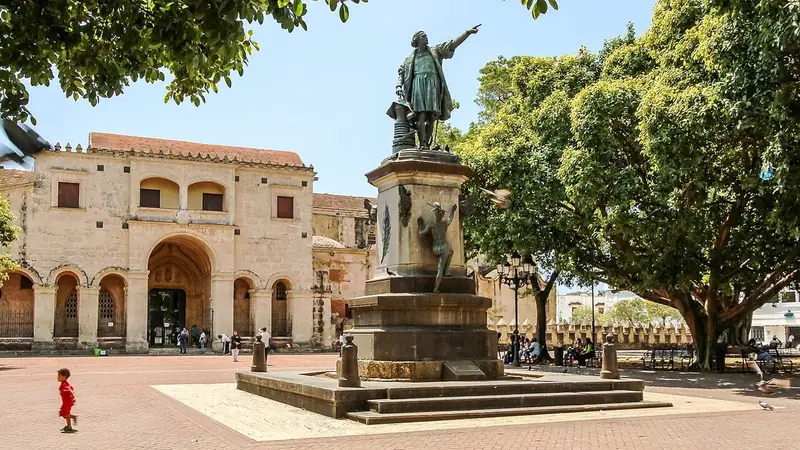
Begin in Parque Colón, the shady square beside the cathedral. In the early sixteenth century this was the Plaza Mayor, the main square of the colonial city, where markets, parades and public ceremonies were held. In its centre stands a bronze statue of Christopher Columbus by a French sculptor, pointing out towards the north, and at its base is the figure of a Taíno woman, often identified as Anacaona, a Taíno leader. The square was renamed Parque Colón, Columbus Park, when the statue was inaugurated in 1887. Look around at the colonial buildings that border it, including the old town hall and the arcaded Palacio de Borgellá, built in the early nineteenth century during the period of Haitian rule. On the west side of the square, the shaded benches are a favourite meeting place, and the square is full of pigeons, street sellers and people watching the world go by.
Photo: Dr. Thomas Liptak · CC BY-SA 4.0 · Wikimedia Commons
What to see at Colonial Santo Domingo: 8 stops, in visit order
- 01
 Parque ColónThe old main squareFree preview
- 02
 The CathedralFirst in the AmericasIn the guide
- 03
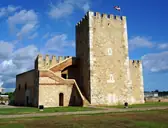 Fortaleza OzamaThe oldest fortressIn the guide
- 04
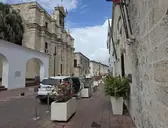 Calle Las DamasStreet of the ladiesIn the guide
- 05
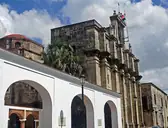 The National PantheonResting place of heroesIn the guide
- 06
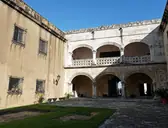 Museo de las Casas RealesSeat of royal powerIn the guide
- 07
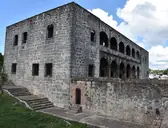 Alcázar de ColónPalace of the viceroyIn the guide
- 08
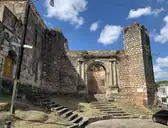 San Francisco MonasteryThe first monasteryIn the guide
Site map of Colonial Santo Domingo
History of Colonial Santo Domingo
The Taíno people lived on the island they called Ayiti or Quisqueya for centuries before Christopher Columbus arrived in 1492. Within a few decades, war, forced labour and disease brought by the Europeans had devastated the Taíno. Santo Domingo was founded in the 1490s by Bartholomew Columbus on the east bank of the Ozama, and after a hurricane in 1502 it was rebuilt on the west bank under Governor Nicolás de Ovando. For a time it was the base from which Spain explored and conquered other Caribbean islands and much of the mainland. Spanish rule over the colony lasted, with interruptions, from 1492 until the early nineteenth century; it was followed by French and Haitian rule, and the Dominican Republic declared its independence in 1844.
Colonial Santo Domingo guide: questions
How many stops does the Colonial Santo Domingo guide have?
8 stops, in visit order: 1. Parque Colón; 2. The Cathedral; 3. Fortaleza Ozama; 4. Calle Las Damas; 5. The National Pantheon; 6. Museo de las Casas Reales; 7. Alcázar de Colón; 8. San Francisco Monastery.
Can I do a self-guided tour of Colonial Santo Domingo with this guide?
Yes. The guide is made for a self-guided tour: 8 stops in visit order, each with a photo, a story and a voice, so you can explore Colonial Santo Domingo at your own pace, without joining a group. Download it before you go and it works offline.
How long is each guide?
The 8 stops add up to about 6 minutes of listening in total. You play each stop when you’re ready, so you can go at your own pace.
Does the guide work offline?
Yes, once it’s downloaded. The guide is a single self-contained web page (about 8.0 MB) with the photos, text and audio built in. Download it to your phone before you go (Wi-Fi is best); after that it opens in any modern browser on iPhone or Android, with no app, account or mobile signal needed.
Does it use GPS or need my location?
No. The guide doesn’t use GPS and doesn’t know where you are: you play each stop when you reach it. It works on iPhone and Android in any modern browser, and it’s in English.
What’s included?
One self-contained HTML guide: 8 stops in visit order, each with a photo, text and a voice, plus the story of who built the site.
Who built Colonial Santo Domingo?
The Taíno people lived on the island they called Ayiti or Quisqueya for centuries before Christopher Columbus arrived in 1492. Within a few decades, war, forced labour and disease brought by the Europeans had devastated the Taíno.
Where is Colonial Santo Domingo?
The Ciudad Colonial, or Colonial City, is the oldest part of Santo Domingo, capital of the Dominican Republic, on the west bank of the Ozama River where it meets the Caribbean Sea.
Is there a free audio guide to Colonial Santo Domingo?
The first stop, Parque Colón, is free to read and hear on this page, so you can try the Colonial Santo Domingo audio tour before you buy. The full guide, with all 8 stops, is a one-off purchase: download it once and it’s yours to keep, working offline.
Is the Colonial Santo Domingo guide worth it?
If you’d like to know what you’re looking at, yes. For $10 you get 8 stops in visit order, each with a photo, a short history and a voice you play when you’re ready, plus a site map of the stops, and about 6 minutes of listening in all. It’s short on purpose, so you spend your time looking, not listening. It’s yours to keep, works offline and needs no app. The first stop is free on this page, so you can try it before you buy. If you’d like hours of detail, a guided tour will go deeper.
Audio guide or guided tour?
It depends how you like to visit. This guide lets you explore Colonial Santo Domingo at your own pace, at any time, for a one-off price. A guided tour gives you a live expert you can ask questions, but at fixed times and usually for a higher price. Many people use both: a tour for the big picture, and the guide to read beforehand or to revisit the stops in their own time.
Is this the official Colonial Santo Domingo guide?
No. It’s an independent guide by The Historian Guide, not affiliated with or endorsed by the operator of Colonial Santo Domingo. For tickets and opening hours, check the official site operator before you go.
Does the guide include entry tickets or opening hours?
No. The guide is a digital companion only. Admission to Colonial Santo Domingo is separate, so check the official site operator for current tickets and opening hours before you go.
- Stop 1 · Parque Colón: Dr. Thomas Liptak · CC BY-SA 4.0 · Wikimedia Commons · resized
- Stop 2 · The Cathedral: Martin Falbisoner · CC BY-SA 4.0 · Wikimedia Commons · resized
- Stop 3 · Fortaleza Ozama: Mariordo (Mario Roberto Durán Ortiz) · CC BY-SA 4.0 · Wikimedia Commons · resized
- Stop 4 · Calle Las Damas: Desox7x · CC0 · Wikimedia Commons · resized
- Stop 5 · The National Pantheon: Mariordo (Mario Roberto Durán Ortiz) · CC BY-SA 4.0 · Wikimedia Commons · resized
- Stop 6 · Museo de las Casas Reales (also the cover): Mariordo (Mario Roberto Durán Ortiz) · CC BY-SA 4.0 · Wikimedia Commons · resized
- Stop 7 · Alcázar de Colón: Phyrexian · CC BY-SA 4.0 · Wikimedia Commons · resized
- Stop 8 · San Francisco Monastery: Mariordo (Mario Roberto Durán Ortiz) · CC BY-SA 4.0 · Wikimedia Commons · resized


All photographs from Wikimedia Commons under the licences shown.
More guides in Dominican Republic
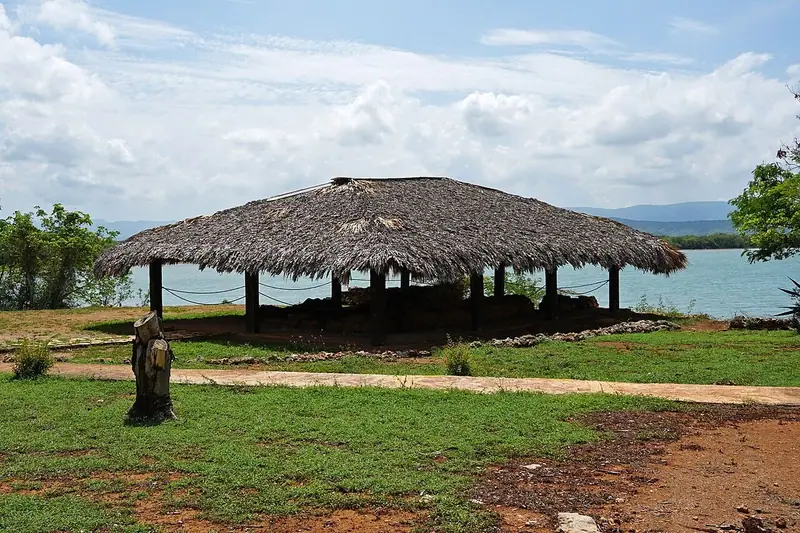 Spanish and Taíno8 stops · 1493–1500
La Isabela audio guide
The stone foundations of Columbus’s La Isabela on a bluff above the bay, from the admiral’s house to the church and cemetery.
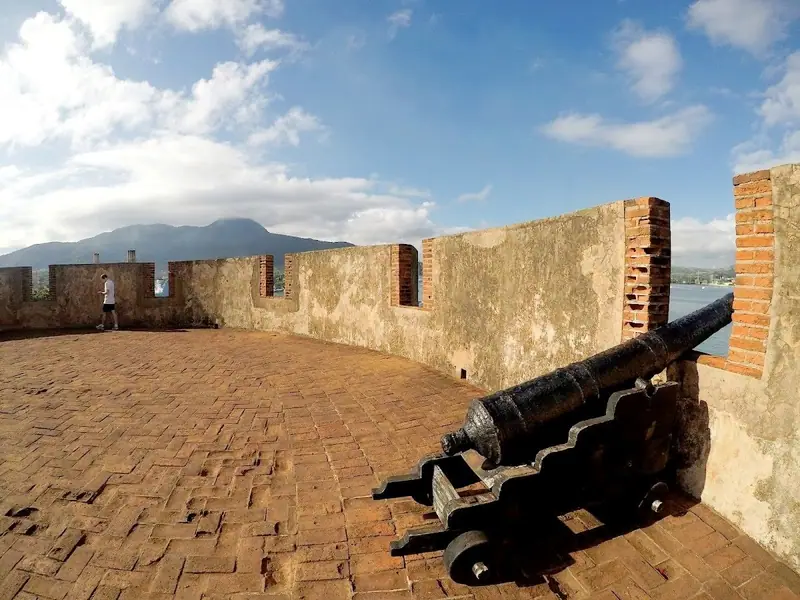 Spanish Colonial7 stops · 1577 (fort); 1865 onwards (Victorian town)
Puerto Plata audio guide
From the central park among Victorian gingerbread houses to the cathedral, the amber museum and the Fortaleza San Felipe on the Malecón.
 Spanish Colonial7 stops · 1718–1782
Alamo and San Antonio Missions audio guide
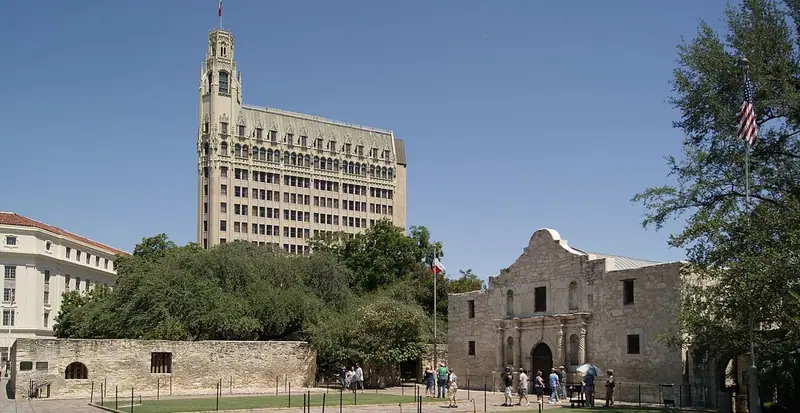
From the battle-scarred Alamo to Mission San José and the Espada Aqueduct, the five missions that made San Antonio.
Every guide, in every country
Colonial Santo Domingo and every other guide we publish, including future ones. One payment, no subscription.