Before you start
The Louvre is the most visited museum in the world. It fills a royal palace that grew over eight hundred years, from a medieval fortress to the vast building you see today. Walking every gallery would take days. This guide picks out the essentials: the glass pyramid, the walls of the medieval castle, the Great Sphinx, the Venus de Milo, the Winged Victory, the crown jewels, the Mona Lisa and the great French paintings. Allow three hours. Galleries close in rotation, so pick up a museum plan at the entrance.
Use it as a self-guided tour of the Louvre: 8 stops in visit order, each played when you’re ready, at your own pace.
 Free preview · Stop 1
The Pyramid
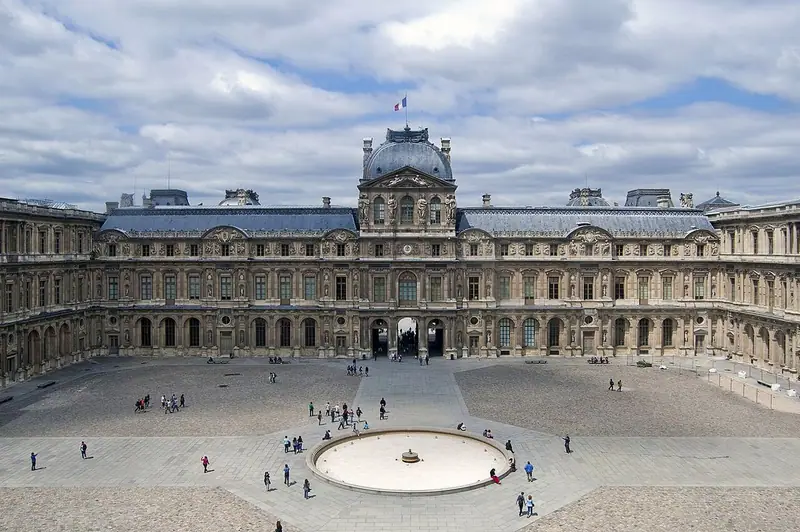
Begin in the Cour Napoléon, the great courtyard, beside the glass pyramid. It was designed by the Chinese-American architect I. M. Pei as part of the Grand Louvre project launched by President François Mitterrand. It opened in 1989. The pyramid is about twenty-one metres tall, made of 673 panes of glass on a frame of steel and cable. Its slope is close to that of the ancient pyramids of Egypt. Many Parisians hated it at first. Critics called it a modern intrusion into a classical palace, and a symbol of death in the heart of the city. Today it is one of the best-loved buildings in Paris. Its purpose was practical: to bring daylight into a large hall underground, and to lead visitors into the three wings around you. The wings on either side were completed under Napoleon the Third in the 1850s and 1860s.
Photo: King of Hearts · CC BY-SA 3.0 · Wikimedia Commons · The Cour Carrée, beside the pyramid courtyard
What to see at the Louvre: 8 stops, in visit order
- 01
 The PyramidGlass in a royal courtyardFree preview
- 02
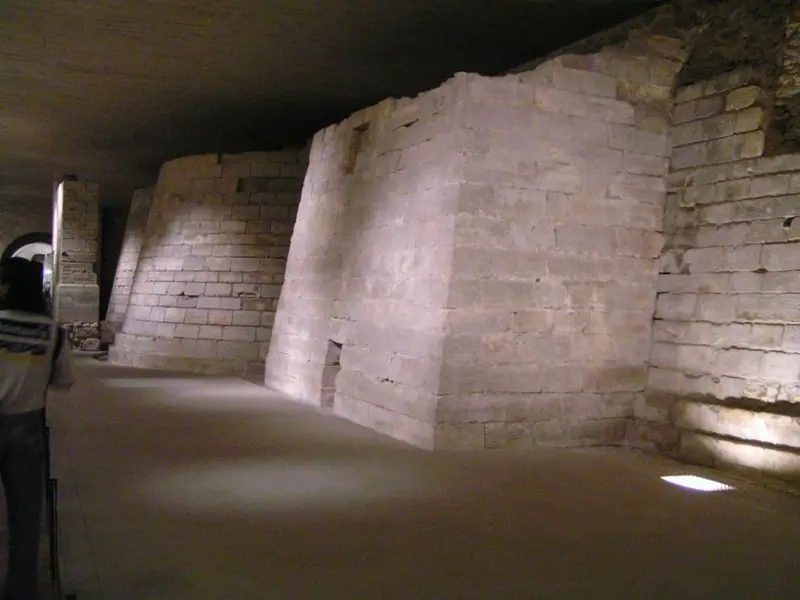
 The Medieval LouvreA castle beneath the museumIn the guide
- 03
 The Great Sphinx of TanisA guardian of pink graniteIn the guide
- 04
 The Venus de MiloA goddess without armsIn the guide
- 05
 The Winged VictoryA goddess on the prow of a shipIn the guide
- 06
 The Galerie d’ApollonThe crown jewels of FranceIn the guide
- 07
 The Mona LisaThe world’s most famous portraitIn the guide
- 08
 The Great French PaintingsShipwreck and revolutionIn the guide
History of the Louvre
Around 1190 King Philip Augustus built a fortress here, guarding the western edge of Paris while he was away on crusade. In the fourteenth century Charles the Fifth turned it into a royal residence. From 1546 Francis the First began to rebuild it as a Renaissance palace, and later kings extended it again and again. In 1682 Louis the Fourteenth moved his court to Versailles, and the Louvre was left to artists and the royal collections. During the Revolution, on the tenth of August 1793, it opened as a public museum. Napoleon filled it with treasures, many of them seized in war.
The full history continues in the guide.
The Louvre guide: questions
How many stops does the Louvre guide have?
8 stops, in visit order: 1. The Pyramid; 2. The Medieval Louvre; 3. The Great Sphinx of Tanis; 4. The Venus de Milo; 5. The Winged Victory; 6. The Galerie d’Apollon; 7. The Mona Lisa; 8. The Great French Paintings.
Can I do a self-guided tour of the Louvre with this guide?
Yes. The guide is made for a self-guided tour: 8 stops in visit order, each with a photo, a story and a voice, so you can explore the Louvre at your own pace, without joining a group. Download it before you go and it works offline.
How long is each guide?
The 8 stops add up to about 6 minutes of listening in total. You play each stop when you’re ready, so you can go at your own pace.
Does the guide work offline?
Yes, once it’s downloaded. The guide is a single self-contained web page (about 6.9 MB) with the photos, text and audio built in. Download it to your phone before you go (Wi-Fi is best); after that it opens in any modern browser on iPhone or Android, with no app, account or mobile signal needed.
Does it use GPS or need my location?
No. The guide doesn’t use GPS and doesn’t know where you are: you play each stop when you reach it. It works on iPhone and Android in any modern browser, and it’s in English.
What’s included?
One self-contained HTML guide: 8 stops in visit order, each with a photo, text and a voice, plus the story of who built the site.
Who built the Louvre?
Around 1190 King Philip Augustus built a fortress here, guarding the western edge of Paris while he was away on crusade. In the fourteenth century Charles the Fifth turned it into a royal residence.
Is there a free audio guide to the Louvre?
The first stop, The Pyramid, is free to read and hear on this page, so you can try the Louvre audio tour before you buy. The full guide, with all 8 stops, is a one-off purchase: download it once and it’s yours to keep, working offline.
Is the Louvre guide worth it?
If you’d like to know what you’re looking at, yes. For $10 you get 8 stops in visit order, each with a photo, a short history and a voice you play when you’re ready, about 6 minutes of listening in all. It’s short on purpose, so you spend your time looking, not listening. It’s yours to keep, works offline and needs no app. The first stop is free on this page, so you can try it before you buy. If you’d like hours of detail, a guided tour will go deeper.
Audio guide or guided tour?
It depends how you like to visit. This guide lets you explore the Louvre at your own pace, at any time, for a one-off price. A guided tour gives you a live expert you can ask questions, but at fixed times and usually for a higher price. Many people use both: a tour for the big picture, and the guide to read beforehand or to revisit the stops in their own time.
Is this the official Louvre guide?
No. It’s an independent guide by The Historian Guide, not affiliated with or endorsed by the operator of the Louvre. For tickets and opening hours, check the official site operator before you go.
Does the guide include entry tickets or opening hours?
No. The guide is a digital companion only. Admission to the Louvre is separate, so check the official site operator for current tickets and opening hours before you go.
- Stop 1 · The Pyramid: King of Hearts · CC BY-SA 3.0 · Wikimedia Commons · resized
- Stop 2 · The Medieval Louvre (also the cover): ceronne from Mexico · CC BY 2.0 · Wikimedia Commons · resized
- Stop 3 · The Great Sphinx of Tanis: Wilfredor · CC0 · Wikimedia Commons · resized
- Stop 4 · The Venus de Milo: Bradley Weber · CC BY 2.0 · Wikimedia Commons · resized
- Stop 5 · The Winged Victory: Wilfredor · CC0 · Wikimedia Commons · resized
- Stop 6 · The Galerie d’Apollon: Wilfredor · CC0 · Wikimedia Commons · resized
- Stop 7 · The Mona Lisa: Stefan Wloch · CC BY-SA 2.0 · Wikimedia Commons · resized
- Stop 8 · The Great French Paintings: jean-louis zimmermann · CC BY 2.0 · Wikimedia Commons · resized


All photographs from Wikimedia Commons under the licences shown.
More guides in France
 Napoleonic France8 stops · Napoleonic era
Arc de Triomphe audio guide
Cross beneath the traffic to Napoleon’s arch, read its carved victories and the names of its generals, then climb to the rooftop terrace.
 Neolithic10 stops · c. 5000 – 2300 BCE (megalith building)
Carnac Megaliths audio guide
Thousands of standing stones in rows, giant mounds and decorated tombs: the alignments of Carnac, the broken menhir of Locmariaquer and the carved cairn of Gavrinis.
 Gothic8 stops · 12th–13th century CE
Chartres Cathedral audio guide
Step through the Royal Portal into a Gothic cathedral rebuilt after the fire of 1194, with its labyrinth and the deep Chartres blue of its glass.
 Renaissance8 stops · from 1519 CE
Château de Chambord audio guide
Climb the double-helix staircase of François I’s great hunting château to roof terraces crowded with chimneys and turrets, above a vast walled forest park.
 Renaissance8 stops · 1513–1521 CE
Château de Chenonceau audio guide
Cross the River Cher on the long gallery of the château built under Katherine Briçonnet’s eye and later home to Diane de Poitiers.
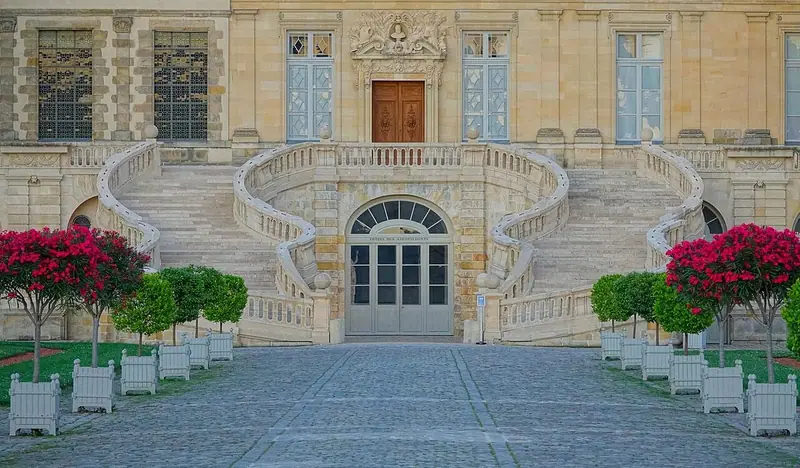 Renaissance8 stops · from 1528 CE
Château de Fontainebleau audio guide
From the Courtyard of Farewells through François I’s Renaissance gallery to the throne room and Napoleon’s apartments.
Every guide, in every country
The Louvre and every other guide we publish, including future ones. One payment, no subscription.