Before you start
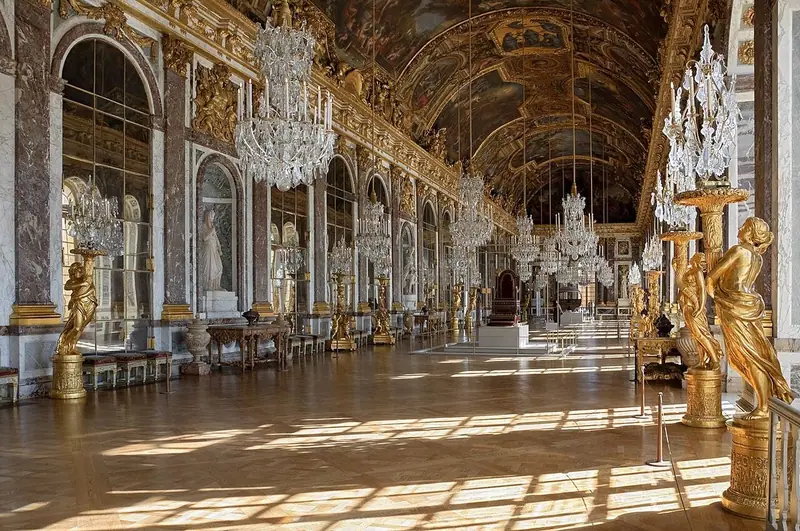
The Palace of Versailles lies in the town of Versailles, about twenty kilometres south-west of central Paris, reached by RER line C to Versailles Château Rive Gauche or by trains from Paris Saint-Lazare and Montparnasse. The estate is vast: the palace itself, around eight hundred hectares of gardens and park, and the Trianon estate. It has been a UNESCO World Heritage Site since 1979 and is run by a French public body, the Établissement public du château, du musée et du domaine national de Versailles. This guide follows the main route through the palace: the Royal Gate and Marble Court, the Royal Chapel, the King’s State Apartments, the Hall of Mirrors, and the bedchambers of the king and queen. It then heads out into the gardens and finishes at the Trianon estate and the Queen’s Hamlet. Expect crowds inside, and plan a full day.
Use it as a self-guided tour of Versailles: 8 stops in visit order, each played when you’re ready, at your own pace.
 Free preview · Stop 1
The Royal Gate and Marble Court
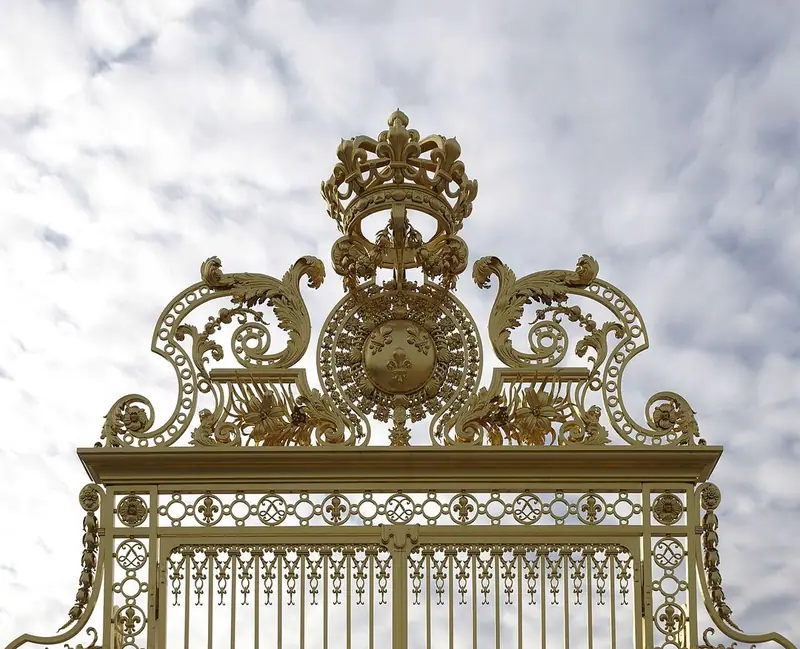
Begin in the great Place d’Armes and walk towards the palace through the gilded Royal Gate. The original gate was destroyed after the Revolution, and the one you see today is a reconstruction completed in 2008, covered in thousands of gold leaves. Beyond it, the courtyards narrow step by step towards the oldest part of the palace, the Marble Court, paved in black and white marble. The brick and stone buildings around it are the core of Louis XIII’s château, which his son chose to keep and wrap within his great new palace rather than demolish. Look up at the central first-floor windows overlooking the court: behind them is the King’s Bedchamber, at the symbolic heart of Versailles. Everything here was designed to impress visitors with the power of the king, from the scale of the courtyards to the gilding on the roofs.
Photo: Jebulon · CC0 · Wikimedia Commons
What to see at Versailles: 8 stops, in visit order
- 01
 The Royal Gate and Marble CourtThe approach to the palaceFree preview
- 02
 The Royal ChapelDedicated to Saint LouisIn the guide
- 03
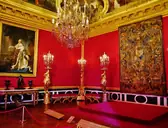 The King’s State ApartmentsRooms named after the planetsIn the guide
- 04
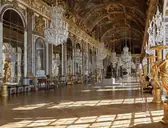 The Hall of MirrorsThe palace’s great galleryIn the guide
- 05
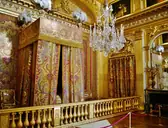 The King’s BedchamberThe centre of court ritualIn the guide
- 06
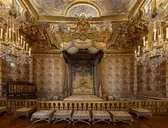 The Queen’s BedchamberMarie-Antoinette’s roomIn the guide
- 07
 The GardensThe vision of André Le NôtreIn the guide
- 08
 The Trianon EstateRetreats of kings and a queenIn the guide
Site map of Versailles
History of Versailles
Versailles was built for the Bourbon kings of France, the dynasty that ruled from 1589, when Henry IV came to the throne, until the monarchy fell during the Revolution in 1792. The Bourbons returned briefly between 1814 and 1830. Louis XIII built a small hunting lodge here in 1623 and replaced it with a modest château a few years later. His son Louis XIV transformed it from the 1660s, employing the architect Louis Le Vau, the painter Charles Le Brun and the garden designer André Le Nôtre, and later Jules Hardouin-Mansart, who built the Hall of Mirrors and the Royal Chapel. In 1682 Louis moved the court and government here, and Versailles became the seat of royal power until 1789, when a crowd from Paris forced Louis XVI and his family to leave. In the 1830s King Louis-Philippe turned it into a museum dedicated to the history of France.
Versailles guide: questions
How many stops does the Versailles guide have?
8 stops, in visit order: 1. The Royal Gate and Marble Court; 2. The Royal Chapel; 3. The King’s State Apartments; 4. The Hall of Mirrors; 5. The King’s Bedchamber; 6. The Queen’s Bedchamber; 7. The Gardens; 8. The Trianon Estate.
Can I do a self-guided tour of Versailles with this guide?
Yes. The guide is made for a self-guided tour: 8 stops in visit order, each with a photo, a story and a voice, so you can explore Versailles at your own pace, without joining a group. Download it before you go and it works offline.
How long is each guide?
The 8 stops add up to about 6 minutes of listening in total. You play each stop when you’re ready, so you can go at your own pace.
Does the guide work offline?
Yes, once it’s downloaded. The guide is a single self-contained web page (about 8.0 MB) with the photos, text and audio built in. Download it to your phone before you go (Wi-Fi is best); after that it opens in any modern browser on iPhone or Android, with no app, account or mobile signal needed.
Does it use GPS or need my location?
No. The guide doesn’t use GPS and doesn’t know where you are: you play each stop when you reach it. It works on iPhone and Android in any modern browser, and it’s in English.
What’s included?
One self-contained HTML guide: 8 stops in visit order, each with a photo, text and a voice, plus the story of who built the site.
Who built Versailles?
Versailles was built for the Bourbon kings of France, the dynasty that ruled from 1589, when Henry IV came to the throne, until the monarchy fell during the Revolution in 1792. The Bourbons returned briefly between 1814 and 1830.
Is there a free audio guide to Versailles?
The first stop, The Royal Gate and Marble Court, is free to read and hear on this page, so you can try the Versailles audio tour before you buy. The full guide, with all 8 stops, is a one-off purchase: download it once and it’s yours to keep, working offline.
Is the Versailles guide worth it?
If you’d like to know what you’re looking at, yes. For $10 you get 8 stops in visit order, each with a photo, a short history and a voice you play when you’re ready, plus a site map of the stops, and about 6 minutes of listening in all. It’s short on purpose, so you spend your time looking, not listening. It’s yours to keep, works offline and needs no app. The first stop is free on this page, so you can try it before you buy. If you’d like hours of detail, a guided tour will go deeper.
Audio guide or guided tour?
It depends how you like to visit. This guide lets you explore Versailles at your own pace, at any time, for a one-off price. A guided tour gives you a live expert you can ask questions, but at fixed times and usually for a higher price. Many people use both: a tour for the big picture, and the guide to read beforehand or to revisit the stops in their own time.
Is this the official Versailles guide?
No. It’s an independent guide by The Historian Guide, not affiliated with or endorsed by the operator of Versailles. For tickets and opening hours, check the official site operator before you go.
Does the guide include entry tickets or opening hours?
No. The guide is a digital companion only. Admission to Versailles is separate, so check the official site operator for current tickets and opening hours before you go.
- Stop 1 · The Royal Gate and Marble Court: Jebulon · CC0 · Wikimedia Commons · resized
- Stop 2 · The Royal Chapel: Julian Lupyan · Public domain · Wikimedia Commons · resized
- Stop 3 · The King’s State Apartments: Zairon · CC BY-SA 4.0 · Wikimedia Commons · resized
- Stop 4 · The Hall of Mirrors (also the cover): Photo: Myrabella / Wikimedia Commons · CC BY-SA 3.0 · Wikimedia Commons · resized
- Stop 5 · The King’s Bedchamber: Zairon · CC BY-SA 4.0 · Wikimedia Commons · resized
- Stop 6 · The Queen’s Bedchamber: Basile Morin · CC BY-SA 4.0 · Wikimedia Commons · resized
- Stop 7 · The Gardens: Basile Morin · CC BY-SA 4.0 · Wikimedia Commons · resized
- Stop 8 · The Trianon Estate: Ji-Elle · CC BY-SA 4.0 · Wikimedia Commons · resized


All photographs from Wikimedia Commons under the licences shown.
More guides in France
 Napoleonic France8 stops · Napoleonic era
Arc de Triomphe audio guide
Cross beneath the traffic to Napoleon’s arch, read its carved victories and the names of its generals, then climb to the rooftop terrace.
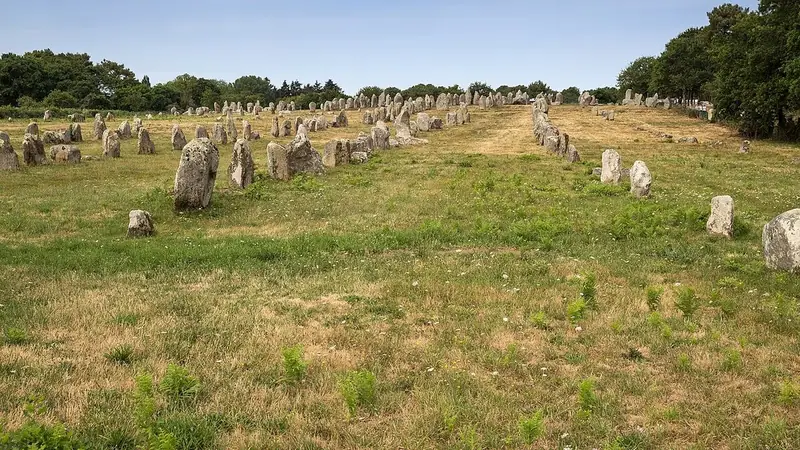 Neolithic10 stops · c. 5000 – 2300 BCE (megalith building)
Carnac Megaliths audio guide
Thousands of standing stones in rows, giant mounds and decorated tombs: the alignments of Carnac, the broken menhir of Locmariaquer and the carved cairn of Gavrinis.
 Gothic8 stops · 12th–13th century CE
Chartres Cathedral audio guide
Step through the Royal Portal into a Gothic cathedral rebuilt after the fire of 1194, with its labyrinth and the deep Chartres blue of its glass.
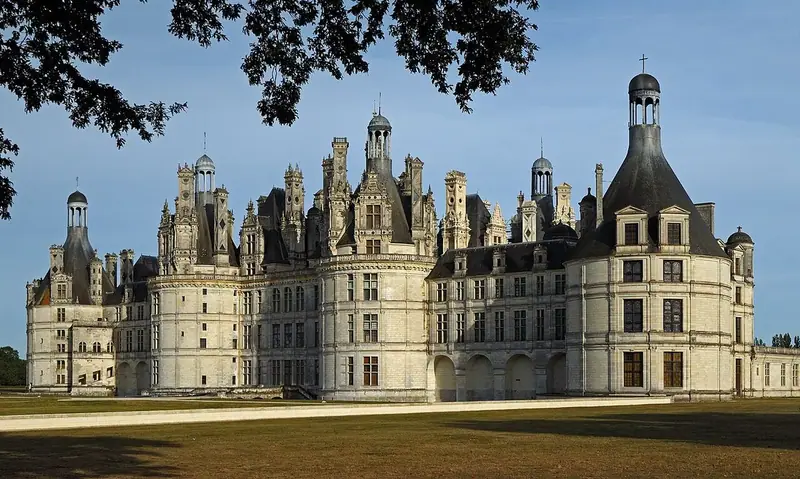 Renaissance8 stops · from 1519 CE
Château de Chambord audio guide
Climb the double-helix staircase of François I’s great hunting château to roof terraces crowded with chimneys and turrets, above a vast walled forest park.
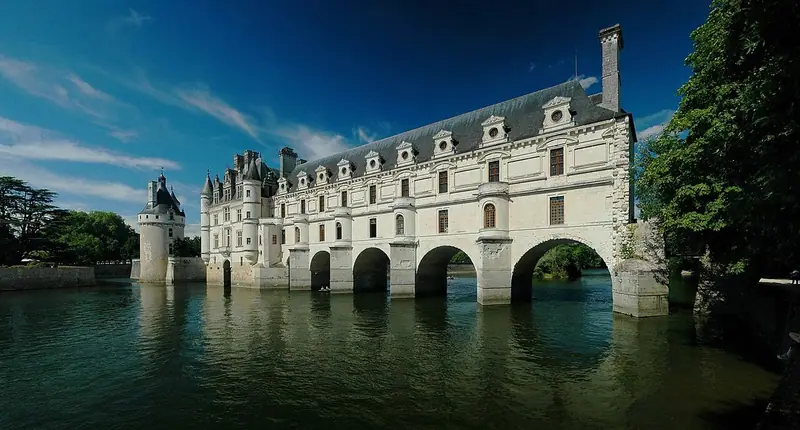 Renaissance8 stops · 1513–1521 CE
Château de Chenonceau audio guide
Cross the River Cher on the long gallery of the château built under Katherine Briçonnet’s eye and later home to Diane de Poitiers.
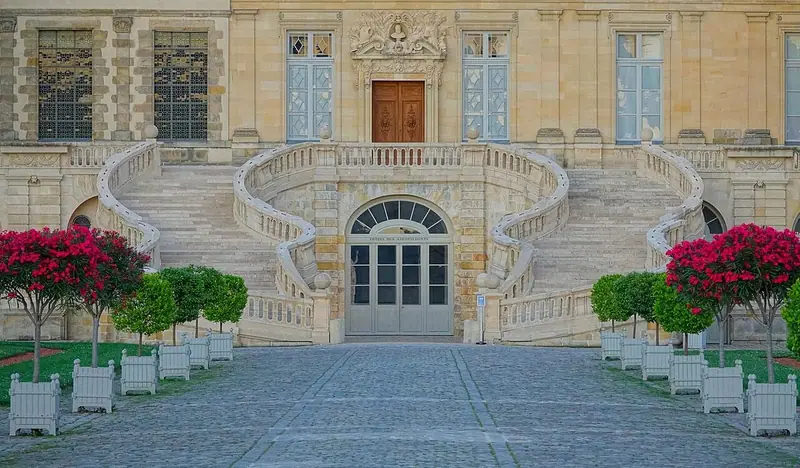 Renaissance8 stops · from 1528 CE
Château de Fontainebleau audio guide
From the Courtyard of Farewells through François I’s Renaissance gallery to the throne room and Napoleon’s apartments.
Every guide, in every country
Versailles and every other guide we publish, including future ones. One payment, no subscription.