Before you start
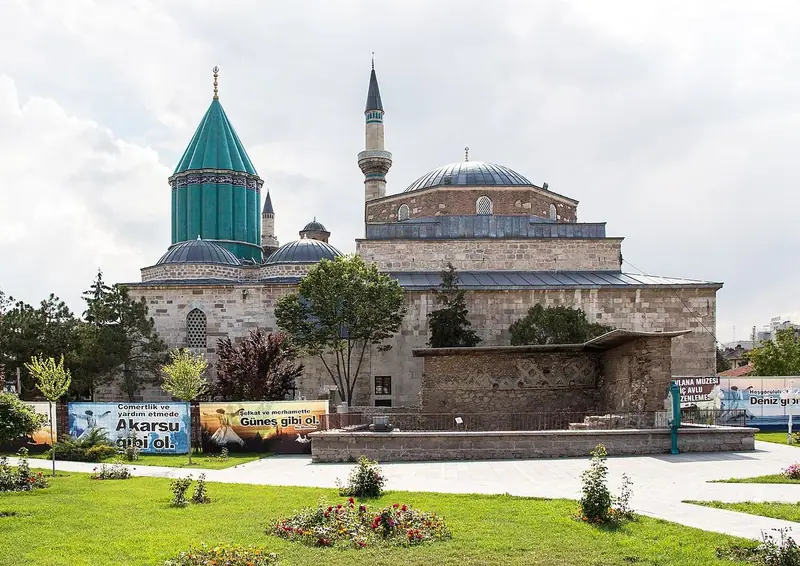
Beneath a turquoise dome in the heart of Konya lies Rumi, the thirteenth-century poet and mystic whose followers became known as the whirling dervishes. His tomb and the dervish lodge that grew around it are now the Mevlâna Museum, one of the most visited museums in Turkey and still a place of pilgrimage. The route takes you through the courtyard, the dervishes' cells and kitchen, the tomb, the ritual hall and the small mosque, and ends at the Selimiye Mosque next door. Allow about two hours.
Use it as a self-guided tour of the Mevlâna Museum: 8 stops in visit order, each played when you’re ready, at your own pace.
 Free preview · Stop 1
The Courtyard
Enter through the main gate, called the Dervishes' Gate, into the courtyard paved with marble. In the middle stands the fountain for ritual washing, built in the time of the Ottoman sultan Selim the First, in the early sixteenth century. Look up at the turquoise dome rising above the tomb at the far end. It has become the symbol of Konya. This was once a busy dervish lodge. Men came here to live, study and serve for years, learning the Mevlevi way of prayer, music and poetry. Many visitors here are pilgrims, not tourists, and some have travelled a very long way, so move quietly and respectfully. Before you go inside, take a moment in the shade, then turn to look at the low buildings that line the courtyard on either side.
Photo: Dosseman · CC BY-SA 4.0 · Wikimedia Commons
What to see at the Mevlâna Museum: 8 stops, in visit order
- 01
 The CourtyardThrough the Dervishes' GateFree preview
- 02
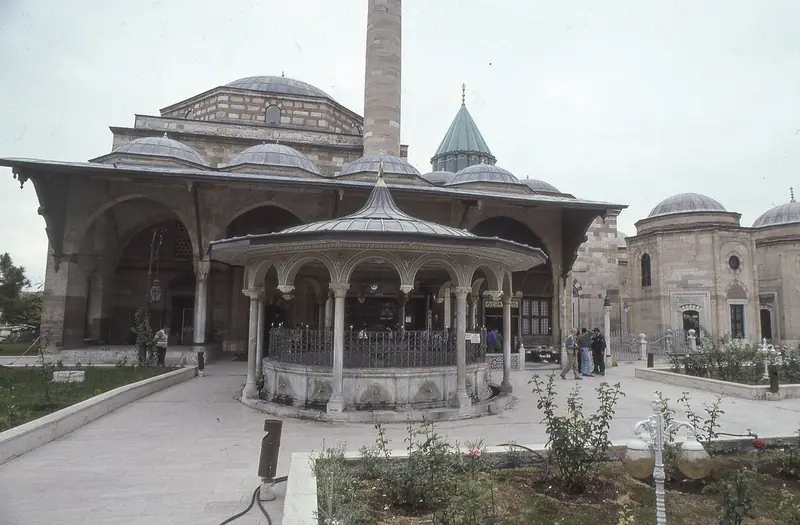
 The Dervish Cells and KitchenA long apprenticeshipIn the guide
- 03
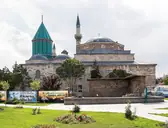 The Green DomeA tomb in a rose gardenIn the guide
- 04
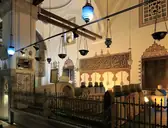 The Recitation RoomWords on the wallsIn the guide
- 05
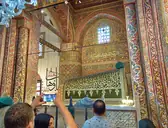 The Tomb of MevlânaThe poet and his familyIn the guide
- 06
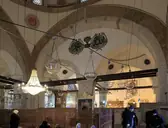 The Ritual HallMusic for whirlingIn the guide
- 07
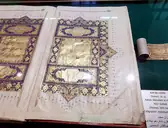 The Small MosqueTreasures of faithIn the guide
- 08
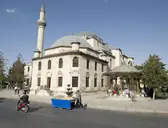 The Selimiye MosqueAn Ottoman neighbourIn the guide
History of the Mevlâna Museum
Rumi was born in 1207 in Central Asia, and his family settled in Konya, then capital of the Seljuk Sultanate of Rum, in 1228. The Seljuk sultan gave his rose garden as a burial place for Rumi’s father. When Rumi died in 1273 he was buried beside him, and in 1274 a domed tomb was built over their graves. His son, Sultan Veled, and his followers founded the Mevlevi order, and under the Ottoman sultans the lodge grew, with new buildings added until 1854. In 1925 the Turkish Republic closed the Sufi lodges, and in 1927 the tomb and lodge opened as a museum.
The Mevlâna Museum guide: questions
How many stops does the Mevlâna Museum guide have?
8 stops, in visit order: 1. The Courtyard; 2. The Dervish Cells and Kitchen; 3. The Green Dome; 4. The Recitation Room; 5. The Tomb of Mevlâna; 6. The Ritual Hall; 7. The Small Mosque; 8. The Selimiye Mosque.
Can I do a self-guided tour of the Mevlâna Museum with this guide?
Yes. The guide is made for a self-guided tour: 8 stops in visit order, each with a photo, a story and a voice, so you can explore the Mevlâna Museum at your own pace, without joining a group. Download it before you go and it works offline.
How long is each guide?
The 8 stops add up to about 5 minutes of listening in total. You play each stop when you’re ready, so you can go at your own pace.
Does the guide work offline?
Yes, once it’s downloaded. The guide is a single self-contained web page (about 6.9 MB) with the photos, text and audio built in. Download it to your phone before you go (Wi-Fi is best); after that it opens in any modern browser on iPhone or Android, with no app, account or mobile signal needed.
Does it use GPS or need my location?
No. The guide doesn’t use GPS and doesn’t know where you are: you play each stop when you reach it. It works on iPhone and Android in any modern browser, and it’s in English.
What’s included?
One self-contained HTML guide: 8 stops in visit order, each with a photo, text and a voice, plus the story of who built the site.
Who built the Mevlâna Museum?
Rumi was born in 1207 in Central Asia, and his family settled in Konya, then capital of the Seljuk Sultanate of Rum, in 1228. The Seljuk sultan gave his rose garden as a burial place for Rumi’s father.
Where is the Mevlâna Museum?
Beneath a turquoise dome in the heart of Konya lies Rumi, the thirteenth-century poet and mystic whose followers became known as the whirling dervishes.
Is there a free audio guide to the Mevlâna Museum?
The first stop, The Courtyard, is free to read and hear on this page, so you can try the Mevlâna Museum audio tour before you buy. The full guide, with all 8 stops, is a one-off purchase: download it once and it’s yours to keep, working offline.
Is the Mevlâna Museum guide worth it?
If you’d like to know what you’re looking at, yes. For $10 you get 8 stops in visit order, each with a photo, a short history and a voice you play when you’re ready, about 5 minutes of listening in all. It’s short on purpose, so you spend your time looking, not listening. It’s yours to keep, works offline and needs no app. The first stop is free on this page, so you can try it before you buy. If you’d like hours of detail, a guided tour will go deeper.
Audio guide or guided tour?
It depends how you like to visit. This guide lets you explore the Mevlâna Museum at your own pace, at any time, for a one-off price. A guided tour gives you a live expert you can ask questions, but at fixed times and usually for a higher price. Many people use both: a tour for the big picture, and the guide to read beforehand or to revisit the stops in their own time.
Is this the official Mevlâna Museum guide?
No. It’s an independent guide by The Historian Guide, not affiliated with or endorsed by the operator of the Mevlâna Museum. For tickets and opening hours, check the official site operator before you go.
Does the guide include entry tickets or opening hours?
No. The guide is a digital companion only. Admission to the Mevlâna Museum is separate, so check the official site operator for current tickets and opening hours before you go.
- Stop 1 · The Courtyard: Dosseman · CC BY-SA 4.0 · Wikimedia Commons · resized
- Stop 2 · The Dervish Cells and Kitchen: Falk2 · CC BY-SA 4.0 · Wikimedia Commons · resized
- Stop 3 · The Green Dome (also the cover): Bernard Gagnon · CC BY-SA 3.0 · Wikimedia Commons · resized
- Stop 4 · The Recitation Room: Falk2 · CC BY-SA 4.0 · Wikimedia Commons · resized
- Stop 5 · The Tomb of Mevlâna: Joe Wallace · CC BY-SA 2.0 · Wikimedia Commons · resized
- Stop 6 · The Ritual Hall: Falk2 · CC BY-SA 4.0 · Wikimedia Commons · resized
- Stop 7 · The Small Mosque: Murat Özsoy 1958 · CC BY-SA 4.0 · Wikimedia Commons · resized
- Stop 8 · The Selimiye Mosque: Dosseman · CC BY-SA 4.0 · Wikimedia Commons · resized


All photographs from Wikimedia Commons under the licences shown.
More guides in Turkey
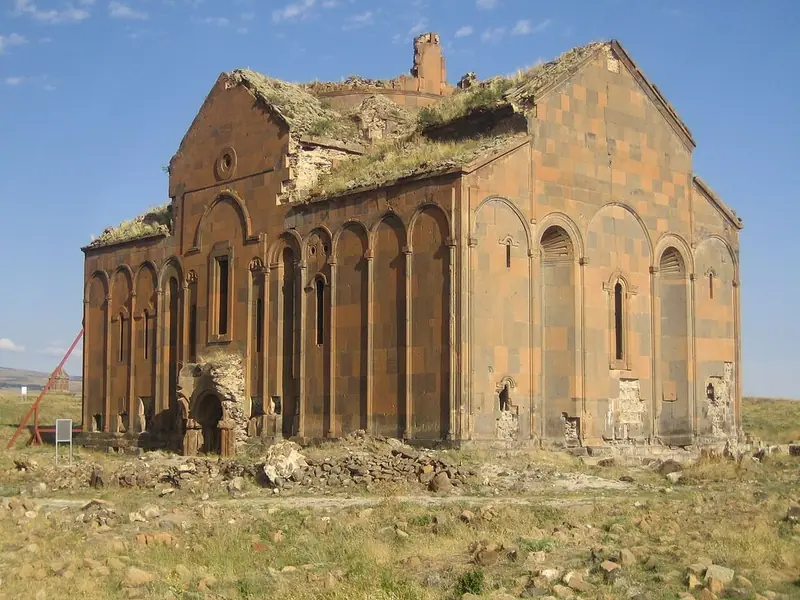 Armenian8 stops · 10th – 14th century CE
Ani audio guide
The ruined capital of medieval Armenia above a border gorge: Trdat’s cathedral, the frescoed church of Tigran Honents, the half-fallen Holy Redeemer and the minaret of Manuchihr.
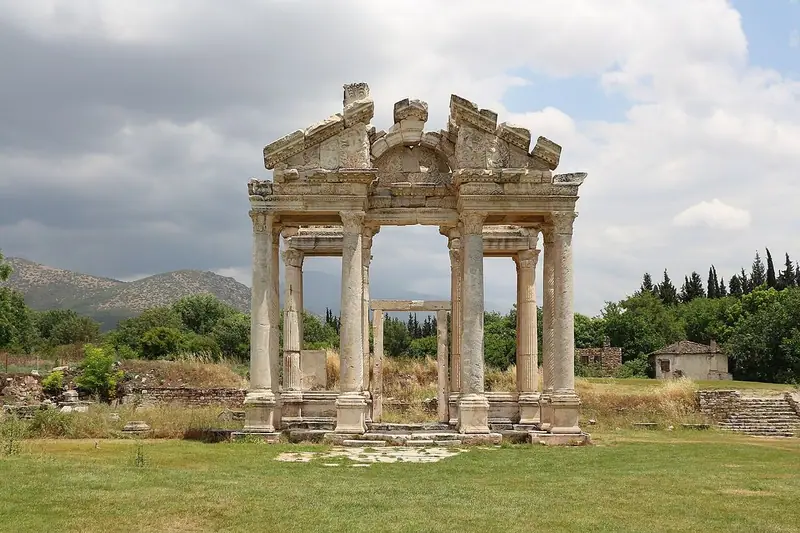 Roman8 stops · 1st century BCE – 4th century CE
Aphrodisias audio guide
The city of Aphrodite: the Tetrapylon gate, the stadium, the theatre and the sculpted reliefs of the Sebasteion.
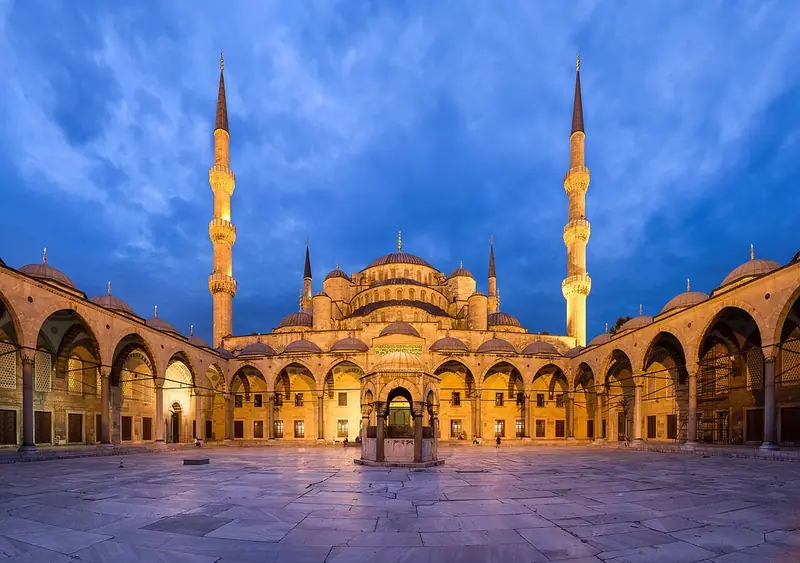 Ottoman9 stops · 1609–1616
Blue Mosque audio guide
Sultan Ahmed’s mosque facing Hagia Sophia, beside the obelisks and Serpent Column of the ancient Hippodrome.
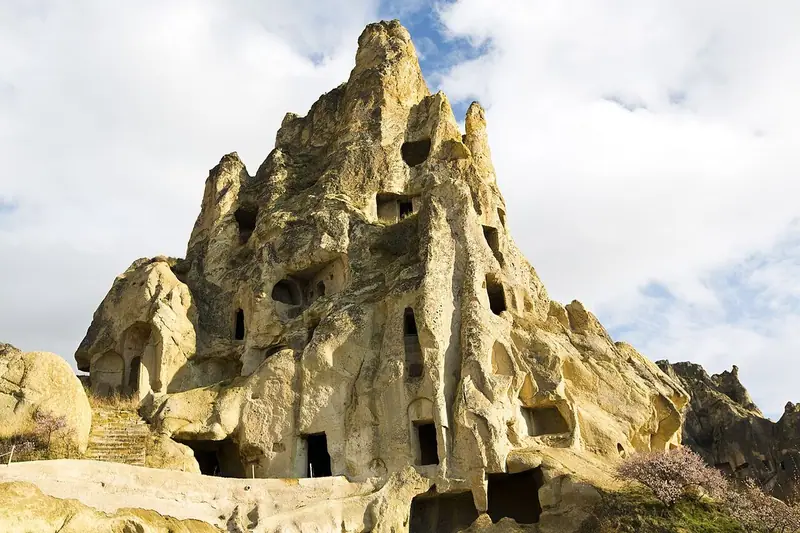 Byzantine8 stops · 10th–12th century
Cappadocia audio guide
Monks' churches and chapels cut into the soft rock of Göreme, among Cappadocia’s fairy chimneys.
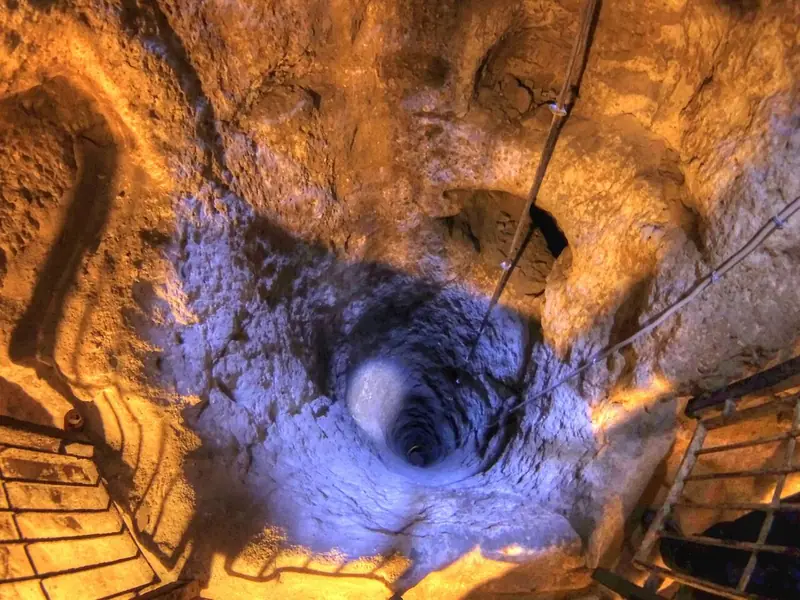 Byzantine7 stops · expanded c. 780–1180 CE
Derinkuyu audio guide
Descend through stables, kitchens and rolling stone doors into an underground city cut deep into the tuff.
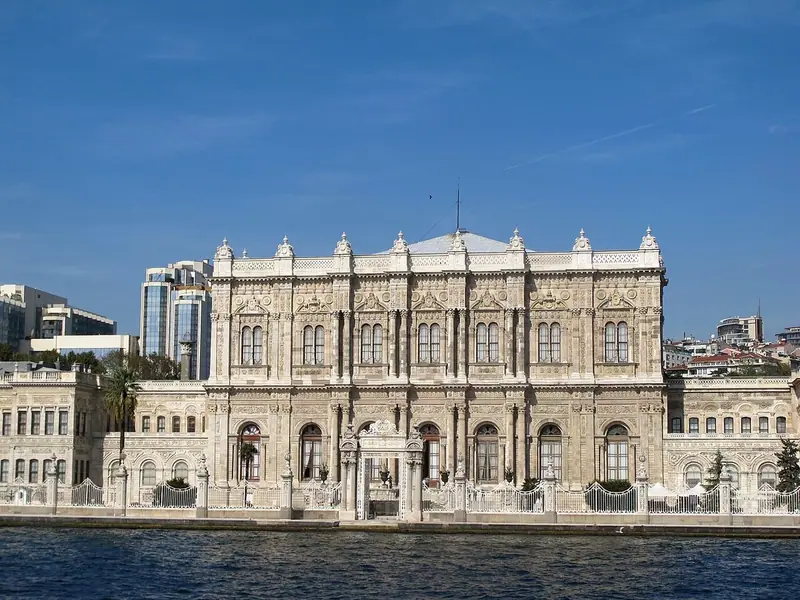 Ottoman8 stops · Late Ottoman
Dolmabahçe Palace audio guide
Climb the crystal staircase of the sultans’ palace of gold and crystal on the Bosphorus, to the vast domed Ceremonial Hall and Atatürk’s room.
Every guide, in every country
The Mevlâna Museum and every other guide we publish, including future ones. One payment, no subscription.