Before you start
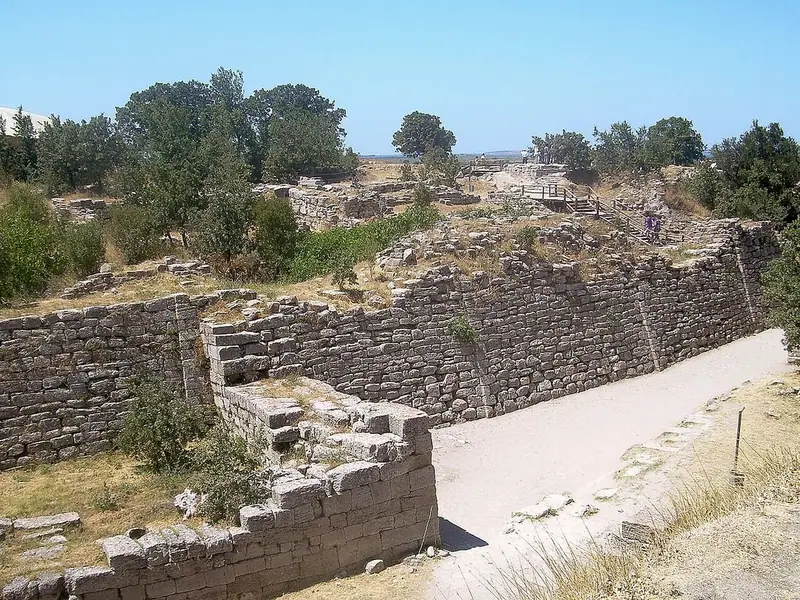
Troy, Troya or Truva in Turkish, lies on the mound of Hisarlık, about 30 kilometres south-west of Çanakkale, near the village of Tevfikiye and a few kilometres from the southern mouth of the Dardanelles, the narrow strait between Europe and Asia. The Archaeological Site of Troy has been a UNESCO World Heritage Site since 1998, and the surrounding landscape is protected as a historical national park. The site is run by the Turkish Ministry of Culture and Tourism, and excavations are led by Turkish archaeologists. It is a confusing place at first, because nine cities lie one on top of another, so follow the signed circuit and look for the colour-coded layer markers. This guide follows that circuit: from the wooden horse to the great east wall of Troy VI, the Temple of Athena, Schliemann’s trench and the ramp of Troy II, then down to the sanctuary, the odeon and the south gate.
Use it as a self-guided tour of Troy: 8 stops in visit order, each played when you’re ready, at your own pace.
 Free preview · Stop 1
The Wooden Horse
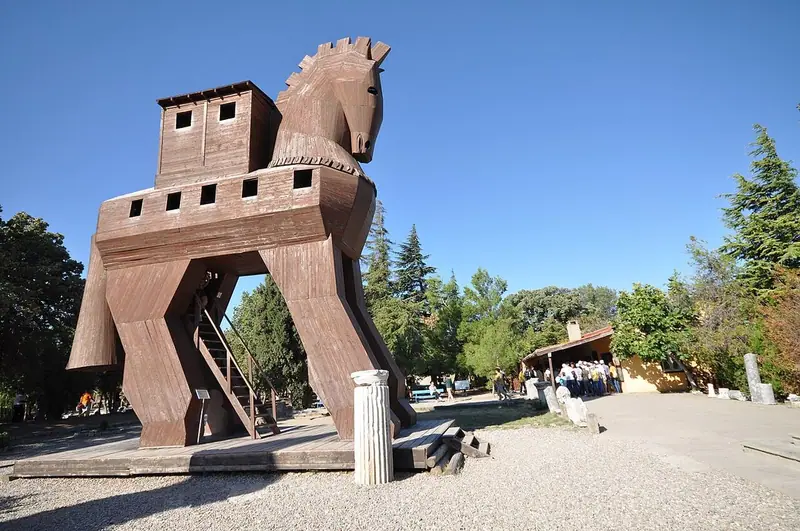
Begin by the large wooden horse near the entrance. It is a modern replica, built in 1975, and you can climb up inside it. No ancient source describes what the real horse looked like, or whether it existed at all; the famous story of Greek soldiers hidden inside is not in Homer’s Iliad, which ends before the fall of Troy; the Odyssey mentions it briefly, and the full tale comes from later poems, especially Virgil’s Aeneid. Still, it is the perfect place to remember the tale: after ten years of siege, the Greeks pretended to sail away, leaving the horse as a gift, and the Trojans dragged it into their city. Look up at the mound behind you: Hisarlık, ‘place of the fortress’. The horse in the town of Çanakkale, by the way, is a different one, used in the 2004 film Troy.
Photo: Jorge Láscar · CC BY 2.0 · Wikimedia Commons
What to see at Troy: 8 stops, in visit order
- 01
 The Wooden HorseTahta AtFree preview
- 02
 The East Wall of Troy VIDoğu SurlarıIn the guide
- 03
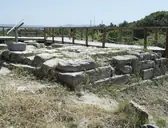 Temple of AthenaAthena TapınağıIn the guide
- 04
 Schliemann’s TrenchSchliemann YarmasıIn the guide
- 05
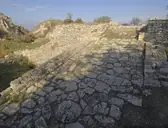 The Ramp and Troy IIRampaIn the guide
- 06
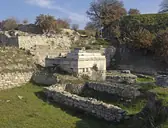 The SanctuaryKutsal AlanIn the guide
- 07
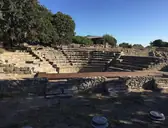 Odeon and BouleuterionOdeonIn the guide
- 08
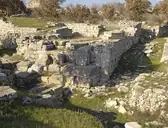 South Gate and Pillar HouseGüney KapısıIn the guide
Site map of Troy
History of Troy
Troy was built and rebuilt for some four thousand years. Archaeologists divide the mound into nine main cities, Troy I to Troy IX, beginning with an Early Bronze Age fortified settlement around 3000 BCE. Troy II, from about 2550 to 2300 BCE, was a wealthy citadel; Troy VI, from about 1750 to 1300 BCE, was the great Late Bronze Age city with its mighty walls and a large lower town. Its people were Anatolians, with links to the Hittite world, and Hittite texts mention a kingdom called Wilusa, which many scholars identify with Homer’s Ilios. Troy VI or the city that followed, Troy VIIa, destroyed around 1180 BCE, is the most likely setting for the legend of the Trojan War. Later, Greek settlers founded Ilion here, Troy VIII, around 700 BCE, and under the Roman Empire, which honoured Troy as the mythical homeland of Aeneas, ancestor of the Romans, it became Troy IX.
The full history continues in the guide.
Troy guide: questions
How many stops does the Troy guide have?
8 stops, in visit order: 1. The Wooden Horse; 2. The East Wall of Troy VI; 3. Temple of Athena; 4. Schliemann’s Trench; 5. The Ramp and Troy II; 6. The Sanctuary; 7. Odeon and Bouleuterion; 8. South Gate and Pillar House.
Can I do a self-guided tour of Troy with this guide?
Yes. The guide is made for a self-guided tour: 8 stops in visit order, each with a photo, a story and a voice, so you can explore Troy at your own pace, without joining a group. Download it before you go and it works offline.
How long is each guide?
The 8 stops add up to about 7 minutes of listening in total. You play each stop when you’re ready, so you can go at your own pace.
Does the guide work offline?
Yes, once it’s downloaded. The guide is a single self-contained web page (about 9.4 MB) with the photos, text and audio built in. Download it to your phone before you go (Wi-Fi is best); after that it opens in any modern browser on iPhone or Android, with no app, account or mobile signal needed.
Does it use GPS or need my location?
No. The guide doesn’t use GPS and doesn’t know where you are: you play each stop when you reach it. It works on iPhone and Android in any modern browser, and it’s in English.
What’s included?
One self-contained HTML guide: 8 stops in visit order, each with a photo, text and a voice, plus the story of who built the site.
Who built Troy?
Troy was built and rebuilt for some four thousand years. Archaeologists divide the mound into nine main cities, Troy I to Troy IX, beginning with an Early Bronze Age fortified settlement around 3000 BCE.
Where is Troy?
Troy, Troya or Truva in Turkish, lies on the mound of Hisarlık, about 30 kilometres south-west of Çanakkale, near the village of Tevfikiye and a few kilometres from the southern mouth of the Dardanelles, the narrow strait between Europe and Asia.
Is there a free audio guide to Troy?
The first stop, The Wooden Horse, is free to read and hear on this page, so you can try the Troy audio tour before you buy. The full guide, with all 8 stops, is a one-off purchase: download it once and it’s yours to keep, working offline.
Is the Troy guide worth it?
If you’d like to know what you’re looking at, yes. For $10 you get 8 stops in visit order, each with a photo, a short history and a voice you play when you’re ready, plus a site map of the stops, and about 7 minutes of listening in all. It’s short on purpose, so you spend your time looking, not listening. It’s yours to keep, works offline and needs no app. The first stop is free on this page, so you can try it before you buy. If you’d like hours of detail, a guided tour will go deeper.
Audio guide or guided tour?
It depends how you like to visit. This guide lets you explore Troy at your own pace, at any time, for a one-off price. A guided tour gives you a live expert you can ask questions, but at fixed times and usually for a higher price. Many people use both: a tour for the big picture, and the guide to read beforehand or to revisit the stops in their own time.
Is this the official Troy guide?
No. It’s an independent guide by The Historian Guide, not affiliated with or endorsed by the operator of Troy. For tickets and opening hours, check the official site operator before you go.
Does the guide include entry tickets or opening hours?
No. The guide is a digital companion only. Admission to Troy is separate, so check the official site operator for current tickets and opening hours before you go.
- Stop 1 · The Wooden Horse: Jorge Láscar from Australia · CC BY 2.0 · Wikimedia Commons · resized
- Stop 2 · The East Wall of Troy VI (also the cover): CherryX per Wikimedia Commons · CC BY-SA 3.0 · Wikimedia Commons · resized
- Stop 3 · Temple of Athena: Dosseman · CC BY-SA 4.0 · Wikimedia Commons · resized
- Stop 4 · Schliemann’s Trench: Dosseman · CC BY-SA 4.0 · Wikimedia Commons · resized
- Stop 5 · The Ramp and Troy II: Dosseman · CC BY-SA 4.0 · Wikimedia Commons · resized
- Stop 6 · The Sanctuary: Dosseman · CC BY-SA 4.0 · Wikimedia Commons · resized
- Stop 7 · Odeon and Bouleuterion: Ertly · CC BY 4.0 · Wikimedia Commons · resized
- Stop 8 · South Gate and Pillar House: Dosseman · CC BY-SA 4.0 · Wikimedia Commons · resized


All photographs from Wikimedia Commons under the licences shown.
More guides in Turkey
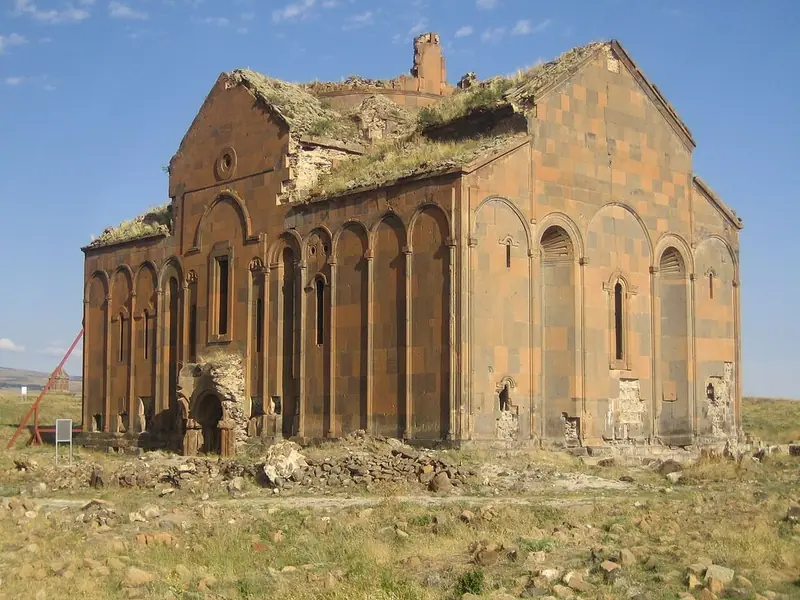 Armenian8 stops · 10th – 14th century CE
Ani audio guide
The ruined capital of medieval Armenia above a border gorge: Trdat’s cathedral, the frescoed church of Tigran Honents, the half-fallen Holy Redeemer and the minaret of Manuchihr.
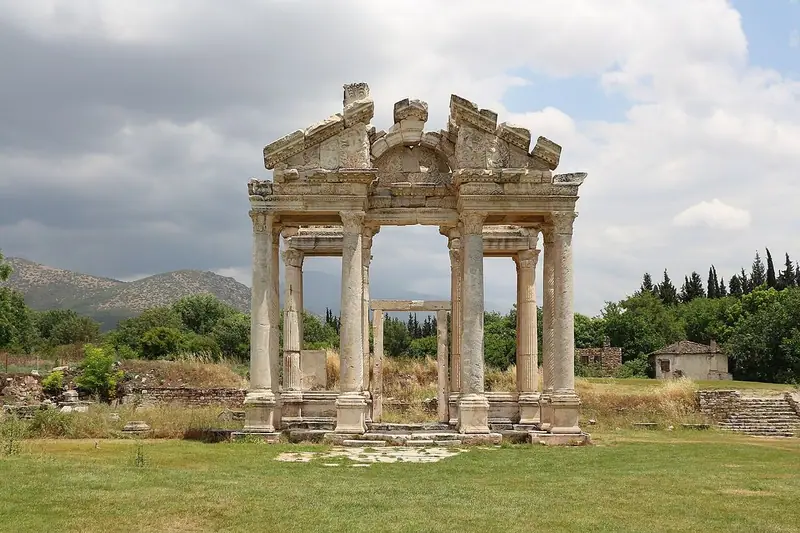 Roman8 stops · 1st century BCE – 4th century CE
Aphrodisias audio guide
The city of Aphrodite: the Tetrapylon gate, the stadium, the theatre and the sculpted reliefs of the Sebasteion.
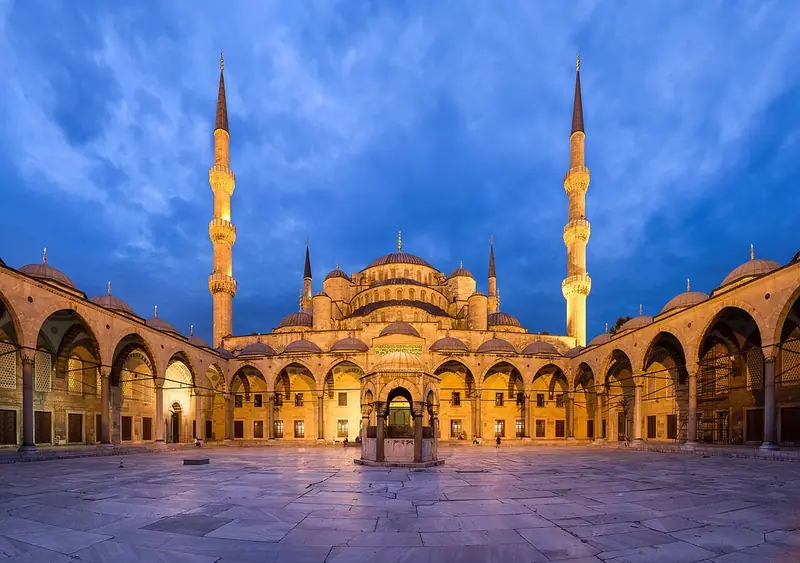 Ottoman9 stops · 1609–1616
Blue Mosque audio guide
Sultan Ahmed’s mosque facing Hagia Sophia, beside the obelisks and Serpent Column of the ancient Hippodrome.
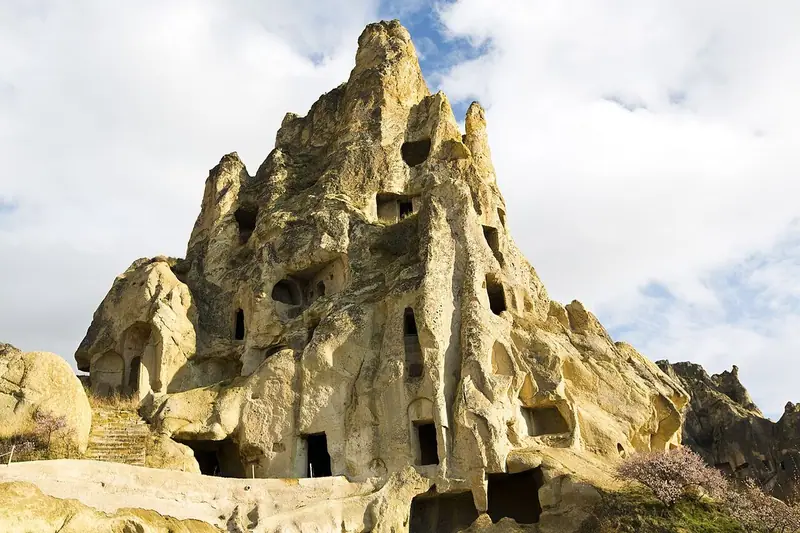 Byzantine8 stops · 10th–12th century
Cappadocia audio guide
Monks' churches and chapels cut into the soft rock of Göreme, among Cappadocia’s fairy chimneys.
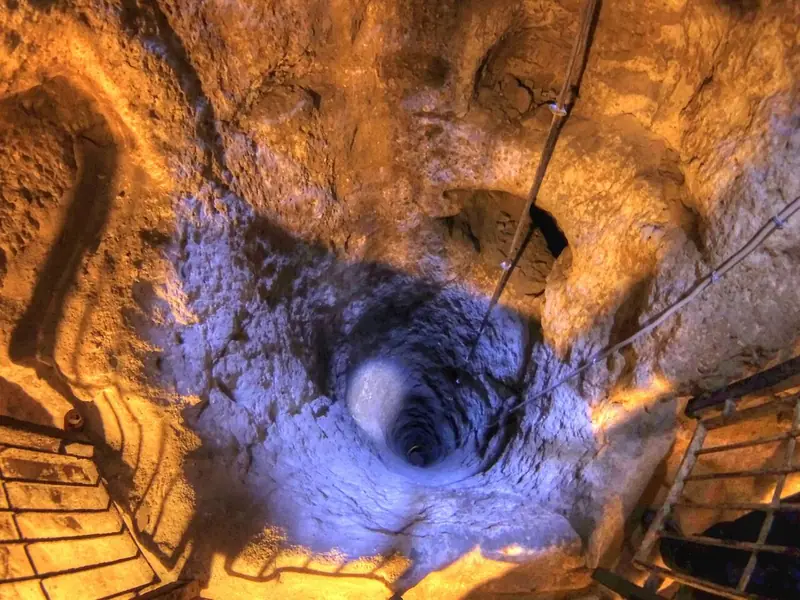 Byzantine7 stops · expanded c. 780–1180 CE
Derinkuyu audio guide
Descend through stables, kitchens and rolling stone doors into an underground city cut deep into the tuff.
 Ottoman8 stops · Late Ottoman
Dolmabahçe Palace audio guide
Climb the crystal staircase of the sultans’ palace of gold and crystal on the Bosphorus, to the vast domed Ceremonial Hall and Atatürk’s room.
Every guide, in every country
Troy and every other guide we publish, including future ones. One payment, no subscription.