Before you start
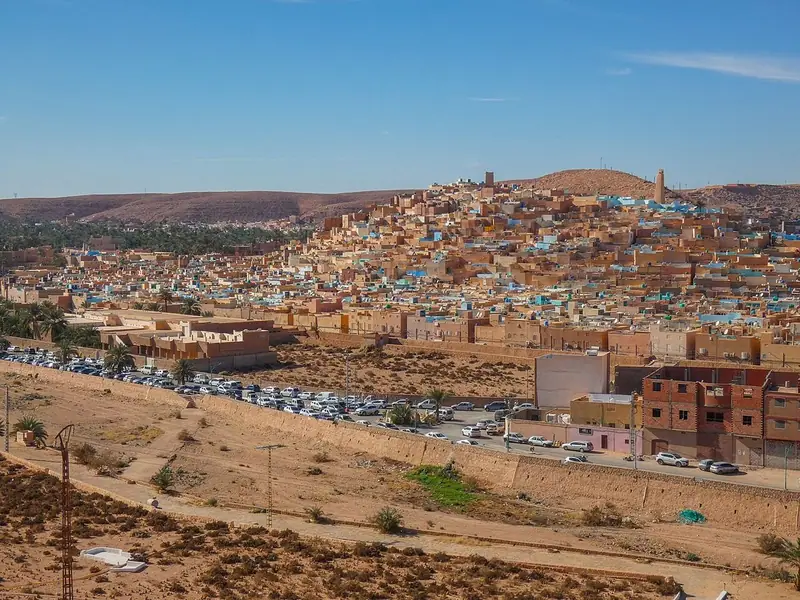
The M’zab Valley lies in the northern Sahara, about six hundred kilometres south of Algiers, where the dry bed of the Wadi M’zab winds through a stony limestone plateau. Here, between 1012 and 1350, Ibadi Muslims founded five fortified towns, or ksour, on rocky outcrops along the valley: El Atteuf, Bou Noura, Melika, Ghardaïa and Beni Isguen. Each is crowned by a mosque whose minaret once served as a watchtower, with houses set in rings around it down to the ramparts, and each is tied to a cemetery and a palm grove watered by an ingenious system for sharing floodwater. UNESCO inscribed the valley as a World Heritage Site in 1982. These are living towns, home to tens of thousands of people, so this guide asks you to follow local rules and to let the communities decide where, when and how you visit.
Use it as a self-guided tour of the M’zab Valley: 9 stops in visit order, each played when you’re ready, at your own pace.
 Free preview · Stop 1
The Valley of the Pentapolis
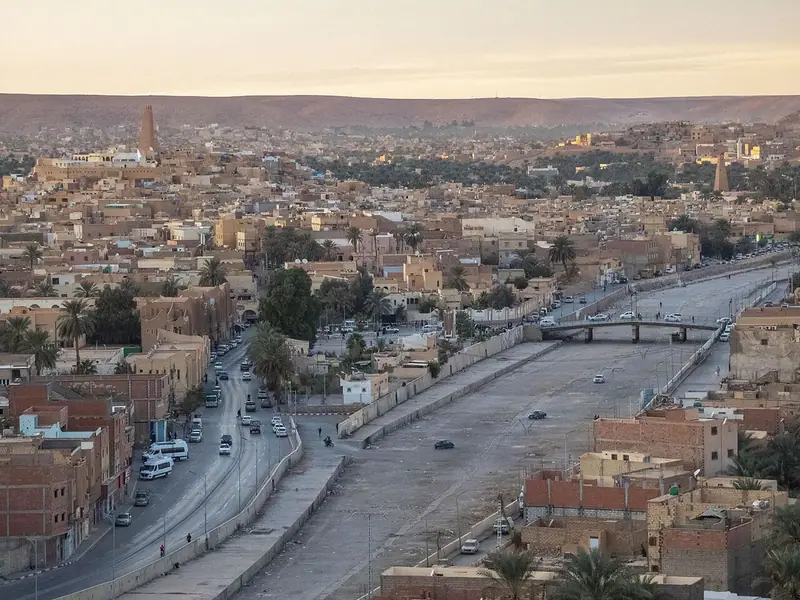
Begin with the view over the Wadi M’zab, the river that gives the valley its name. For most of the year its bed lies dry, but after rare storms it can carry sudden, violent floods; in October 2008 Ghardaïa suffered the worst flooding in fifty years. Around the valley stretches the chebka, a rocky plateau cut by dry gullies. Along the wadi stand the five towns, often called the Pentapolis, each built on its own outcrop: Ghardaïa upstream, then Melika, Beni Isguen and Bou Noura, with El Atteuf, the oldest, farthest downstream. Two later towns, Berriane and El Guerrara, joined the M’zab community in the seventeenth century. Since the 1950s the space between the old towns has filled with new building, and the valley now forms a single urban area some eight kilometres long, with only El Atteuf still standing a little apart.
Photo: Camille Gillet · CC BY-SA 4.0 · Wikimedia Commons
What to see at the M’zab Valley: 9 stops, in visit order
- 01
 The Valley of the PentapolisFive towns along a dry riverFree preview
- 02
 Wells and FloodwaterSharing every dropIn the guide
- 03
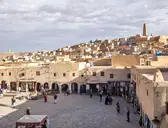 Ghardaïa Market SquareThe trading heart of the valleyIn the guide
- 04
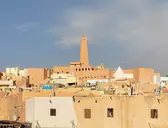 The Great Mosque of GhardaïaThe minaret as watchtowerIn the guide
- 05
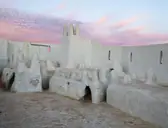 MelikaThe queen of the PentapolisIn the guide
- 06
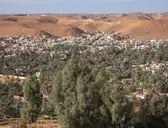 The Palm GroveThe summer citadelIn the guide
- 07
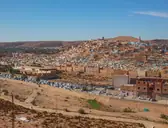 Beni IsguenThe guarded townIn the guide
- 08
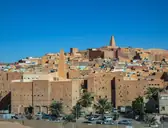 Bou NouraThe luminousIn the guide
- 09
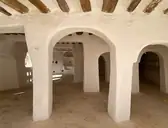 El Atteuf and Sidi BrahimThe oldest townIn the guide
Site map of the M’zab Valley
History of the M’zab Valley
The people of the valley are the Mozabites, a Berber people who speak their own language, Mozabite, and who follow Ibadism, a branch of Islam distinct from both Sunni and Shia Islam. Their story begins at Tahert, near present-day Tiaret, capital of the Ibadi Rustamid imamate, which was conquered by the Fatimids in 909. Many Ibadis fled to Sedrata, near Ouargla, and from there they moved on to the M’zab, a hard and isolated place chosen for refuge and defence. The towns were planned according to set principles of communal life: houses of a standard size and type, reflecting an egalitarian society that guards the privacy of the family. Religious councils, among them the Azzaba, have long regulated local life, and a federal council links the Mozabite towns today. The valley’s architecture later influenced architects of the twentieth century, among them Le Corbusier and Fernand Pouillon.
M’zab Valley guide: questions
How many stops does the M’zab Valley guide have?
9 stops, in visit order: 1. The Valley of the Pentapolis; 2. Wells and Floodwater; 3. Ghardaïa Market Square; 4. The Great Mosque of Ghardaïa; 5. Melika; 6. The Palm Grove; 7. Beni Isguen; 8. Bou Noura; 9. El Atteuf and Sidi Brahim.
Can I do a self-guided tour of the M’zab Valley with this guide?
Yes. The guide is made for a self-guided tour: 9 stops in visit order, each with a photo, a story and a voice, so you can explore the M’zab Valley at your own pace, without joining a group. Download it before you go and it works offline.
How long do you need at the M’zab Valley?
We suggest allowing A full day. The 9 stops add up to about 7 minutes of listening, and you play each one when you’re ready, so you can linger wherever you like.
How long is each guide?
The 9 stops add up to about 7 minutes of listening in total. You play each stop when you’re ready, so you can go at your own pace.
Does the guide work offline?
Yes, once it’s downloaded. The guide is a single self-contained web page (about 8.3 MB) with the photos, text and audio built in. Download it to your phone before you go (Wi-Fi is best); after that it opens in any modern browser on iPhone or Android, with no app, account or mobile signal needed.
Does it use GPS or need my location?
No. The guide doesn’t use GPS and doesn’t know where you are: you play each stop when you reach it. It works on iPhone and Android in any modern browser, and it’s in English.
What’s included?
One self-contained HTML guide: 9 stops in visit order, each with a photo, text and a voice, plus the story of who built the site.
Who built the M’zab Valley?
The people of the valley are the Mozabites, a Berber people who speak their own language, Mozabite, and who follow Ibadism, a branch of Islam distinct from both Sunni and Shia Islam. Their story begins at Tahert, near present-day Tiaret, capital of the Ibadi Rustamid imamate, which was conquered by the Fatimids in 909.
Is there a free audio guide to the M’zab Valley?
The first stop, The Valley of the Pentapolis, is free to read and hear on this page, so you can try the M’zab Valley audio tour before you buy. The full guide, with all 9 stops, is a one-off purchase: download it once and it’s yours to keep, working offline.
Is the M’zab Valley guide worth it?
If you’d like to know what you’re looking at, yes. For $10 you get 9 stops in visit order, each with a photo, a short history and a voice you play when you’re ready, plus a site map of the stops, and about 7 minutes of listening in all. It’s short on purpose, so you spend your time looking, not listening. It’s yours to keep, works offline and needs no app. The first stop is free on this page, so you can try it before you buy. If you’d like hours of detail, a guided tour will go deeper.
Audio guide or guided tour?
It depends how you like to visit. This guide lets you explore the M’zab Valley at your own pace, at any time, for a one-off price. A guided tour gives you a live expert you can ask questions, but at fixed times and usually for a higher price. Many people use both: a tour for the big picture, and the guide to read beforehand or to revisit the stops in their own time.
Is this the official M’zab Valley guide?
No. It’s an independent guide by The Historian Guide, not affiliated with or endorsed by the operator of the M’zab Valley. For tickets and opening hours, check the official site operator before you go.
Does the guide include entry tickets or opening hours?
No. The guide is a digital companion only. Admission to the M’zab Valley is separate, so check the official site operator for current tickets and opening hours before you go.
- Stop 1 · The Valley of the Pentapolis: Camille Gillet · CC BY-SA 4.0 · Wikimedia Commons · resized
- Stop 2 · Wells and Floodwater: Gadmer, Frédéric · CC BY-SA 4.0 · Wikimedia Commons · resized
- Stop 3 · Ghardaïa Market Square: Camille Gillet · CC BY-SA 4.0 · Wikimedia Commons · resized
- Stop 4 · The Great Mosque of Ghardaïa: Bernard Gagnon · CC BY 4.0 · Wikimedia Commons · resized
- Stop 5 · Melika: Camille Gillet · CC BY-SA 4.0 · Wikimedia Commons · resized
- Stop 6 · The Palm Grove: Camille Gillet · CC BY-SA 4.0 · Wikimedia Commons · resized
- Stop 7 · Beni Isguen (also the cover): Camille Gillet · CC BY-SA 4.0 · Wikimedia Commons · resized
- Stop 8 · Bou Noura: Camille Gillet · CC BY-SA 4.0 · Wikimedia Commons · resized
- Stop 9 · El Atteuf and Sidi Brahim: Bernard Gagnon · CC BY 4.0 · Wikimedia Commons · resized


All photographs from Wikimedia Commons under the licences shown.
More guides in Algeria
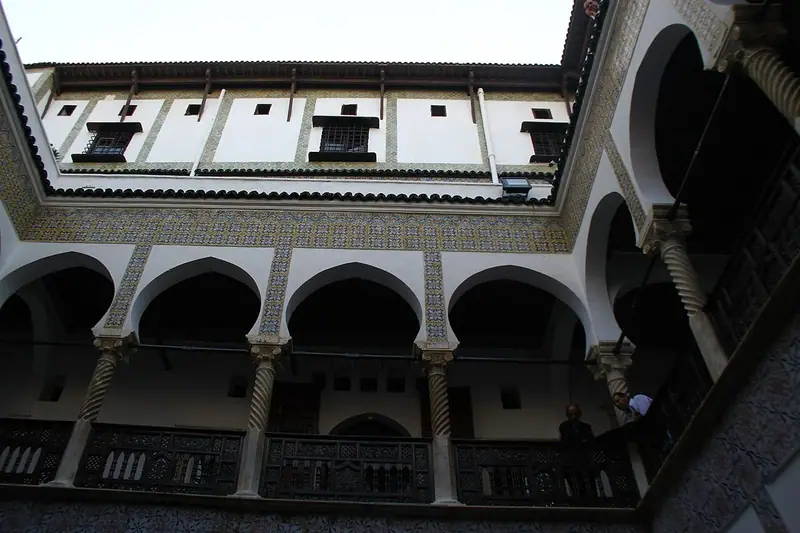 Ottoman9 stops · 16th–19th century
Casbah of Algiers audio guide
Up the stepped lanes of old Algiers, past Ottoman mosques and palaces of the deys, to the citadel at the top of the Casbah.
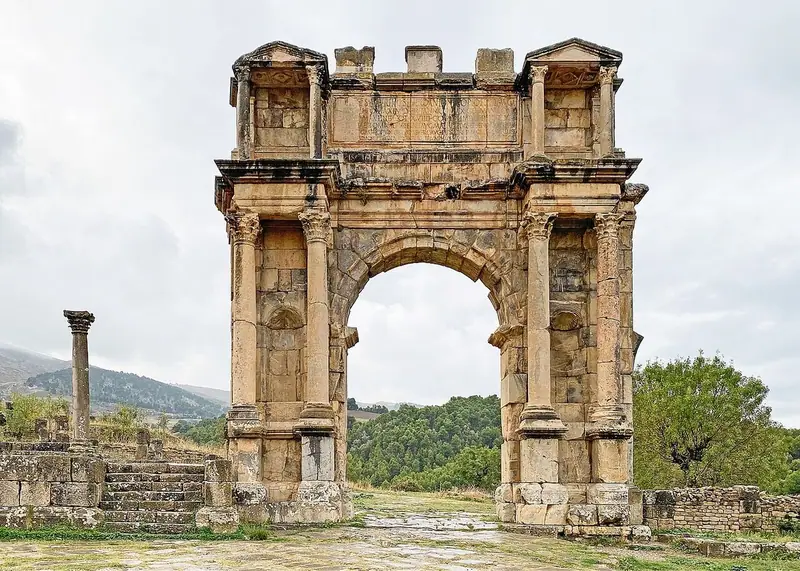 Roman8 stops · c. 96 CE – 6th century
Djémila audio guide
Roman Cuicul on its mountain spur, from the Severan square and the Arch of Caracalla to the theatre and the Christian quarter.
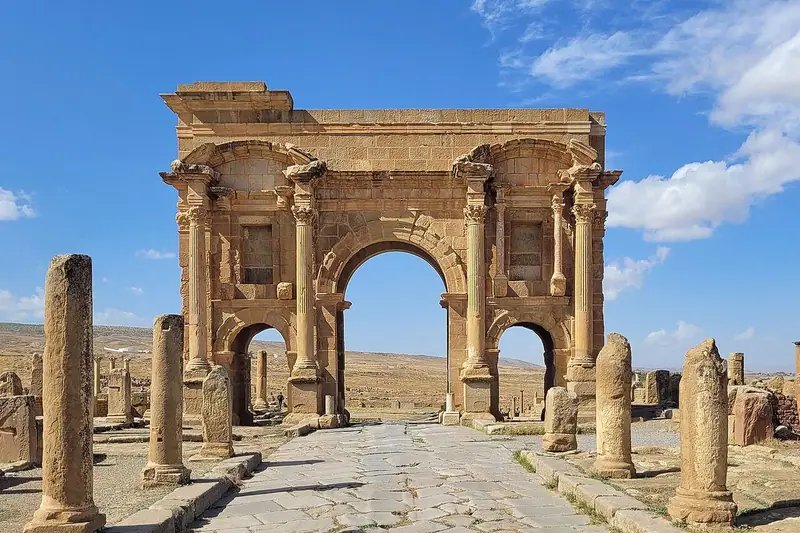 Roman8 stops · 100 CE – 7th century
Timgad audio guide
Trajan’s veterans' colony on the high plains: a perfect Roman grid of stone streets, a theatre, a library and the Arch of Trajan.
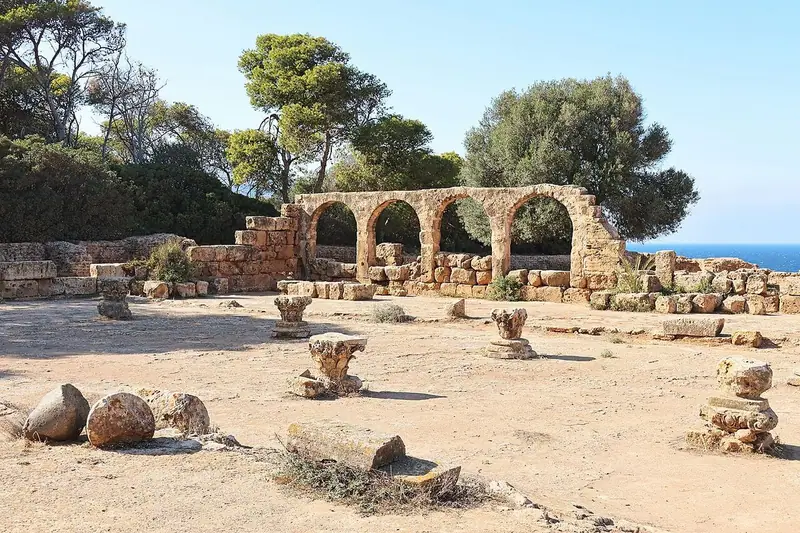 Roman8 stops · 6th century BCE – 6th century CE
Tipasa audio guide
Roman ruins among pines above the Mediterranean, from the amphitheatre and the Great Basilica to Camus’s stele and the Royal Mausoleum of Mauretania.
Every guide, in every country
M’zab Valley and every other guide we publish, including future ones. One payment, no subscription.