Before you start
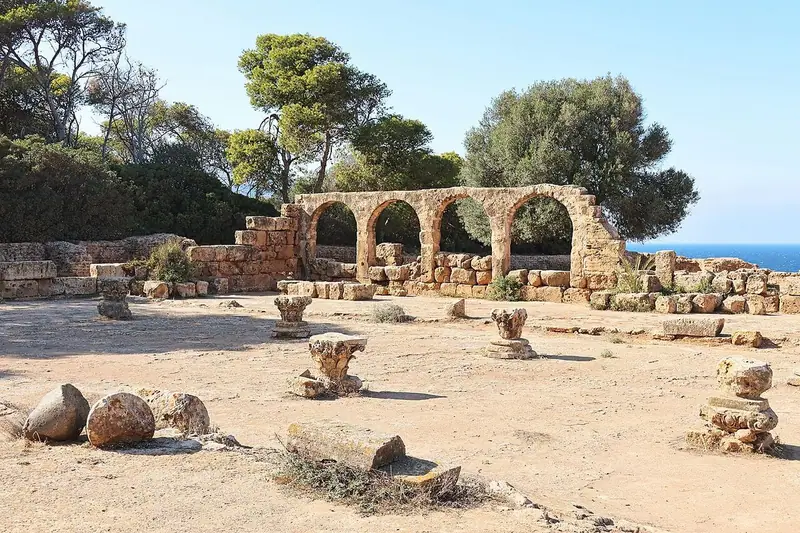
Tipasa lies on the Mediterranean coast about 70 kilometres west of Algiers, beside the modern town of Tipaza and below the bulk of Mount Chenoua. Most visitors come by car, taxi or bus from Algiers. UNESCO inscribed Tipasa as a World Heritage Site in 1982; the property takes in two archaeological parks and the Royal Mausoleum of Mauretania, 11 kilometres to the south-east. Unlike the compact ruins of Timgad and Djémila, Tipasa is scattered among pines and gardens on the edge of the sea, and much of the ancient town still lies buried. Paths are sandy and uneven, with steps down to the shore, so wear sturdy shoes, and bring water, a hat and sun cream in summer. Please do not climb on the walls or sit on sarcophagi. The route crosses the main archaeological park from the entrance by the amphitheatre to the headland and the seafront, and ends at the mausoleum, which you will need transport to reach.
Use it as a self-guided tour of Tipasa: 8 stops in visit order, each played when you’re ready, at your own pace.
 Free preview · Stop 1
Amphitheatre
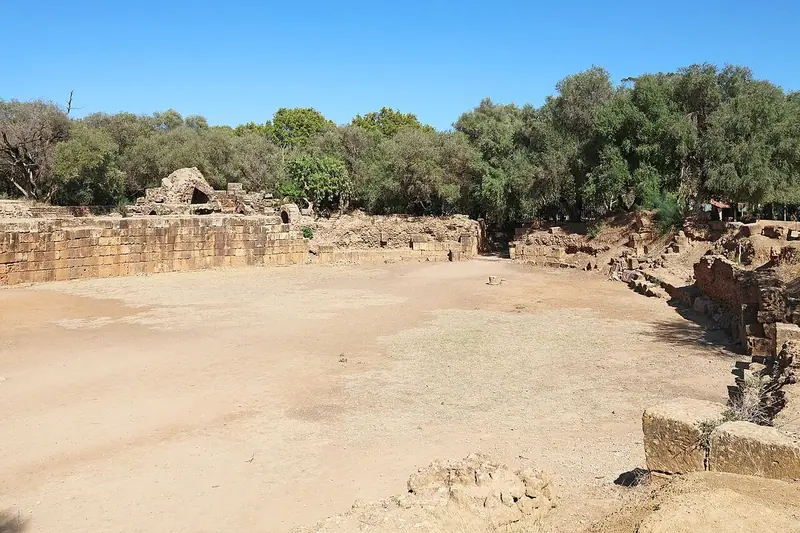
Just inside the entrance of the archaeological park, on your right, is the amphitheatre, the first monument you will see. It is about 80 metres long and lies east to west, and only its northern half has been excavated. You can make out the vaults that supported the rows of seats, the high walls that enclosed the arena to protect spectators, and the gates: two main entrances at either end, and three smaller doors on each side. Here crowds watched fights between gladiators and with wild animals. The amphitheatre was built late in the town’s history, and it was squeezed into the existing town, cutting into the space of the temples beside it. Beyond it, the Decumanus Maximus, the main street, runs west. It continued the coastal road between Icosium, modern Algiers, and Caesarea, now Cherchell. Follow it towards the next stop.
Photo: Bernard Gagnon · CC BY 4.0 · Wikimedia Commons
What to see at Tipasa: 8 stops, in visit order
- 01
 AmphitheatreWhere the games were heldFree preview
- 02
 NymphaeumA cascade of marble and waterIn the guide
- 03
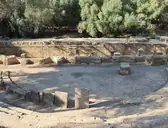 TheatreBuilt on level groundIn the guide
- 04
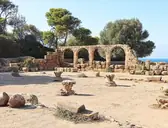 Great BasilicaThe largest church in AlgeriaIn the guide
- 05
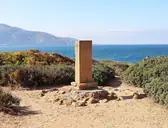 Camus SteleA writer’s hymn to TipasaIn the guide
- 06
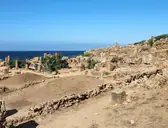 Villa of the FrescoesA house with a view of the seaIn the guide
- 07
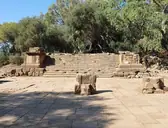 TemplesTwo shrines to unknown godsIn the guide
- 08
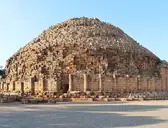 Royal Mausoleum of MauretaniaA tomb for a dynastyIn the guide
Site map of Tipasa
History of Tipasa
Tipasa was founded by Phoenician sailors and grew into a Roman town. Phoenician civilisation spread from the cities of the Levant across the Mediterranean from around 1100 BCE; its great western colony, Carthage, dominated this coast until its destruction by Rome in 146 BCE. Roman civilisation, which grew from the city of Rome, traditionally founded in 753 BCE, lasted in the West until 476 CE. Around the sixth century BCE the Phoenicians set up a trading post here, a sheltered stop between modern Algiers and Cherchell, and its Punic cemeteries are among the oldest and largest in the Punic world. The town then belonged to the Berber kingdom of Mauretania, whose king Juba II ruled from nearby Caesarea. After Rome annexed the kingdom, Tipasa became a municipium in 46 CE and later a colony, and around 200 CE it may have had some twenty thousand inhabitants.
The full history continues in the guide.
Tipasa guide: questions
How many stops does the Tipasa guide have?
8 stops, in visit order: 1. Amphitheatre; 2. Nymphaeum; 3. Theatre; 4. Great Basilica; 5. Camus Stele; 6. Villa of the Frescoes; 7. Temples; 8. Royal Mausoleum of Mauretania.
Can I do a self-guided tour of Tipasa with this guide?
Yes. The guide is made for a self-guided tour: 8 stops in visit order, each with a photo, a story and a voice, so you can explore Tipasa at your own pace, without joining a group. Download it before you go and it works offline.
How long do you need at Tipasa?
We suggest allowing 3–4 hours. The 8 stops add up to about 6 minutes of listening, and you play each one when you’re ready, so you can linger wherever you like.
How long is each guide?
The 8 stops add up to about 6 minutes of listening in total. You play each stop when you’re ready, so you can go at your own pace.
Does the guide work offline?
Yes, once it’s downloaded. The guide is a single self-contained web page (about 8.4 MB) with the photos, text and audio built in. Download it to your phone before you go (Wi-Fi is best); after that it opens in any modern browser on iPhone or Android, with no app, account or mobile signal needed.
Does it use GPS or need my location?
No. The guide doesn’t use GPS and doesn’t know where you are: you play each stop when you reach it. It works on iPhone and Android in any modern browser, and it’s in English.
What’s included?
One self-contained HTML guide: 8 stops in visit order, each with a photo, text and a voice, plus the story of who built the site.
Who built Tipasa?
Tipasa was founded by Phoenician sailors and grew into a Roman town. Phoenician civilisation spread from the cities of the Levant across the Mediterranean from around 1100 BCE; its great western colony, Carthage, dominated this coast until its destruction by Rome in 146 BCE.
Where is Tipasa?
Tipasa lies on the Mediterranean coast about 70 kilometres west of Algiers, beside the modern town of Tipaza and below the bulk of Mount Chenoua.
Is there a free audio guide to Tipasa?
The first stop, Amphitheatre, is free to read and hear on this page, so you can try the Tipasa audio tour before you buy. The full guide, with all 8 stops, is a one-off purchase: download it once and it’s yours to keep, working offline.
Is the Tipasa guide worth it?
If you’d like to know what you’re looking at, yes. For $10 you get 8 stops in visit order, each with a photo, a short history and a voice you play when you’re ready, plus a site map of the stops, and about 6 minutes of listening in all. It’s short on purpose, so you spend your time looking, not listening. It’s yours to keep, works offline and needs no app. The first stop is free on this page, so you can try it before you buy. If you’d like hours of detail, a guided tour will go deeper.
Audio guide or guided tour?
It depends how you like to visit. This guide lets you explore Tipasa at your own pace, at any time, for a one-off price. A guided tour gives you a live expert you can ask questions, but at fixed times and usually for a higher price. Many people use both: a tour for the big picture, and the guide to read beforehand or to revisit the stops in their own time.
Is this the official Tipasa guide?
No. It’s an independent guide by The Historian Guide, not affiliated with or endorsed by the operator of Tipasa. For tickets and opening hours, check the official site operator before you go.
Does the guide include entry tickets or opening hours?
No. The guide is a digital companion only. Admission to Tipasa is separate, so check the official site operator for current tickets and opening hours before you go.
- Stop 1 · Amphitheatre: Bernard Gagnon · CC BY 4.0 · Wikimedia Commons · resized
- Stop 2 · Nymphaeum: Bernard Gagnon · CC BY 4.0 · Wikimedia Commons · resized
- Stop 3 · Theatre: Bernard Gagnon · CC BY 4.0 · Wikimedia Commons · resized
- Stop 4 · Great Basilica (also the cover): Bernard Gagnon · CC BY 4.0 · Wikimedia Commons · resized
- Stop 5 · Camus Stele: Bernard Gagnon · CC BY 4.0 · Wikimedia Commons · resized
- Stop 6 · Villa of the Frescoes: Bernard Gagnon · CC BY 4.0 · Wikimedia Commons · resized
- Stop 7 · Temples: Bernard Gagnon · CC BY 4.0 · Wikimedia Commons · resized
- Stop 8 · Royal Mausoleum of Mauretania: Bernard Gagnon · CC BY 4.0 · Wikimedia Commons · resized


All photographs from Wikimedia Commons under the licences shown.
More guides in Algeria
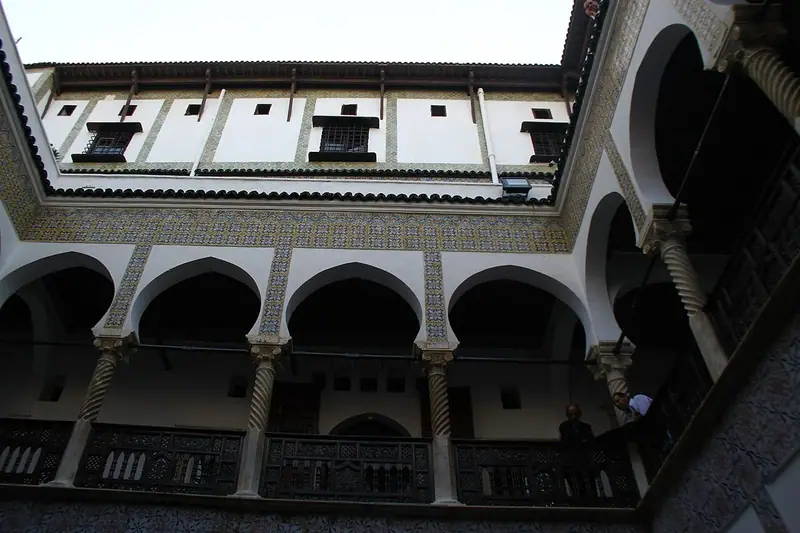 Ottoman9 stops · 16th–19th century
Casbah of Algiers audio guide
Up the stepped lanes of old Algiers, past Ottoman mosques and palaces of the deys, to the citadel at the top of the Casbah.
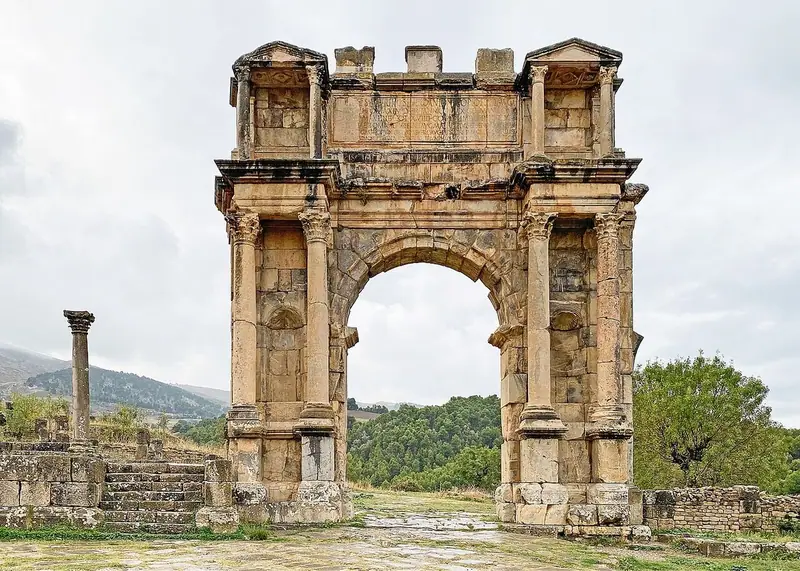 Roman8 stops · c. 96 CE – 6th century
Djémila audio guide
Roman Cuicul on its mountain spur, from the Severan square and the Arch of Caracalla to the theatre and the Christian quarter.
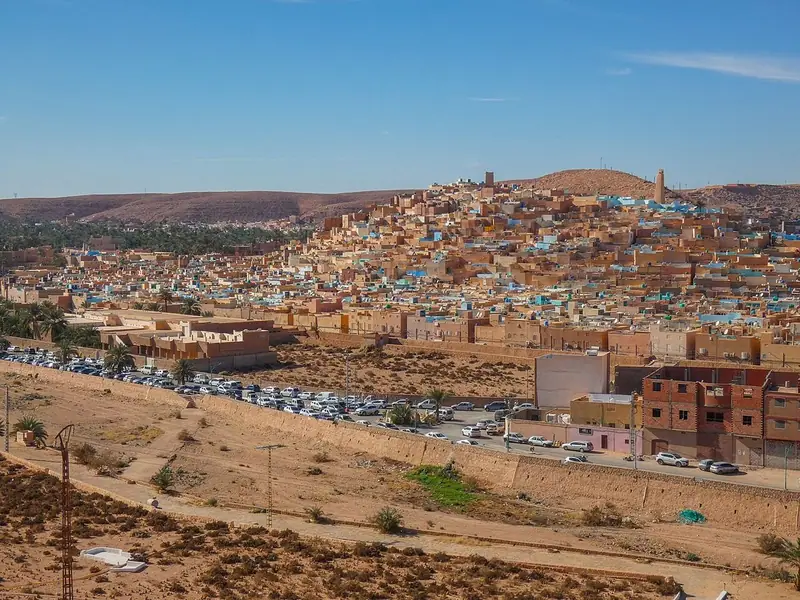 Amazigh9 stops · 1012 – 1350 (foundation of the five ksour)
M’zab Valley audio guide
Five fortified Ibadi towns of the northern Sahara: Ghardaïa, Melika, Beni Isguen, Bou Noura and El Atteuf, with watchtower minarets, palm groves and an ancient system for sharing floodwater.
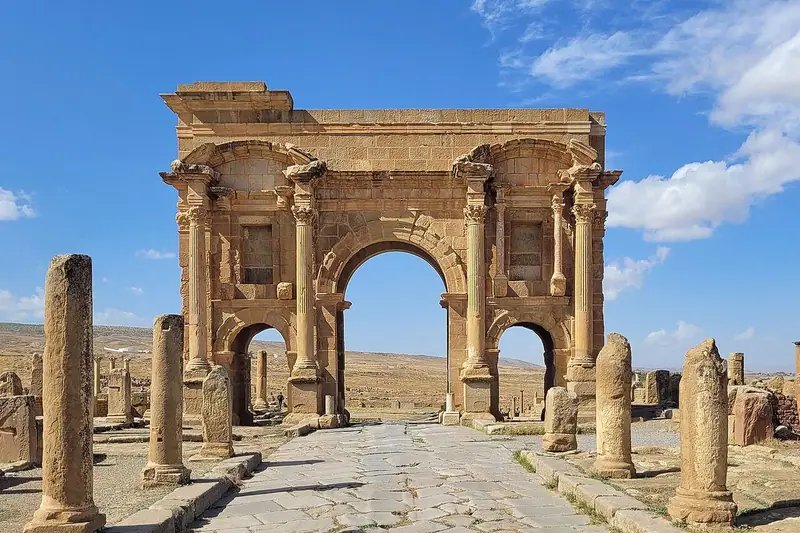 Roman8 stops · 100 CE – 7th century
Timgad audio guide
Trajan’s veterans' colony on the high plains: a perfect Roman grid of stone streets, a theatre, a library and the Arch of Trajan.
Every guide, in every country
Tipasa and every other guide we publish, including future ones. One payment, no subscription.