Before you start
Timgad stands on a high plateau on the northern edge of the Aurès Mountains in north-eastern Algeria, about 35 kilometres east of the city of Batna and some 110 kilometres south of Constantine. Most visitors come by car or taxi from Batna. UNESCO inscribed the site as a World Heritage Site in 1982, and its grid of straight streets is one of the finest surviving examples of Roman town planning. The ruins cover a wide, open area with almost no shade; summers here are hot and winters can be cold and windy, so dress for the season and bring water, a hat and sun cream. Wear sturdy shoes, as the paving stones are large, uneven and deeply rutted. Please do not climb on walls or columns. The route starts on the main street of the original town, visits its public buildings, then heads out to the western suburbs and the Byzantine fort to the south.
Use it as a self-guided tour of Timgad: 8 stops in visit order, each played when you’re ready, at your own pace.
 Free preview · Stop 1
Decumanus Maximus
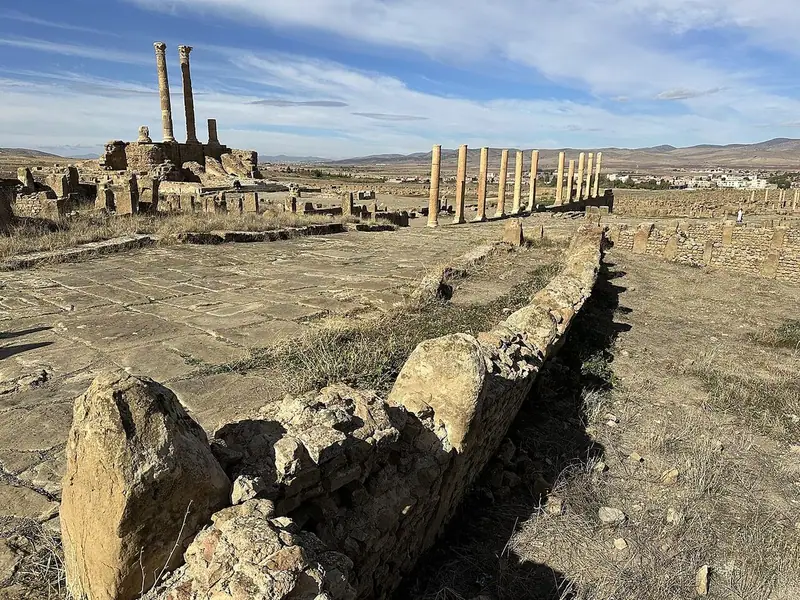
Begin on the Decumanus Maximus, the main east–west street, and look along its length. When the town was founded in 100 CE, its surveyors drew a square grid of straight streets crossing at right angles, dividing the space inside the walls into 132 blocks of about 400 square metres each. The street is paved with large rectangular limestone slabs, and you can still see the ruts worn into them by cart wheels. It was lined by a colonnade, part of which has been put back up, sheltering people on foot and the shops behind. The Cardo, the main north–south street, does not run straight across the town: it stops at the forum. Fourteen public baths have been identified here, a sign of the care taken over public comfort.
Photo: Rachid Hamatou · CC BY-SA 4.0 · Wikimedia Commons
What to see at Timgad: 8 stops, in visit order
- 01
 Decumanus MaximusThe main street of a model townFree preview
- 02
 LibraryA gift of four hundred thousand sestercesIn the guide
- 03
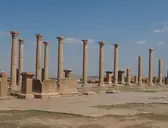 ForumThe civic heart of the colonyIn the guide
- 04
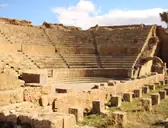 TheatrePlays and shows on the hillsideIn the guide
- 05
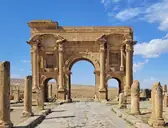 Arch of TrajanThe western gateIn the guide
- 06
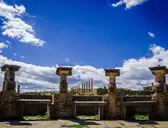 Market of SertiusA rich man’s gift to his townIn the guide
- 07
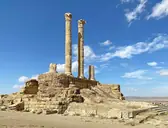 CapitolThe temple of Rome’s three great godsIn the guide
- 08
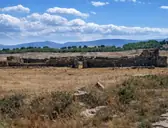 Byzantine FortThe last strongholdIn the guide
Site map of Timgad
History of Timgad
Timgad was built by the Romans. Roman civilisation grew from the city of Rome, traditionally founded in 753 BCE, and lasted in the West until the fall of the Western Roman Empire in 476 CE. Rome took this part of North Africa after defeating Carthage and absorbing the Berber kingdom of Numidia. In 100 CE the emperor Trajan founded Colonia Marciana Traiana Thamugadi: Marciana recalls his sister, and Thamugadi was probably the local name of the place. The colony was probably laid out by soldiers of the Third Augustan Legion, which was later based at nearby Lambaesis, and its first settlers were largely army veterans. The town prospered and spread far beyond its walls; by the early third century it may have had around fifteen thousand inhabitants.
The full history continues in the guide.
Timgad guide: questions
How many stops does the Timgad guide have?
8 stops, in visit order: 1. Decumanus Maximus; 2. Library; 3. Forum; 4. Theatre; 5. Arch of Trajan; 6. Market of Sertius; 7. Capitol; 8. Byzantine Fort.
Can I do a self-guided tour of Timgad with this guide?
Yes. The guide is made for a self-guided tour: 8 stops in visit order, each with a photo, a story and a voice, so you can explore Timgad at your own pace, without joining a group. Download it before you go and it works offline.
How long do you need at Timgad?
We suggest allowing 2–3 hours. The 8 stops add up to about 6 minutes of listening, and you play each one when you’re ready, so you can linger wherever you like.
How long is each guide?
The 8 stops add up to about 6 minutes of listening in total. You play each stop when you’re ready, so you can go at your own pace.
Does the guide work offline?
Yes, once it’s downloaded. The guide is a single self-contained web page (about 7.2 MB) with the photos, text and audio built in. Download it to your phone before you go (Wi-Fi is best); after that it opens in any modern browser on iPhone or Android, with no app, account or mobile signal needed.
Does it use GPS or need my location?
No. The guide doesn’t use GPS and doesn’t know where you are: you play each stop when you reach it. It works on iPhone and Android in any modern browser, and it’s in English.
What’s included?
One self-contained HTML guide: 8 stops in visit order, each with a photo, text and a voice, plus the story of who built the site.
Who built Timgad?
Timgad was built by the Romans. Roman civilisation grew from the city of Rome, traditionally founded in 753 BCE, and lasted in the West until the fall of the Western Roman Empire in 476 CE.
Where is Timgad?
Timgad stands on a high plateau on the northern edge of the Aurès Mountains in north-eastern Algeria, about 35 kilometres east of the city of Batna and some 110 kilometres south of Constantine.
Is there a free audio guide to Timgad?
The first stop, Decumanus Maximus, is free to read and hear on this page, so you can try the Timgad audio tour before you buy. The full guide, with all 8 stops, is a one-off purchase: download it once and it’s yours to keep, working offline.
Is the Timgad guide worth it?
If you’d like to know what you’re looking at, yes. For $10 you get 8 stops in visit order, each with a photo, a short history and a voice you play when you’re ready, plus a site map of the stops, and about 6 minutes of listening in all. It’s short on purpose, so you spend your time looking, not listening. It’s yours to keep, works offline and needs no app. The first stop is free on this page, so you can try it before you buy. If you’d like hours of detail, a guided tour will go deeper.
Audio guide or guided tour?
It depends how you like to visit. This guide lets you explore Timgad at your own pace, at any time, for a one-off price. A guided tour gives you a live expert you can ask questions, but at fixed times and usually for a higher price. Many people use both: a tour for the big picture, and the guide to read beforehand or to revisit the stops in their own time.
Is this the official Timgad guide?
No. It’s an independent guide by The Historian Guide, not affiliated with or endorsed by the operator of Timgad. For tickets and opening hours, check the official site operator before you go.
Does the guide include entry tickets or opening hours?
No. The guide is a digital companion only. Admission to Timgad is separate, so check the official site operator for current tickets and opening hours before you go.
- Stop 1 · Decumanus Maximus: Rachid Hamatou · CC BY-SA 4.0 · Wikimedia Commons · resized
- Stop 2 · Library: Carole Raddato · CC BY-SA 2.0 · Wikimedia Commons · resized
- Stop 3 · Forum: Zinou2go · CC BY-SA 3.0 · Wikimedia Commons · resized
- Stop 4 · Theatre: Zenstar · CC BY-SA 4.0 · Wikimedia Commons · resized
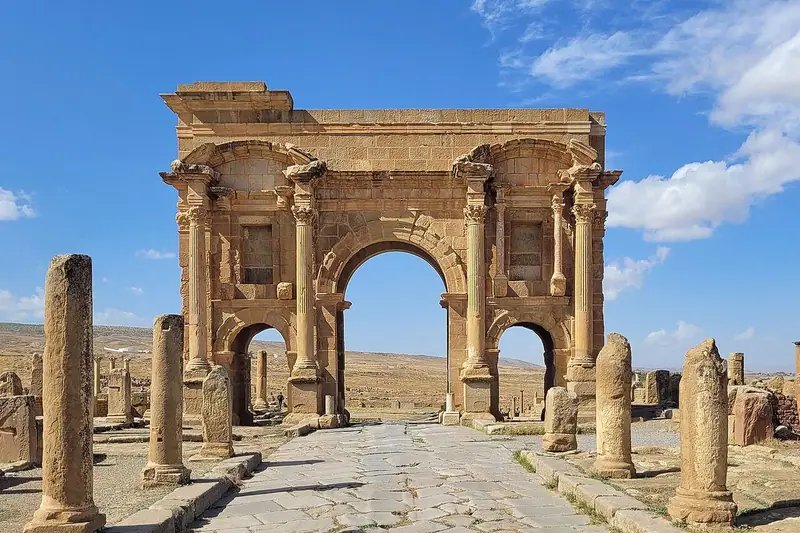
- Stop 5 · Arch of Trajan (also the cover): Bernard Gagnon · CC BY 4.0 · Wikimedia Commons · resized
- Stop 6 · Market of Sertius: Manar.melow · CC BY-SA 4.0 · Wikimedia Commons · resized
- Stop 7 · Capitol: Bernard Gagnon · CC BY 4.0 · Wikimedia Commons · resized
- Stop 8 · Byzantine Fort: Reda Kerbush · CC BY-SA 4.0 · Wikimedia Commons · resized


All photographs from Wikimedia Commons under the licences shown.
More guides in Algeria
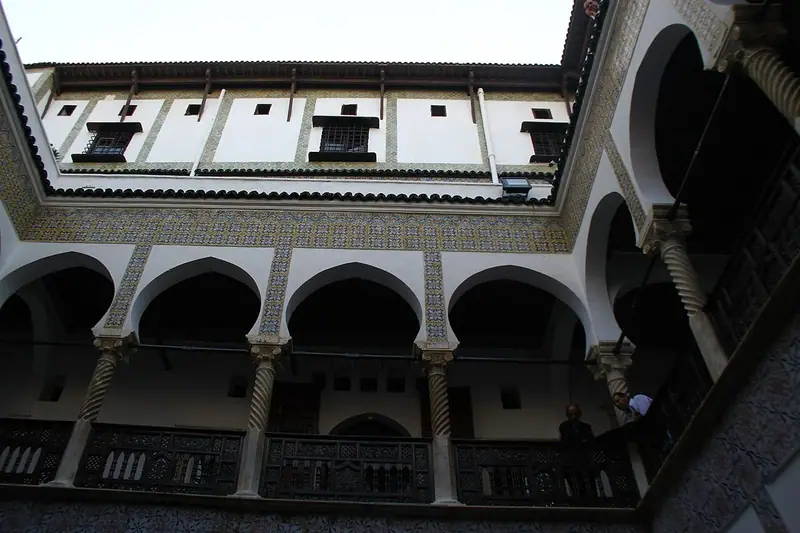 Ottoman9 stops · 16th–19th century
Casbah of Algiers audio guide
Up the stepped lanes of old Algiers, past Ottoman mosques and palaces of the deys, to the citadel at the top of the Casbah.
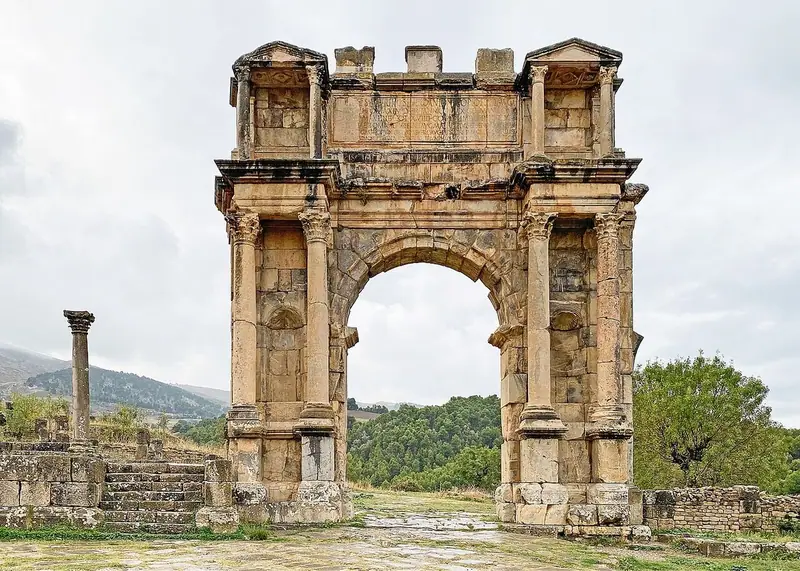 Roman8 stops · c. 96 CE – 6th century
Djémila audio guide
Roman Cuicul on its mountain spur, from the Severan square and the Arch of Caracalla to the theatre and the Christian quarter.
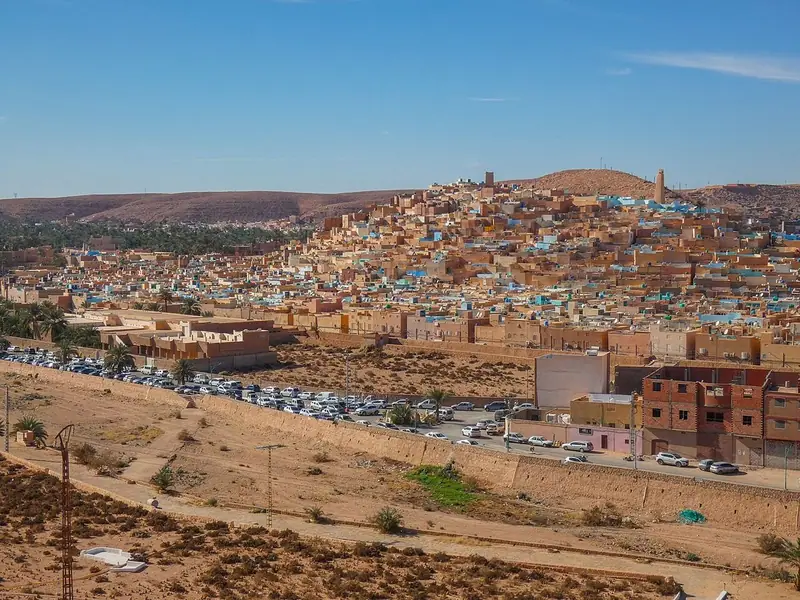 Amazigh9 stops · 1012 – 1350 (foundation of the five ksour)
M’zab Valley audio guide
Five fortified Ibadi towns of the northern Sahara: Ghardaïa, Melika, Beni Isguen, Bou Noura and El Atteuf, with watchtower minarets, palm groves and an ancient system for sharing floodwater.
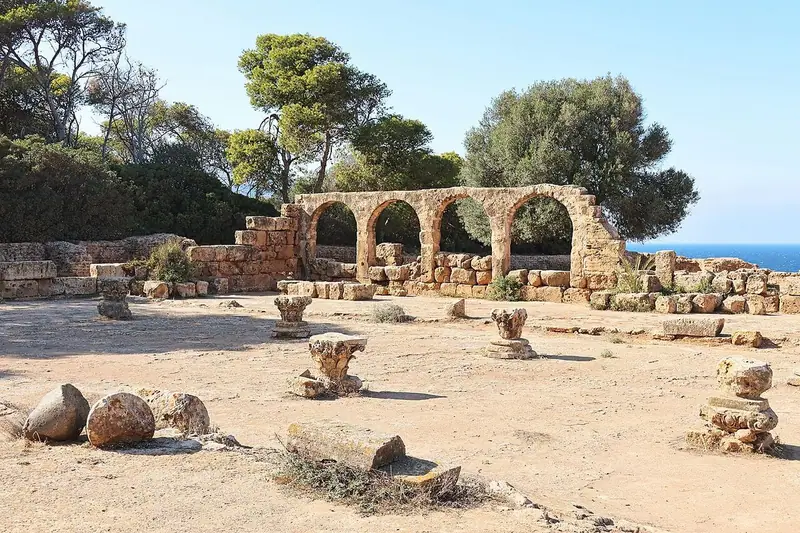 Roman8 stops · 6th century BCE – 6th century CE
Tipasa audio guide
Roman ruins among pines above the Mediterranean, from the amphitheatre and the Great Basilica to Camus’s stele and the Royal Mausoleum of Mauretania.
Every guide, in every country
Timgad and every other guide we publish, including future ones. One payment, no subscription.