Before you start
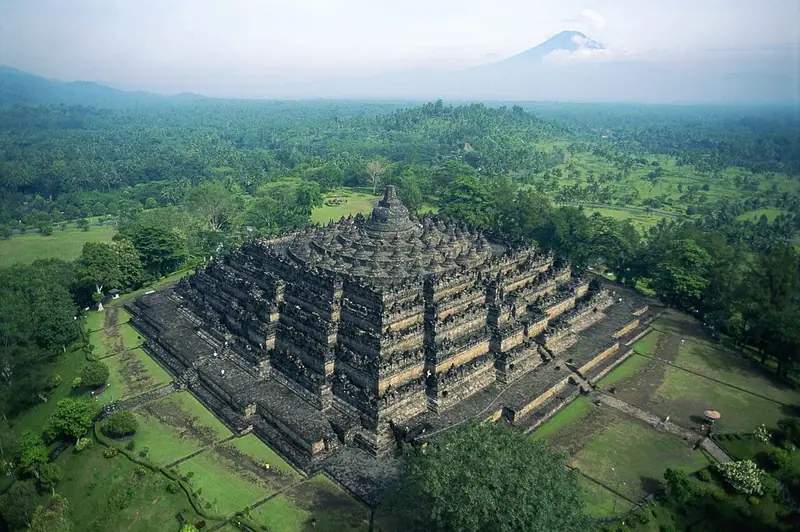
Borobudur rises from the green Kedu Plain of Central Java, about forty kilometres north-west of Yogyakarta, ringed by volcanoes. It is the largest Buddhist temple in the world and the most visited monument in Indonesia, and it became a UNESCO World Heritage Site in 1991. The monument is built as a single vast stupa on a hill, rising in nine platforms: six square terraces lined with carved galleries, and three circular terraces crowned by a great central stupa. Pilgrims climbed it clockwise, gallery by gallery, moving symbolically from the world of desire towards enlightenment. Climbing the monument now needs a separate ticket, is guided and is limited in numbers, and parts may be closed, so check before you go. This guide follows the pilgrims’ route from the grounds to the summit.
Use it as a self-guided tour of Borobudur: 8 stops in visit order, each played when you’re ready, at your own pace.
 Free preview · Stop 1
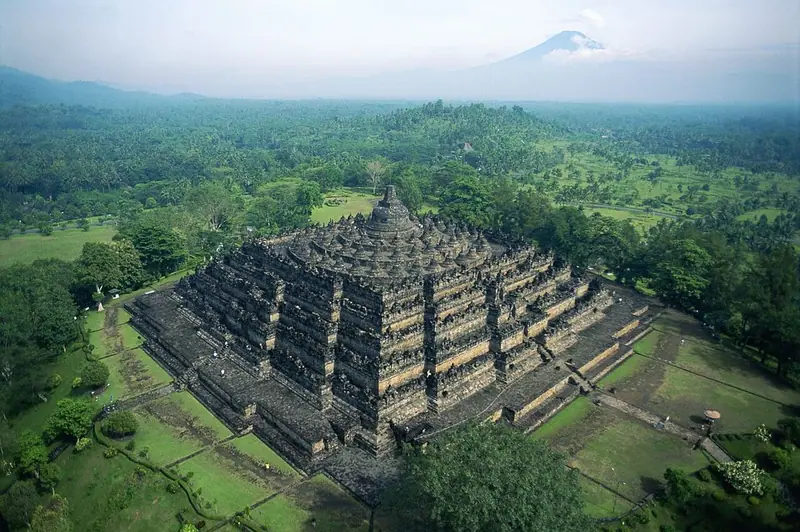
The Temple Grounds
Walk up through the gardens to the foot of the monument and look at its shape. From a distance Borobudur looks like a stepped hill crowned with bell-shaped stupas, the whole forming a single great stupa and, seen from above, a mandala, a diagram of the Buddhist universe. Its base is a square of about 118 metres on each side. The main stairway is on the east side, and pilgrims began here. Look around at the landscape: the volcanoes of Merapi and Merbabu rise to the east, and Sumbing and Sindoro to the north-west. During restoration in the early twentieth century, it was noticed that Borobudur stands in a straight line with two smaller temples to the east, Pawon and Mendut, and the annual Vesak procession still walks from Mendut to Borobudur. Take a moment before you begin your ascent.
Photo: Zaenulihsan91 · CC BY-SA 4.0 · Wikimedia Commons
What to see at Borobudur: 8 stops, in visit order
- 01
 The Temple GroundsApproach from the EastFree preview
- 02
 The Hidden FootReliefs of Cause and EffectIn the guide
- 03
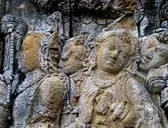 Life of the BuddhaFirst GalleryIn the guide
- 04
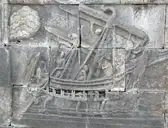 Tales of Former LivesJatakas and AvadanasIn the guide
- 05
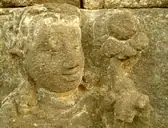 The Upper GalleriesSearch for WisdomIn the guide
- 06
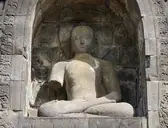 Buddhas in the NichesGuardians of the DirectionsIn the guide
- 07
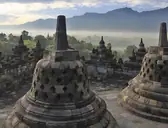 The Circular TerracesSeventy-Two StupasIn the guide
- 08
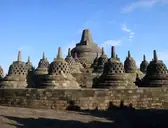 The Main StupaSummitIn the guide
History of Borobudur
Borobudur was built by the Sailendra dynasty, rulers of the kingdom of Mataram in Central Java, who were devoted to Mahayana Buddhism and held power there from the mid-eighth century until the middle of the ninth. No record of its construction survives, but by comparing the style of its carvings and inscriptions, scholars date the work to between about 780 and 833. It was raised over a natural hill from blocks of volcanic stone fitted together without mortar. After the centre of power moved to East Java in the tenth century, the monument was gradually abandoned and covered by volcanic ash and jungle. In 1814 the British governor Stamford Raffles sent the engineer Hermann Cornelius to clear it, and major restorations followed in 1907 to 1911 and in 1975 to 1982.
Borobudur guide: questions
How many stops does the Borobudur guide have?
8 stops, in visit order: 1. The Temple Grounds; 2. The Hidden Foot; 3. Life of the Buddha; 4. Tales of Former Lives; 5. The Upper Galleries; 6. Buddhas in the Niches; 7. The Circular Terraces; 8. The Main Stupa.
Can I do a self-guided tour of Borobudur with this guide?
Yes. The guide is made for a self-guided tour: 8 stops in visit order, each with a photo, a story and a voice, so you can explore Borobudur at your own pace, without joining a group. Download it before you go and it works offline.
How long is each guide?
The 8 stops add up to about 6 minutes of listening in total. You play each stop when you’re ready, so you can go at your own pace.
Does the guide work offline?
Yes, once it’s downloaded. The guide is a single self-contained web page (about 7.7 MB) with the photos, text and audio built in. Download it to your phone before you go (Wi-Fi is best); after that it opens in any modern browser on iPhone or Android, with no app, account or mobile signal needed.
Does it use GPS or need my location?
No. The guide doesn’t use GPS and doesn’t know where you are: you play each stop when you reach it. It works on iPhone and Android in any modern browser, and it’s in English.
What’s included?
One self-contained HTML guide: 8 stops in visit order, each with a photo, text and a voice, plus the story of who built the site.
Who built Borobudur?
Borobudur was built by the Sailendra dynasty, rulers of the kingdom of Mataram in Central Java, who were devoted to Mahayana Buddhism and held power there from the mid-eighth century until the middle of the ninth. No record of its construction survives, but by comparing the style of its carvings and inscriptions, scholars date the work to between about 780 and 833.
Where is Borobudur?
Borobudur rises from the green Kedu Plain of Central Java, about forty kilometres north-west of Yogyakarta, ringed by volcanoes.
Is there a free audio guide to Borobudur?
The first stop, The Temple Grounds, is free to read and hear on this page, so you can try the Borobudur audio tour before you buy. The full guide, with all 8 stops, is a one-off purchase: download it once and it’s yours to keep, working offline.
Is the Borobudur guide worth it?
If you’d like to know what you’re looking at, yes. For $10 you get 8 stops in visit order, each with a photo, a short history and a voice you play when you’re ready, about 6 minutes of listening in all. It’s short on purpose, so you spend your time looking, not listening. It’s yours to keep, works offline and needs no app. The first stop is free on this page, so you can try it before you buy. If you’d like hours of detail, a guided tour will go deeper.
Audio guide or guided tour?
It depends how you like to visit. This guide lets you explore Borobudur at your own pace, at any time, for a one-off price. A guided tour gives you a live expert you can ask questions, but at fixed times and usually for a higher price. Many people use both: a tour for the big picture, and the guide to read beforehand or to revisit the stops in their own time.
Is this the official Borobudur guide?
No. It’s an independent guide by The Historian Guide, not affiliated with or endorsed by the operator of Borobudur. For tickets and opening hours, check the official site operator before you go.
Does the guide include entry tickets or opening hours?
No. The guide is a digital companion only. Admission to Borobudur is separate, so check the official site operator for current tickets and opening hours before you go.
- Stop 1 · The Temple Grounds (also the cover): Zaenulihsan91 · CC BY-SA 4.0 · Wikimedia Commons · resized
- Stop 2 · The Hidden Foot: Photo Dharma from Penang, Malaysia · CC BY 2.0 · Wikimedia Commons · resized
- Stop 3 · Life of the Buddha: Photo Dharma from Penang, Malaysia · CC BY 2.0 · Wikimedia Commons · resized
- Stop 4 · Tales of Former Lives: Andreas Sihono · CC BY-SA 3.0 · Wikimedia Commons · resized
- Stop 5 · The Upper Galleries: Photo Dharma from Penang, Malaysia · CC BY 2.0 · Wikimedia Commons · resized
- Stop 6 · Buddhas in the Niches: Anandajoti Bhikkhu · CC BY-SA 3.0 · Wikimedia Commons · resized
- Stop 7 · The Circular Terraces: Photo by CEphoto, Uwe Aranas or alternatively © CEphoto, Uwe Aranas · CC BY-SA 3.0 · Wikimedia Commons · resized
- Stop 8 · The Main Stupa: Gunawan Kartapranata · CC BY-SA 4.0 · Wikimedia Commons · resized


All photographs from Wikimedia Commons under the licences shown.
More guides in Indonesia
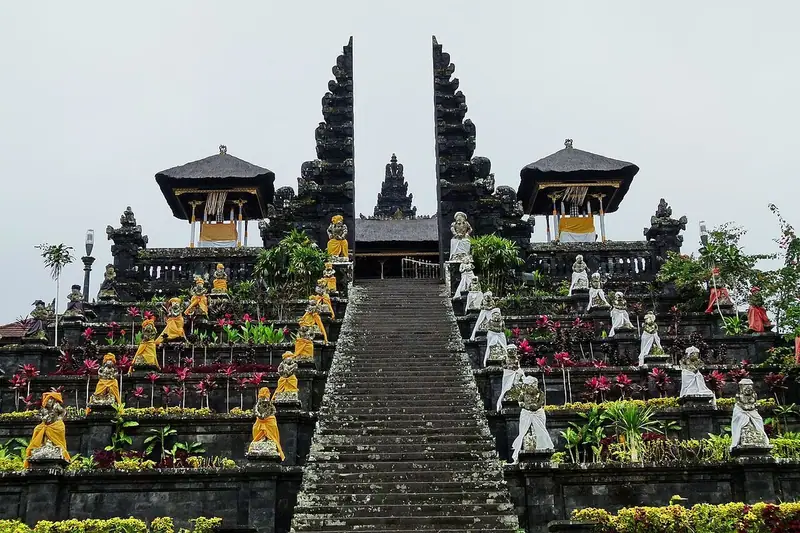 Balinese Hindu8 stops · from the 13th century CE
Besakih Temple audio guide
Climb the slopes of Mount Agung to Bali’s Mother Temple: twenty-three temples along the ridges, with the great Pura Penataran Agung at their heart.
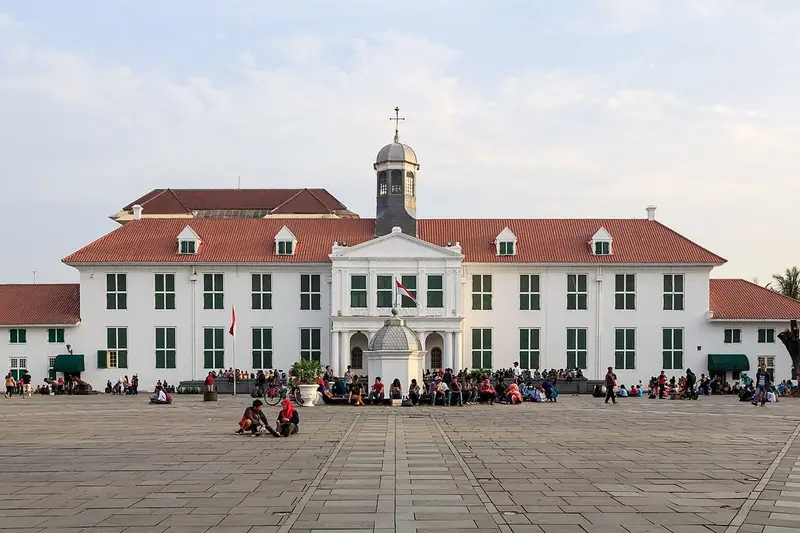 Dutch Colonial8 stops · 1619–1799 CE
Kota Tua Jakarta audio guide
The cobbled square of old Batavia, Asian headquarters of the Dutch East India Company, past the Red Shop to the old harbour of Sunda Kelapa.
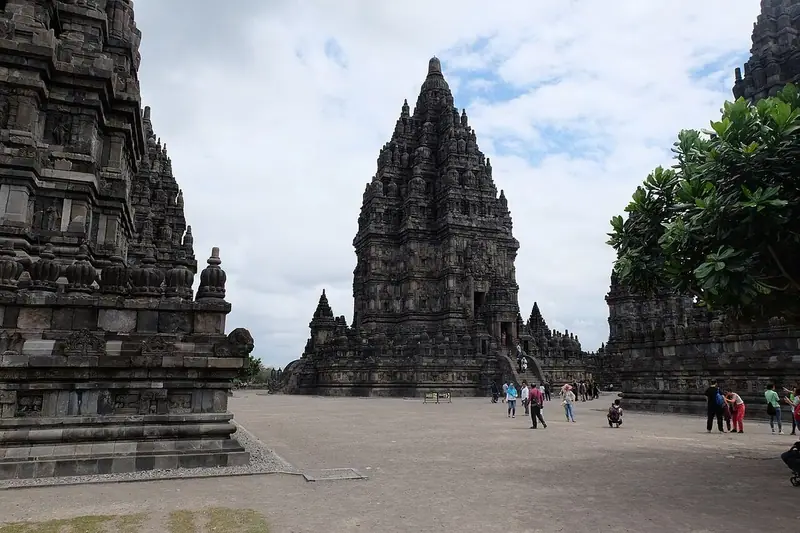 Mataram8 stops · c. 850 CE
Prambanan audio guide
Soaring stone towers to Shiva, Vishnu and Brahma, wrapped in reliefs of the Ramayana.
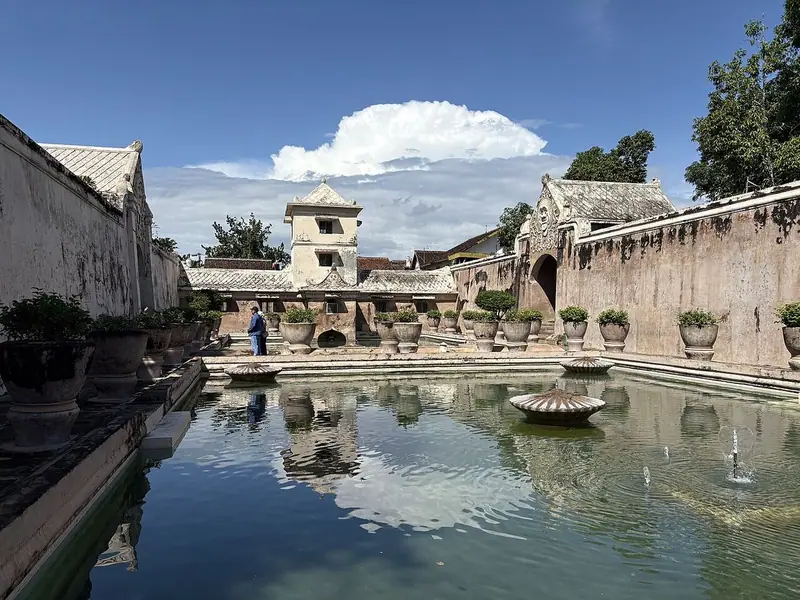 Yogyakarta Sultanate8 stops · from 1755 CE
Yogyakarta Kraton audio guide
Explore the living palace of the Sultan of Yogyakarta, built in 1755–56, then walk on through the old lanes to Taman Sari, the Water Castle.
Every guide, in every country
Borobudur and every other guide we publish, including future ones. One payment, no subscription.