Before you start
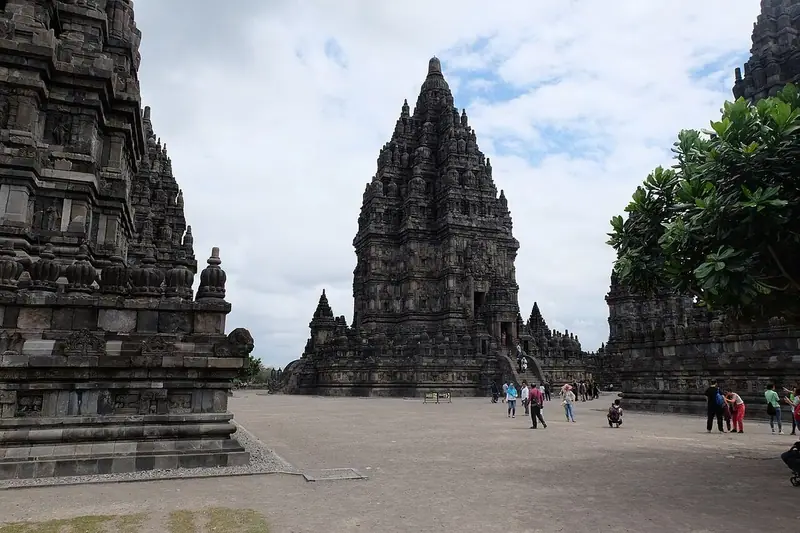
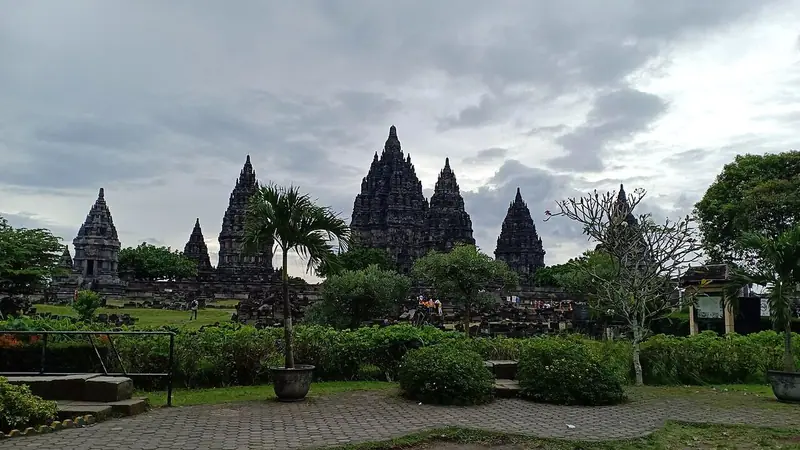
Prambanan lies about seventeen kilometres north-east of Yogyakarta, on the border between Yogyakarta and Central Java. It is the largest Hindu temple site in Indonesia, a soaring group of stone towers dedicated to the three great gods of Hinduism: Brahma the creator, Vishnu the preserver and Shiva the destroyer. Together with the nearby Buddhist temples of Sewu, Lumbung and Bubrah, it became a UNESCO World Heritage Site in 1991. The temples stand in a large archaeological park. This guide begins in the central courtyard of Prambanan, visits the three main temples and their carvings and the shrines of the gods’ mounts, then heads north through the park past Lumbung and Bubrah to the Buddhist complex of Sewu. Some interiors may be closed, and access arrangements change, so check on arrival.
Use it as a self-guided tour of Prambanan: 8 stops in visit order, each played when you’re ready, at your own pace.
 Free preview · Stop 1
The Central Courtyard
Enter the raised central courtyard, the holiest part of the temple compound. Prambanan was laid out as a series of square enclosures, one inside another. In the outer zones stood 224 small shrines in four rows, most of which still lie in heaps of stones, with only a handful rebuilt. Here in the centre stand sixteen temples. On the western side are the three great temples of the Trimurti, with Shiva in the middle, Vishnu to the north and Brahma to the south. Facing them on the eastern side are three smaller temples for the animals that carried the gods. Between the two rows, at the north and south ends, stand two flanking temples, and small shrines mark the gates and corners. Look up at the pointed towers, crowned with stone finials, which give Prambanan its dramatic outline against the sky.
Photo: Firzafp · CC BY-SA 4.0 · Wikimedia Commons
What to see at Prambanan: 8 stops, in visit order
- 01
 The Central CourtyardTemple PlanFree preview
- 02
 Shiva TempleMain ShrineIn the guide
- 03
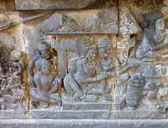 Ramayana ReliefsStory in StoneIn the guide
- 04
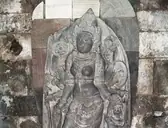 Rara JonggrangThe Slender MaidenIn the guide
- 05
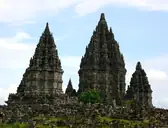 Vishnu and Brahma TemplesPreserver and CreatorIn the guide
- 06
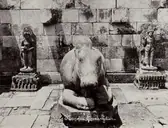 The Vahana TemplesMounts of the GodsIn the guide
- 07
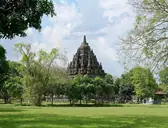 Lumbung and BubrahTemples of the ParkIn the guide
- 08
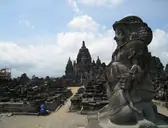 SewuA Thousand TemplesIn the guide
Site map of Prambanan
History of Prambanan
Prambanan was built by the kingdom of Mataram, also known as Medang, which ruled Central Java from the early eighth century and moved its centre to East Java in the tenth, lasting until the early eleventh century. Its kings patronised both Buddhism and Hinduism. The Buddhist temple of Sewu was begun in the late eighth century, while Prambanan was probably started by King Rakai Pikatan, whose name was found painted on a stone of the Shiva temple. An inscription of 856 records the inauguration of a great temple to Shiva, which is thought to be Prambanan, by his successor, Lokapala. After the court moved east, the temples were abandoned, and they collapsed in a major earthquake in the sixteenth century. Restoration began in 1918 and still continues.
Prambanan guide: questions
How many stops does the Prambanan guide have?
8 stops, in visit order: 1. The Central Courtyard; 2. Shiva Temple; 3. Ramayana Reliefs; 4. Rara Jonggrang; 5. Vishnu and Brahma Temples; 6. The Vahana Temples; 7. Lumbung and Bubrah; 8. Sewu.
Can I do a self-guided tour of Prambanan with this guide?
Yes. The guide is made for a self-guided tour: 8 stops in visit order, each with a photo, a story and a voice, so you can explore Prambanan at your own pace, without joining a group. Download it before you go and it works offline.
How long is each guide?
The 8 stops add up to about 6 minutes of listening in total. You play each stop when you’re ready, so you can go at your own pace.
Does the guide work offline?
Yes, once it’s downloaded. The guide is a single self-contained web page (about 7.6 MB) with the photos, text and audio built in. Download it to your phone before you go (Wi-Fi is best); after that it opens in any modern browser on iPhone or Android, with no app, account or mobile signal needed.
Does it use GPS or need my location?
No. The guide doesn’t use GPS and doesn’t know where you are: you play each stop when you reach it. It works on iPhone and Android in any modern browser, and it’s in English.
What’s included?
One self-contained HTML guide: 8 stops in visit order, each with a photo, text and a voice, plus the story of who built the site.
Who built Prambanan?
Prambanan was built by the kingdom of Mataram, also known as Medang, which ruled Central Java from the early eighth century and moved its centre to East Java in the tenth, lasting until the early eleventh century. Its kings patronised both Buddhism and Hinduism.
Where is Prambanan?
Prambanan lies about seventeen kilometres north-east of Yogyakarta, on the border between Yogyakarta and Central Java.
Is there a free audio guide to Prambanan?
The first stop, The Central Courtyard, is free to read and hear on this page, so you can try the Prambanan audio tour before you buy. The full guide, with all 8 stops, is a one-off purchase: download it once and it’s yours to keep, working offline.
Is the Prambanan guide worth it?
If you’d like to know what you’re looking at, yes. For $10 you get 8 stops in visit order, each with a photo, a short history and a voice you play when you’re ready, plus a site map of the stops, and about 6 minutes of listening in all. It’s short on purpose, so you spend your time looking, not listening. It’s yours to keep, works offline and needs no app. The first stop is free on this page, so you can try it before you buy. If you’d like hours of detail, a guided tour will go deeper.
Audio guide or guided tour?
It depends how you like to visit. This guide lets you explore Prambanan at your own pace, at any time, for a one-off price. A guided tour gives you a live expert you can ask questions, but at fixed times and usually for a higher price. Many people use both: a tour for the big picture, and the guide to read beforehand or to revisit the stops in their own time.
Is this the official Prambanan guide?
No. It’s an independent guide by The Historian Guide, not affiliated with or endorsed by the operator of Prambanan. For tickets and opening hours, check the official site operator before you go.
Does the guide include entry tickets or opening hours?
No. The guide is a digital companion only. Admission to Prambanan is separate, so check the official site operator for current tickets and opening hours before you go.
- Stop 1 · The Central Courtyard: Firzafp · CC BY-SA 4.0 · Wikimedia Commons · resized
- Stop 2 · Shiva Temple (also the cover): Magul · CC BY-SA 4.0 · Wikimedia Commons · resized
- Stop 3 · Ramayana Reliefs: Photo Dharma from Penang, Malaysia · CC BY 2.0 · Wikimedia Commons · resized
- Stop 4 · Rara Jonggrang: Gunawan Kartapranata · CC BY-SA 4.0 · Wikimedia Commons · cropped and resized
- Stop 5 · Vishnu and Brahma Temples: Anthony Cramp · CC BY 2.0 · Wikimedia Commons · resized
- Stop 6 · The Vahana Temples: Kassian Cephas · Public domain · Wikimedia Commons · resized
- Stop 7 · Lumbung and Bubrah: Jakub Hałun · CC BY-SA 4.0 · Wikimedia Commons · resized
- Stop 8 · Sewu: Photo Dharma from Penang, Malaysia · CC BY 2.0 · Wikimedia Commons · resized


All photographs from Wikimedia Commons under the licences shown.
More guides in Indonesia
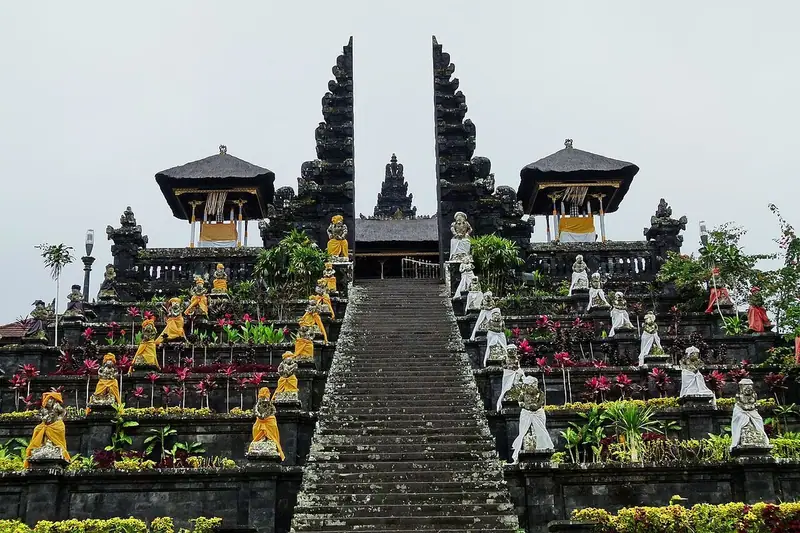 Balinese Hindu8 stops · from the 13th century CE
Besakih Temple audio guide
Climb the slopes of Mount Agung to Bali’s Mother Temple: twenty-three temples along the ridges, with the great Pura Penataran Agung at their heart.
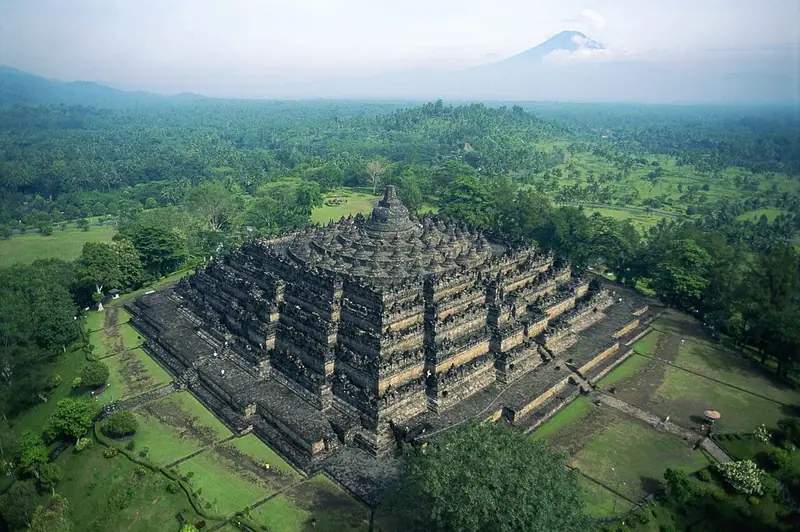 Sailendra8 stops · c. 780–830 CE
Borobudur audio guide
Circle upwards past the life of the Buddha in stone, gallery after gallery, to the stupas of the circular terraces.
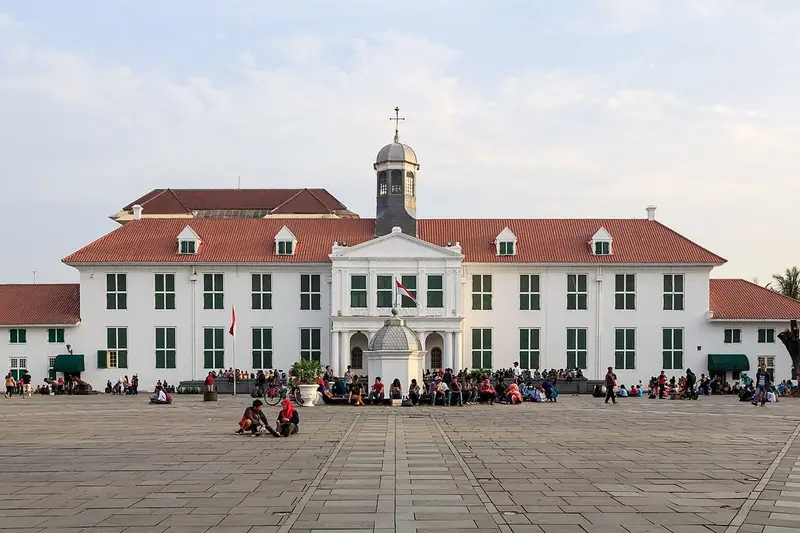 Dutch Colonial8 stops · 1619–1799 CE
Kota Tua Jakarta audio guide
The cobbled square of old Batavia, Asian headquarters of the Dutch East India Company, past the Red Shop to the old harbour of Sunda Kelapa.
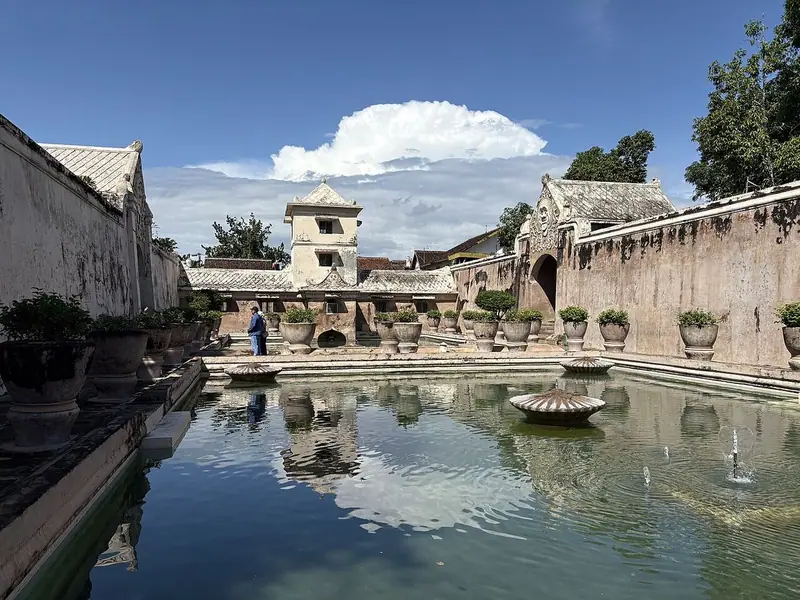 Yogyakarta Sultanate8 stops · from 1755 CE
Yogyakarta Kraton audio guide
Explore the living palace of the Sultan of Yogyakarta, built in 1755–56, then walk on through the old lanes to Taman Sari, the Water Castle.
Every guide, in every country
Prambanan and every other guide we publish, including future ones. One payment, no subscription.