Before you start
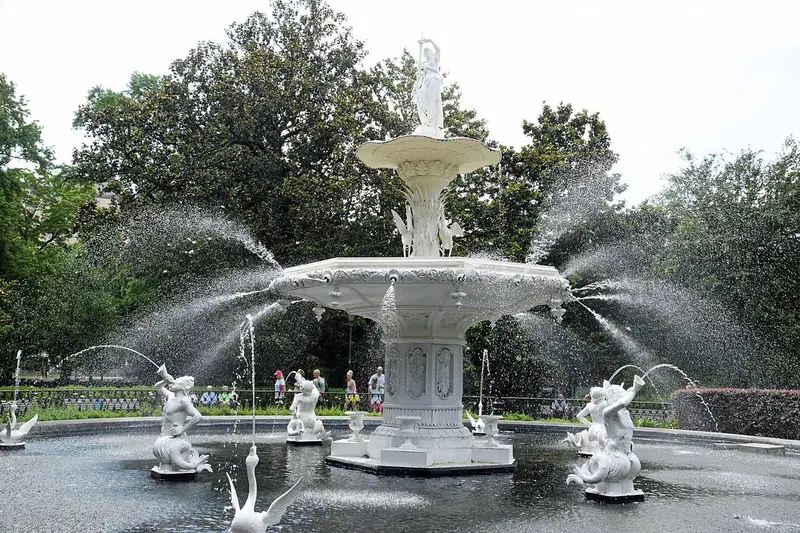
Savannah stands on a bluff above the Savannah River, about twenty-five kilometres from the Atlantic, in the south-east corner of Georgia. It was founded in 1733 as the first town of the colony of Georgia, and it was laid out to a plan of wards built around small public squares, linked by a grid of streets. Of the twenty-four squares that were laid out, twenty-two survive, shaded by live oaks hung with Spanish moss and lined with houses, churches and monuments from almost three centuries. This guide starts at one of the oldest African American churches in the country, follows the river bluff to City Hall, then goes south through the squares, past a house museum and the old cemetery, to the fountain in Forsyth Park.
Use it as a self-guided tour of Savannah: 10 stops in visit order, each played when you’re ready, at your own pace.
 Free preview · Stop 1
The First African Baptist Church
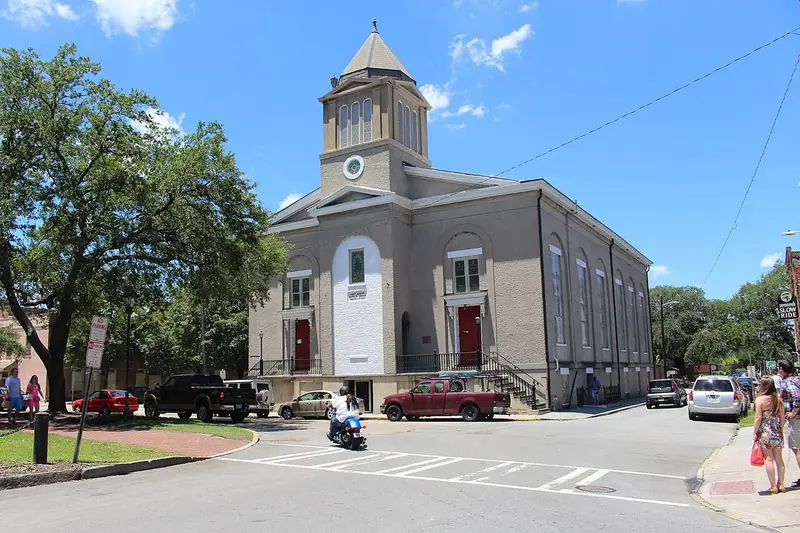
Begin at the First African Baptist Church on Franklin Square, at the western edge of the old town. The congregation traces its roots to 1773, when George Leile, an enslaved man who became the first African American licensed by the Baptists to preach in Georgia, gathered believers at a plantation near the city. It is one of the oldest African American churches in North America, though other congregations also claim to be the first. The present church was finished in 1859. It was built of Savannah grey brick by members of the congregation, both free and enslaved, many of whom worked on it after their day's labour was done. Inside are a gallery with pews made by enslaved craftsmen, and a pattern of holes drilled in the floor, which church tradition links to a crawl space used to hide people escaping from slavery. In the twentieth century the church was a centre of the civil rights movement, and Martin Luther King Junior spoke here.
Photo: Michael Rivera · CC BY-SA 4.0 · Wikimedia Commons
What to see at Savannah: 10 stops, in visit order
- 01
 The First African Baptist ChurchA congregation older than the nationFree preview
- 02
 City Hall and Factors WalkThe bluff above the riverIn the guide
- 03
 Johnson SquareThe first squareIn the guide
- 04
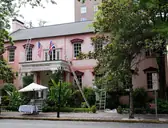 Reynolds SquareJohn Wesley's squareIn the guide
- 05
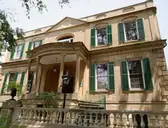 The Owens–Thomas HouseA Regency house and its slave quartersIn the guide
- 06
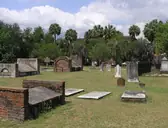 Colonial Park CemeteryThe old burial groundIn the guide
- 07
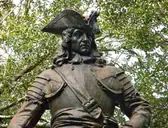 Chippewa SquareOglethorpe's statueIn the guide
- 08
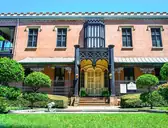 Madison SquareSherman's headquartersIn the guide
- 09
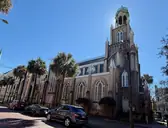 Monterey SquareThe synagogue and the Mercer HouseIn the guide
- 10
 Forsyth ParkThe fountainIn the guide
History of Savannah
The Yamacraw people, led by Tomochichi, lived on the bluff when on 12 February 1733 General James Oglethorpe landed with the first settlers from the ship Anne. Oglethorpe and Tomochichi agreed to share the land, and Oglethorpe laid out the town to his plan of wards and squares. The colony at first banned slavery, but the ban was lifted in 1751, and the rice and cotton economy that followed rested on the labour of enslaved Africans. During the American Revolution the British took Savannah in 1778, and in 1779 a French and American army failed to win it back. In the nineteenth century the city became one of the great cotton ports of the world. In December 1864 the Union general William Tecumseh Sherman reached Savannah at the end of his March to the Sea, and the city surrendered without a battle.
The full history continues in the guide.
Savannah guide: questions
How many stops does the Savannah guide have?
10 stops, in visit order: 1. The First African Baptist Church; 2. City Hall and Factors Walk; 3. Johnson Square; 4. Reynolds Square; 5. The Owens–Thomas House; 6. Colonial Park Cemetery; 7. Chippewa Square; 8. Madison Square; 9. Monterey Square; 10. Forsyth Park.
Can I do a self-guided tour of Savannah with this guide?
Yes. The guide is made for a self-guided tour: 10 stops in visit order, each with a photo, a story and a voice, so you can explore Savannah at your own pace, without joining a group. Download it before you go and it works offline.
How long is each guide?
The 10 stops add up to about 8 minutes of listening in total. You play each stop when you’re ready, so you can go at your own pace.
Does the guide work offline?
Yes, once it’s downloaded. The guide is a single self-contained web page (about 10.3 MB) with the photos, text and audio built in. Download it to your phone before you go (Wi-Fi is best); after that it opens in any modern browser on iPhone or Android, with no app, account or mobile signal needed.
Does it use GPS or need my location?
No. The guide doesn’t use GPS and doesn’t know where you are: you play each stop when you reach it. It works on iPhone and Android in any modern browser, and it’s in English.
What’s included?
One self-contained HTML guide: 10 stops in visit order, each with a photo, text and a voice, plus the story of who built the site.
Who built Savannah?
The Yamacraw people, led by Tomochichi, lived on the bluff when on 12 February 1733 General James Oglethorpe landed with the first settlers from the ship Anne. Oglethorpe and Tomochichi agreed to share the land, and Oglethorpe laid out the town to his plan of wards and squares.
Where is Savannah?
Savannah stands on a bluff above the Savannah River, about twenty-five kilometres from the Atlantic, in the south-east corner of Georgia.
Is there a free audio guide to Savannah?
The first stop, The First African Baptist Church, is free to read and hear on this page, so you can try the Savannah audio tour before you buy. The full guide, with all 10 stops, is a one-off purchase: download it once and it’s yours to keep, working offline.
Is the Savannah guide worth it?
If you’d like to know what you’re looking at, yes. For $10 you get 10 stops in visit order, each with a photo, a short history and a voice you play when you’re ready, about 8 minutes of listening in all. It’s short on purpose, so you spend your time looking, not listening. It’s yours to keep, works offline and needs no app. The first stop is free on this page, so you can try it before you buy. If you’d like hours of detail, a guided tour will go deeper.
Audio guide or guided tour?
It depends how you like to visit. This guide lets you explore Savannah at your own pace, at any time, for a one-off price. A guided tour gives you a live expert you can ask questions, but at fixed times and usually for a higher price. Many people use both: a tour for the big picture, and the guide to read beforehand or to revisit the stops in their own time.
Is this the official Savannah guide?
No. It’s an independent guide by The Historian Guide, not affiliated with or endorsed by the operator of Savannah. For tickets and opening hours, check the official site operator before you go.
Does the guide include entry tickets or opening hours?
No. The guide is a digital companion only. Admission to Savannah is separate, so check the official site operator for current tickets and opening hours before you go.
- Stop 1 · The First African Baptist Church: Michael Rivera · CC BY-SA 4.0 · Wikimedia Commons · resized
- Stop 2 · City Hall and Factors Walk: Billy Hathorn · CC BY-SA 3.0 · Wikimedia Commons · resized
- Stop 3 · Johnson Square: Tjbliss · CC BY 4.0 · Wikimedia Commons · resized
- Stop 4 · Reynolds Square: Jud McCranie · CC BY-SA 4.0 · Wikimedia Commons · resized
- Stop 5 · The Owens–Thomas House: Judson McCranie · CC BY-SA 3.0 · Wikimedia Commons · resized
- Stop 6 · Colonial Park Cemetery: Daniel Mayer · CC BY-SA 3.0 · Wikimedia Commons · resized
- Stop 7 · Chippewa Square: Jennifer Morrow from San Francisco · CC BY 2.0 · Wikimedia Commons · resized
- Stop 8 · Madison Square: Pabaguilar · CC BY-SA 3.0 · Wikimedia Commons · resized
- Stop 9 · Monterey Square: Oleg Yunakov · CC BY-SA 4.0 · Wikimedia Commons · resized
- Stop 10 · Forsyth Park (also the cover): Bubba73 (Jud McCranie) · CC BY-SA 4.0 · Wikimedia Commons · resized


All photographs from Wikimedia Commons under the licences shown.
More guides in United States
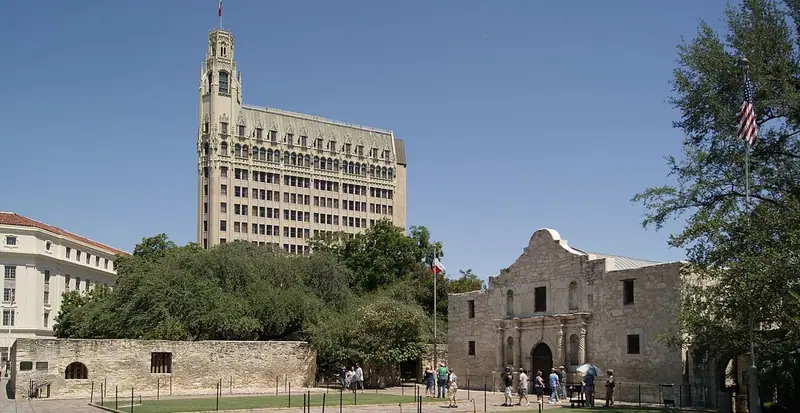 Spanish Colonial7 stops · 1718–1782
Alamo and San Antonio Missions audio guide
From the battle-scarred Alamo to Mission San José and the Espada Aqueduct, the five missions that made San Antonio.
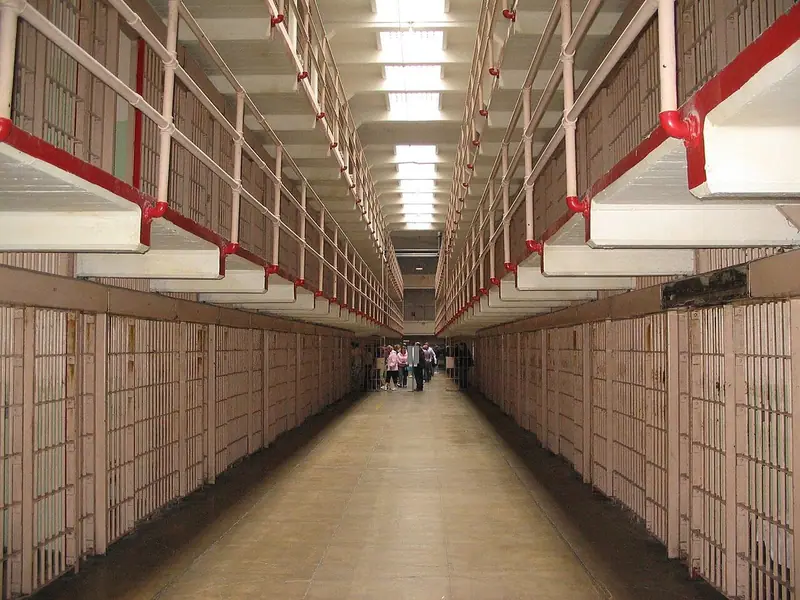 Modern8 stops · 1853–1963
Alcatraz audio guide
Step off the boat into the cellhouse, walk D Block and the yard, and hear the story of the 1962 escape.
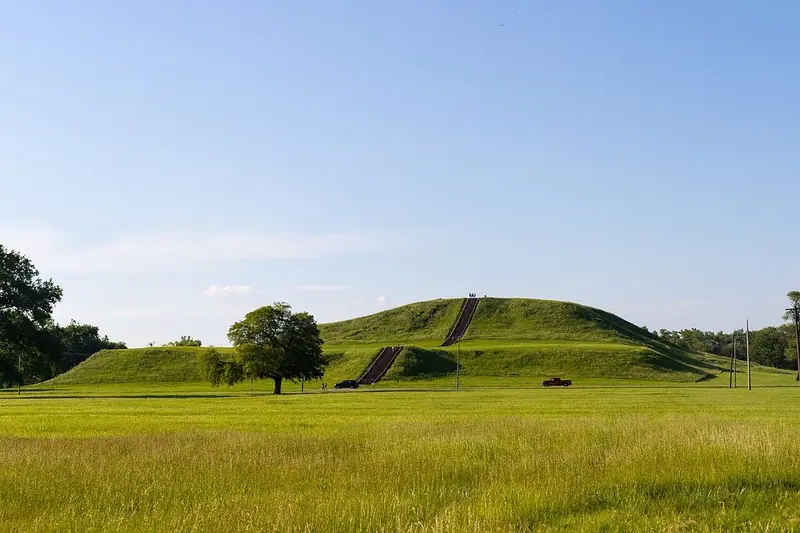 Mississippian8 stops · c. 1050 – 1350 CE
Cahokia Mounds audio guide
The largest pre-Columbian city north of Mexico, with Monks Mound, the Grand Plaza and the remains of its solar calendar posts.
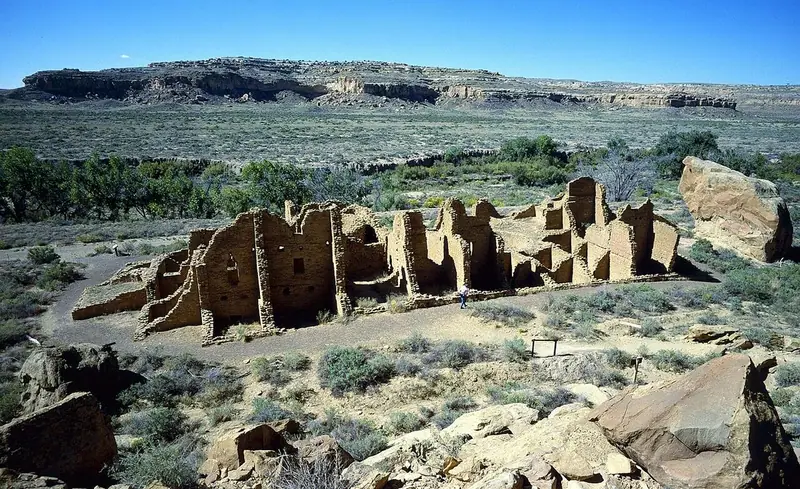 Ancestral Puebloan8 stops · c. 850–1150 CE
Chaco Canyon audio guide
The great houses of Pueblo Bonito and Chetro Ketl, planned buildings of stone that rose several storeys high.
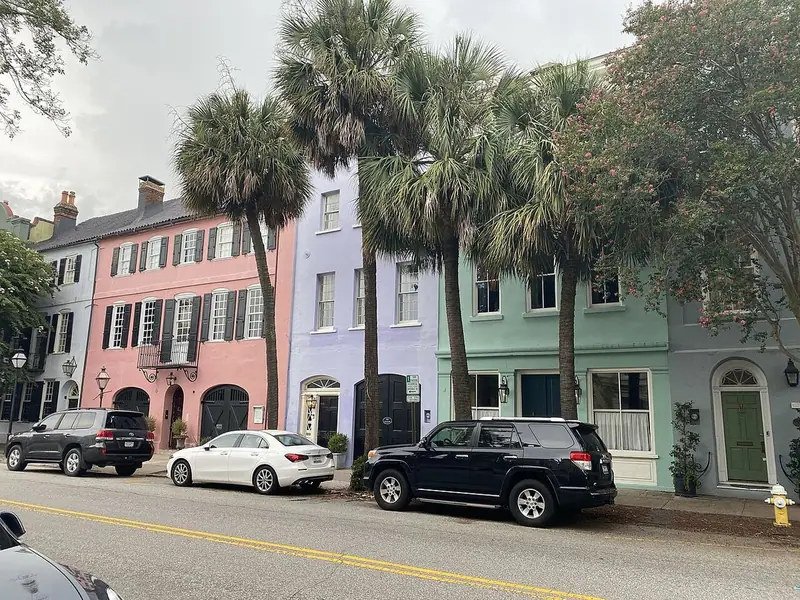 Colonial American12 stops · 17th–20th century CE
Charleston audio guide
Mother Emanuel and Beth Elohim, St Philip’s and the Huguenot Church, the Old Slave Mart, the Four Corners of Law, Rainbow Row and the Battery.
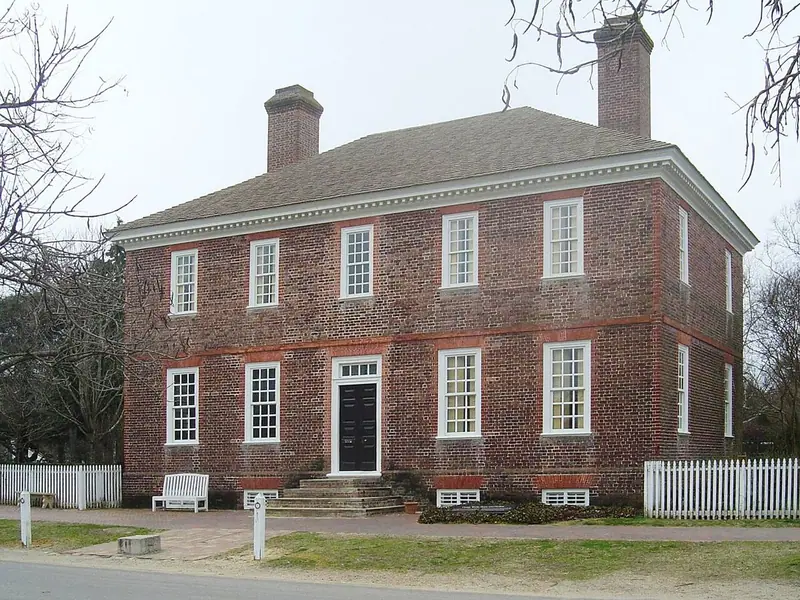 Colonial American8 stops · 1699–1780
Colonial Williamsburg audio guide
Duke of Gloucester Street, from the Capitol to the Governor’s Palace, in the restored capital of colonial Virginia.
Every guide, in every country
Savannah and every other guide we publish, including future ones. One payment, no subscription.