Before you start
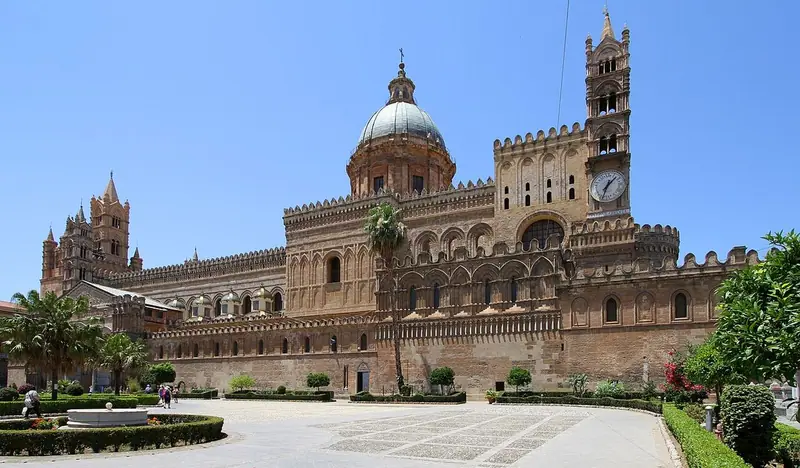
In the twelfth century Palermo was the capital of the Norman Kingdom of Sicily, one of the richest and most cosmopolitan states in Europe. Its kings were Norman, but they ruled over Muslims, Greek-speaking Christians, Latins and Jews, and they employed Arab craftsmen, Byzantine mosaicists and Western masons side by side. The result was an art found nowhere else: churches with red domes like those of North Africa, Arabic inscriptions beside Greek ones, and walls of glittering gold mosaic. In 2015 UNESCO inscribed nine of these buildings, from the period between 1130 and 1194, as a World Heritage Site: Arab-Norman Palermo and the Cathedral Churches of Cefalù and Monreale. This guide visits all nine in one pass from west to east: it begins at the cathedral of Monreale in the hills above the city, comes down to the Zisa, takes in the cathedral, the royal palace and San Giovanni degli Eremiti in the old city of Palermo, crosses to the Piazza Bellini and the Admiral’s Bridge, and ends at the cathedral of Cefalù by the sea.
Use it as a self-guided tour of Arab-Norman Palermo, Monreale and Cefalù: 11 stops in visit order, each played when you’re ready, at your own pace.
 Free preview · Stop 1
Monreale Cathedral
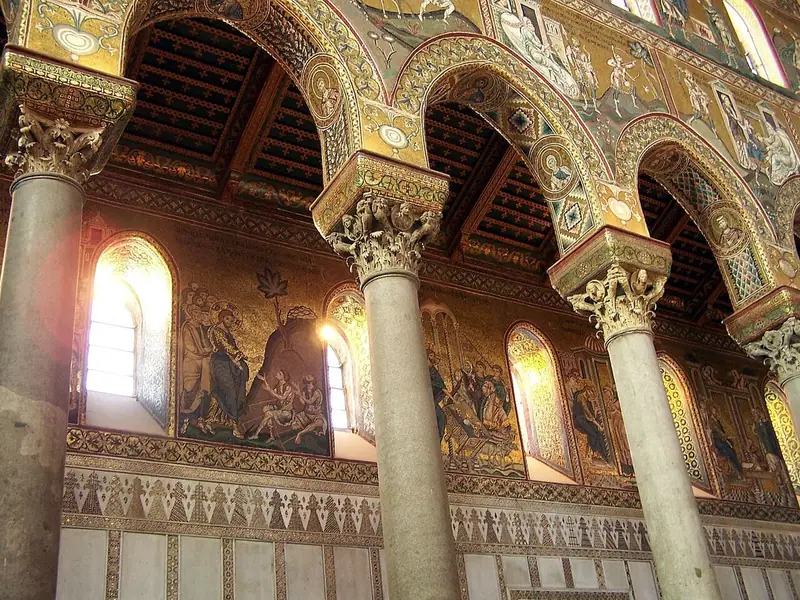
Begin in the hills above Palermo at Monreale, overlooking the valley of orange and lemon groves once called the Conca d’Oro, the golden shell. Here William II began a great cathedral and Benedictine abbey in 1174, perhaps to rival the archbishop of Palermo, though legend says the Virgin appeared to him in a dream while he slept under a carob tree. The plain exterior hides one of the largest mosaic schemes in the world: more than six thousand square metres of gold, covering the walls with stories from the Old and New Testaments. Over the apse a vast Christ Pantocrator raises his hand in blessing. Look for the mosaic of William II offering the church to the Virgin. The bronze main doors were made by Bonanno Pisano in 1186, and those on the north side by Barisano da Trani. William I and William II are buried here.
Photo: Peppe64 · CC BY-SA 3.0 · Wikimedia Commons
What to see at Arab-Norman Palermo, Monreale and Cefalù: 11 stops, in visit order
- 01
 Monreale CathedralChrist in gold above the valleyFree preview
- 02
 The Cloister of MonrealeTwo hundred carved columnsIn the guide
- 03
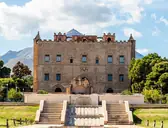 The ZisaThe splendid palaceIn the guide
- 04
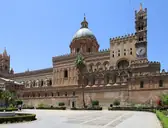 Palermo CathedralThe tombs of kings and emperorsIn the guide
- 05
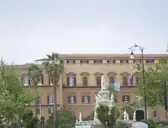 The Royal PalaceThe palace of the NormansIn the guide
- 06
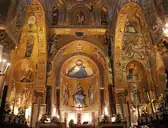 The Palatine ChapelGold mosaics and an Islamic ceilingIn the guide
- 07
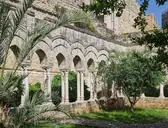 San Giovanni degli EremitiThe red domesIn the guide
- 08
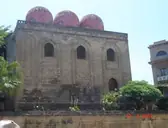 San CataldoThree domes on a cubeIn the guide
- 09
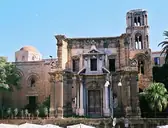 Santa Maria dell’AmmiraglioThe MartoranaIn the guide
- 10
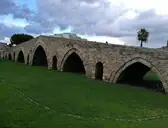 The Admiral’s BridgeA bridge without a riverIn the guide
- 11
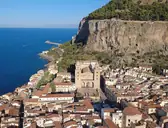 Cefalù CathedralThe king’s vowIn the guide
Site map of Arab-Norman Palermo, Monreale and Cefalù
History of Arab-Norman Palermo, Monreale and Cefalù
Sicily was ruled from Constantinople until Arab and Berber forces from North Africa began its conquest in 827; Palermo fell in 831 and became the capital of an Islamic emirate, a great city of mosques, markets and gardens. From the 1060s Norman adventurers, the brothers Robert Guiscard and Roger de Hauteville, fought their way across the island and took Palermo in 1072. Roger’s son, Roger II, was crowned the first King of Sicily on Christmas Day 1130. He and his successors, William I and William II, kept many of the island’s Arab officials and Greek administrators, used Arabic, Greek and Latin in their documents, and borrowed freely from every tradition. Their greatest minister was George of Antioch, a Greek-speaking Christian from Syria. In 1194 the crown passed to the German Hohenstaufen dynasty, and under Frederick II the special mixture of cultures slowly faded, but its buildings survived.
Arab-Norman Palermo, Monreale and Cefalù guide: questions
How many stops does the Arab-Norman Palermo, Monreale and Cefalù guide have?
11 stops, in visit order: 1. Monreale Cathedral; 2. The Cloister of Monreale; 3. The Zisa; 4. Palermo Cathedral; 5. The Royal Palace; 6. The Palatine Chapel; 7. San Giovanni degli Eremiti; 8. San Cataldo; 9. Santa Maria dell’Ammiraglio; 10. The Admiral’s Bridge; 11. Cefalù Cathedral.
Can I do a self-guided tour of Arab-Norman Palermo, Monreale and Cefalù with this guide?
Yes. The guide is made for a self-guided tour: 11 stops in visit order, each with a photo, a story and a voice, so you can explore Arab-Norman Palermo, Monreale and Cefalù at your own pace, without joining a group. Download it before you go and it works offline.
How long do you need at Arab-Norman Palermo, Monreale and Cefalù?
We suggest allowing two days. The 11 stops add up to about 9 minutes of listening, and you play each one when you’re ready, so you can linger wherever you like.
How long is each guide?
The 11 stops add up to about 9 minutes of listening in total. You play each stop when you’re ready, so you can go at your own pace.
Does the guide work offline?
Yes, once it’s downloaded. The guide is a single self-contained web page (about 10.5 MB) with the photos, text and audio built in. Download it to your phone before you go (Wi-Fi is best); after that it opens in any modern browser on iPhone or Android, with no app, account or mobile signal needed.
Does it use GPS or need my location?
No. The guide doesn’t use GPS and doesn’t know where you are: you play each stop when you reach it. It works on iPhone and Android in any modern browser, and it’s in English.
What’s included?
One self-contained HTML guide: 11 stops in visit order, each with a photo, text and a voice, plus the story of who built the site.
Who built Arab-Norman Palermo, Monreale and Cefalù?
Sicily was ruled from Constantinople until Arab and Berber forces from North Africa began its conquest in 827; Palermo fell in 831 and became the capital of an Islamic emirate, a great city of mosques, markets and gardens. From the 1060s Norman adventurers, the brothers Robert Guiscard and Roger de Hauteville, fought their way across the island and took Palermo in 1072.
Where is Arab-Norman Palermo, Monreale and Cefalù?
In the twelfth century Palermo was the capital of the Norman Kingdom of Sicily, one of the richest and most cosmopolitan states in Europe.
Is there a free audio guide to Arab-Norman Palermo, Monreale and Cefalù?
The first stop, Monreale Cathedral, is free to read and hear on this page, so you can try the Arab-Norman Palermo, Monreale and Cefalù audio tour before you buy. The full guide, with all 11 stops, is a one-off purchase: download it once and it’s yours to keep, working offline.
Is the Arab-Norman Palermo, Monreale and Cefalù guide worth it?
If you’d like to know what you’re looking at, yes. For $10 you get 11 stops in visit order, each with a photo, a short history and a voice you play when you’re ready, plus a site map of the stops, and about 9 minutes of listening in all. It’s short on purpose, so you spend your time looking, not listening. It’s yours to keep, works offline and needs no app. The first stop is free on this page, so you can try it before you buy. If you’d like hours of detail, a guided tour will go deeper.
Audio guide or guided tour?
It depends how you like to visit. This guide lets you explore Arab-Norman Palermo, Monreale and Cefalù at your own pace, at any time, for a one-off price. A guided tour gives you a live expert you can ask questions, but at fixed times and usually for a higher price. Many people use both: a tour for the big picture, and the guide to read beforehand or to revisit the stops in their own time.
Is this the official Arab-Norman Palermo, Monreale and Cefalù guide?
No. It’s an independent guide by The Historian Guide, not affiliated with or endorsed by the operator of Arab-Norman Palermo, Monreale and Cefalù. For tickets and opening hours, check the official site operator before you go.
Does the guide include entry tickets or opening hours?
No. The guide is a digital companion only. Admission to Arab-Norman Palermo, Monreale and Cefalù is separate, so check the official site operator for current tickets and opening hours before you go.
- Stop 1 · Monreale Cathedral: Peppe64 · CC BY-SA 3.0 · Wikimedia Commons · resized
- Stop 2 · The Cloister of Monreale: Macieklew · CC BY-SA 4.0 · Wikimedia Commons · resized
- Stop 3 · The Zisa: Matthias Süßen · CC BY-SA 4.0 · Wikimedia Commons · resized
- Stop 4 · Palermo Cathedral (also the cover): Carlo Pelagalli · CC BY-SA 3.0 · Wikimedia Commons · resized
- Stop 5 · The Royal Palace: Colsu · CC BY-SA 4.0 · Wikimedia Commons · resized
- Stop 6 · The Palatine Chapel: Liilia Moroz · CC BY-SA 4.0 · Wikimedia Commons · resized
- Stop 7 · San Giovanni degli Eremiti: Berthold Werner · CC BY-SA 4.0 · Wikimedia Commons · resized
- Stop 8 · San Cataldo: Sibeaster at Russian Wikipedia · Public domain · Wikimedia Commons · resized
- Stop 9 · Santa Maria dell’Ammiraglio: Bjs · CC0 · Wikimedia Commons · resized
- Stop 10 · The Admiral’s Bridge: Luca Corchia · CC BY-SA 4.0 · Wikimedia Commons · resized
- Stop 11 · Cefalù Cathedral: Enricopis · CC BY-SA 4.0 · Wikimedia Commons · resized


All photographs from Wikimedia Commons under the licences shown.
More guides in Italy
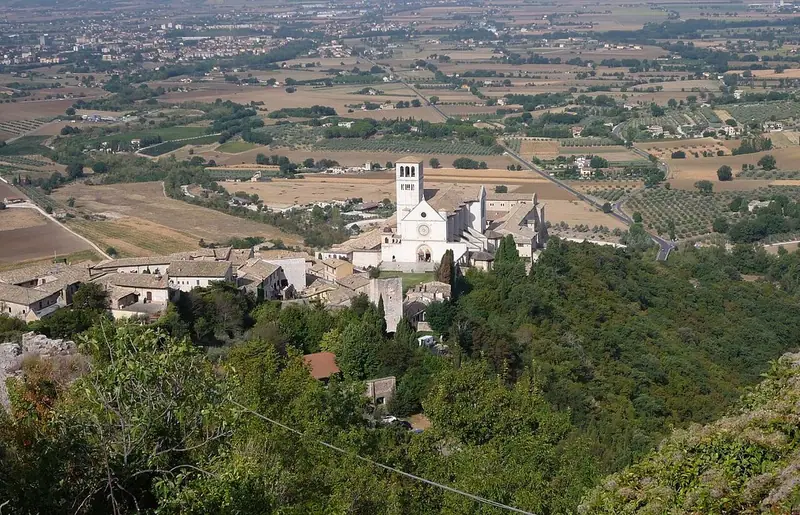 Franciscan10 stops · 1182 – 1253 (lives of Francis and Clare; basilica begun 1228)
Assisi audio guide
The hill town of Saint Francis: the double basilica with Giotto’s frescoes, his tomb, Santa Chiara, San Damiano and a Roman temple on the main square.
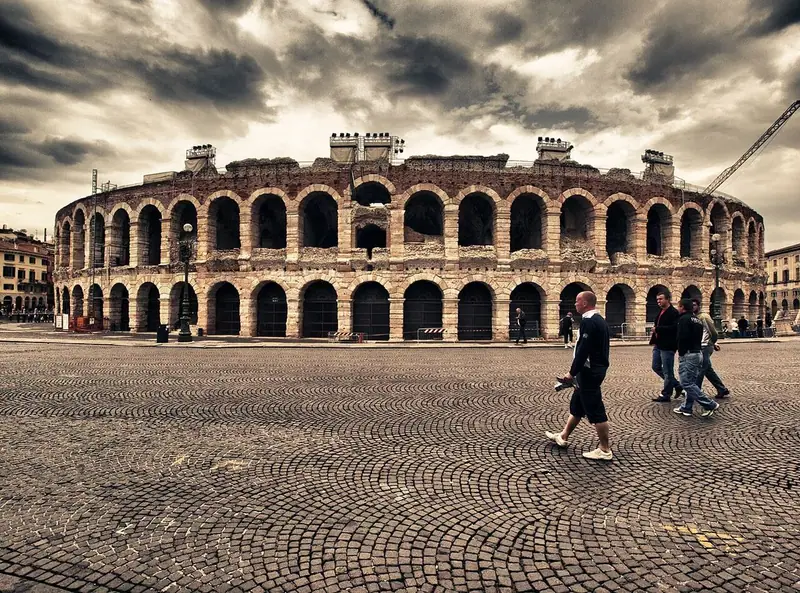 Roman11 stops · 1st c. BCE – 1797 (Roman colony to the end of Venetian rule)
City of Verona audio guide
A Roman arena still used for opera, the towers and tombs of the della Scala lords, and the Romanesque splendour of San Zeno, in a bend of the Adige.
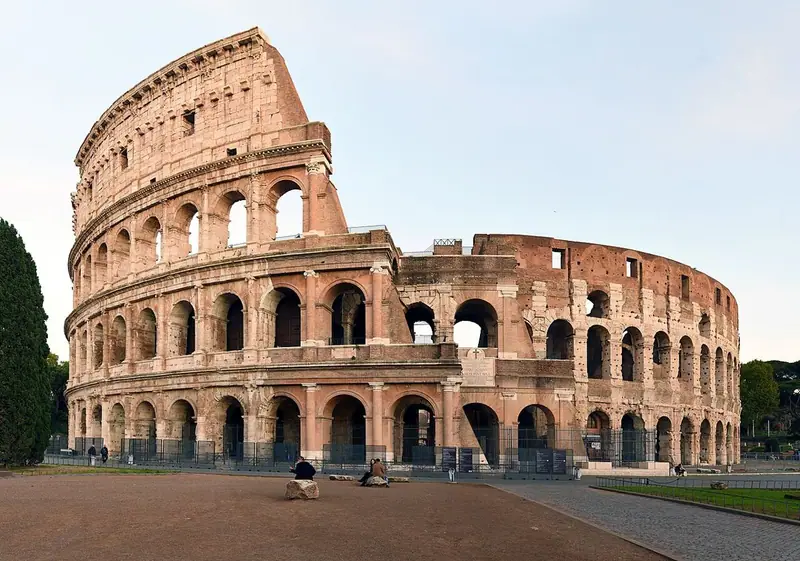 Roman7 stops · 70–80 CE
Colosseum audio guide
From the outer façade into the corridors and seating, then down to the arena floor and the hypogeum beneath it.
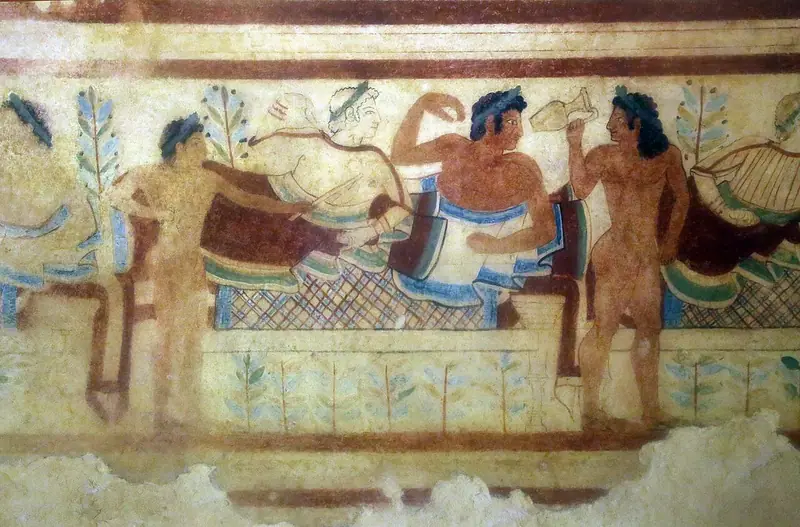 Etruscan9 stops · 9th – 3rd century BCE
Etruscan Necropolises of Cerveteri and Tarquinia audio guide
The Etruscan cities of the dead: the tumuli and tomb streets of the Banditaccia at Cerveteri, the Tomb of the Reliefs, and the painted tombs of Tarquinia’s Monterozzi necropolis.
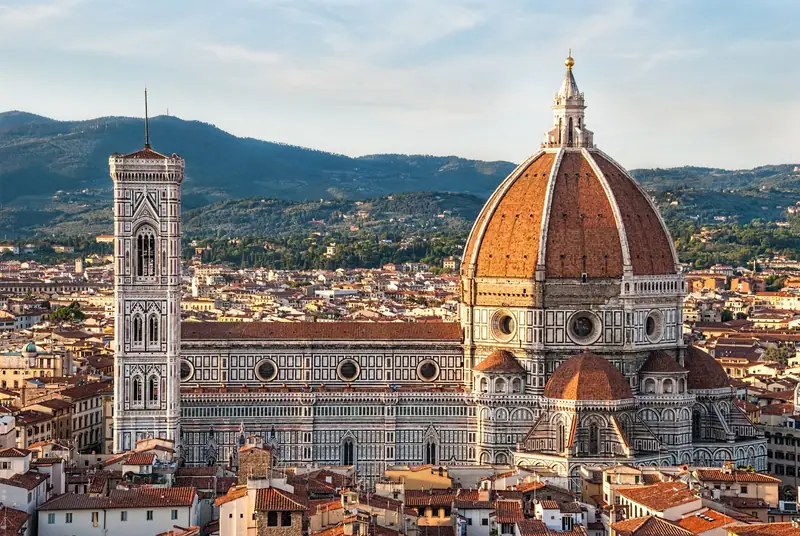 Renaissance7 stops · 1296–1436
Florence Duomo audio guide
The Gates of Paradise, Giotto’s Campanile and Brunelleschi’s dome, the great monument of Renaissance Florence.
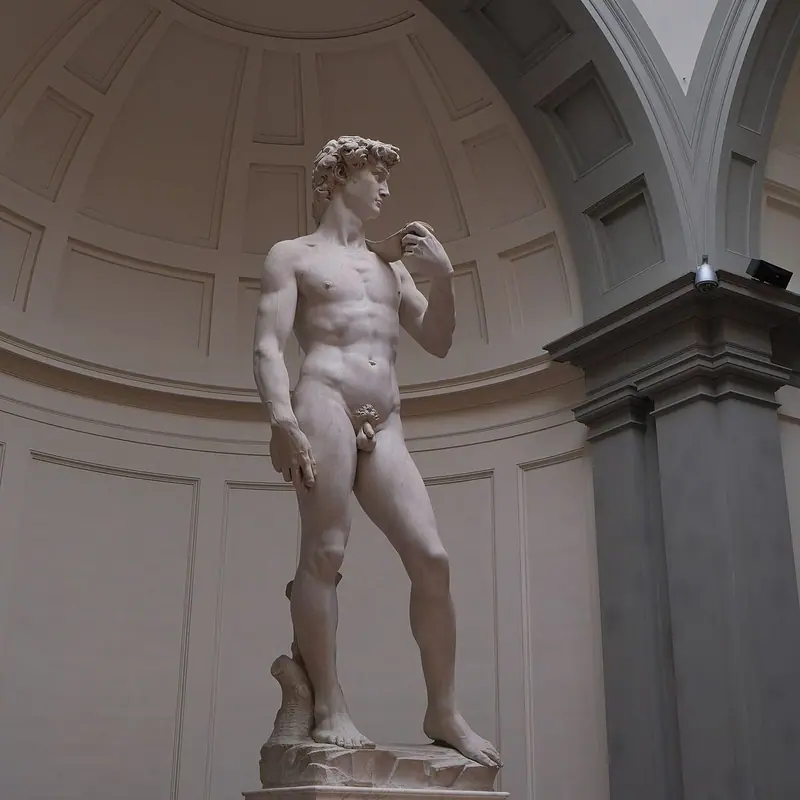 Renaissance8 stops · High Renaissance
Galleria dell’Accademia audio guide
Michelangelo’s unfinished Prisoners and the tribune of his David, then the plaster models and the Medici musical instruments.
Every guide, in every country
Arab-Norman Palermo, Monreale and Cefalù and every other guide we publish, including future ones. One payment, no subscription.