Before you start
The Colosseum stands at the eastern end of the Roman Forum in the centre of Rome, Italy, a short walk from the Colosseo metro station. It lies within the Historic Centre of Rome, a UNESCO World Heritage Site since 1980, and is managed today by the Parco archeologico del Colosseo, which also looks after the Forum and the Palatine. This guide follows the natural order of a visit: around the outer façade, in through the arches and corridors, up into the seating, down to the arena floor and the hypogeum beneath it, up to the top levels for the view, and out to the Arch of Constantine.
Use it as a self-guided tour of the Colosseum: 7 stops in visit order, each played when you’re ready, at your own pace.
 Free preview · Stop 1
The Outer Façade
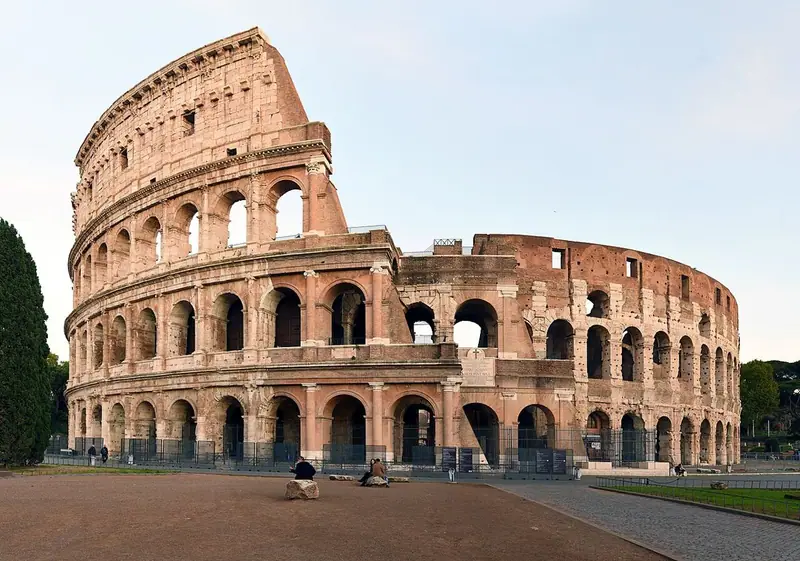
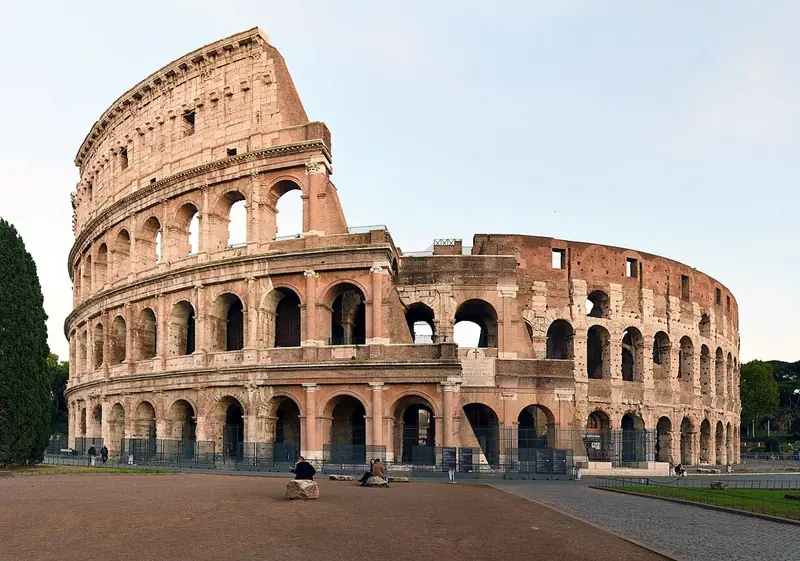
Start outside, and walk a little way round the building to take in its scale. The Colosseum is an ellipse roughly 189 by 156 metres, and its outer wall once rose to around 48 metres. It was built mainly of travertine, a pale limestone quarried near Tivoli, and you can still see the holes where iron clamps were later hacked out for their metal. Look at how the façade is organised: three storeys of arches framed by half-columns, plain Tuscan at the bottom, Ionic in the middle and ornate Corinthian above, with a solid top storey, or attic, decorated with Corinthian pilasters. Near the top are stone brackets that once held wooden masts for the velarium, a vast awning that shaded spectators. On the southern side, the outer ring is missing, brought down by earthquakes and later stone robbing.
Photo: FeaturedPics · CC BY-SA 4.0 · Wikimedia Commons
What to see at the Colosseum: 7 stops, in visit order
- 01
 The Outer FaçadeFacciata esternaFree preview
- 02
 Arches and CorridorsFornici e ambulacriIn the guide
- 03
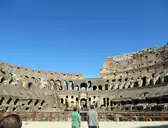 The SeatingLa caveaIn the guide
- 04
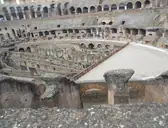 The Arena FloorL’arenaIn the guide
- 05
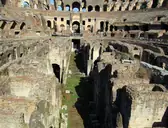 The HypogeumL’ipogeoIn the guide
- 06
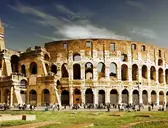 The Upper LevelsLivelli superioriIn the guide
- 07
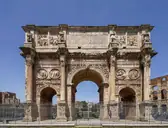 Arch of ConstantineArco di CostantinoIn the guide
History of the Colosseum
The Colosseum was built by the Romans, at the height of their power. Roman civilisation itself spanned well over two thousand years. Tradition dates the founding of Rome to 753 BCE; kings ruled until about 509 BCE, when the Republic was established; after a century of civil wars, Augustus became the first emperor in 27 BCE; the Empire reached its greatest extent under Trajan in 117 CE; the Western Empire ended in 476 CE, while the Eastern Roman, or Byzantine, Empire endured until the fall of Constantinople in 1453. The amphitheatre belongs to the early Empire. The emperor Vespasian, founder of the Flavian dynasty, began it around 70 to 72 CE on the site of the ornamental lake of Nero’s Golden House, returning the land to the people. His son Titus inaugurated it in 80 CE with a hundred days of games, and his younger son Domitian completed it.
The full history continues in the guide.
Colosseum guide: questions
How many stops does the Colosseum guide have?
7 stops, in visit order: 1. The Outer Façade; 2. Arches and Corridors; 3. The Seating; 4. The Arena Floor; 5. The Hypogeum; 6. The Upper Levels; 7. Arch of Constantine.
Can I do a self-guided tour of the Colosseum with this guide?
Yes. The guide is made for a self-guided tour: 7 stops in visit order, each with a photo, a story and a voice, so you can explore the Colosseum at your own pace, without joining a group. Download it before you go and it works offline.
How long is each guide?
The 7 stops add up to about 6 minutes of listening in total. You play each stop when you’re ready, so you can go at your own pace.
Does the guide work offline?
Yes, once it’s downloaded. The guide is a single self-contained web page (about 7.6 MB) with the photos, text and audio built in. Download it to your phone before you go (Wi-Fi is best); after that it opens in any modern browser on iPhone or Android, with no app, account or mobile signal needed.
Does it use GPS or need my location?
No. The guide doesn’t use GPS and doesn’t know where you are: you play each stop when you reach it. It works on iPhone and Android in any modern browser, and it’s in English.
What’s included?
One self-contained HTML guide: 7 stops in visit order, each with a photo, text and a voice, plus the story of who built the site.
Who built the Colosseum?
The Colosseum was built by the Romans, at the height of their power. Roman civilisation itself spanned well over two thousand years.
Where is the Colosseum?
The Colosseum stands at the eastern end of the Roman Forum in the centre of Rome, Italy, a short walk from the Colosseo metro station.
Is there a free audio guide to the Colosseum?
The first stop, The Outer Façade, is free to read and hear on this page, so you can try the Colosseum audio tour before you buy. The full guide, with all 7 stops, is a one-off purchase: download it once and it’s yours to keep, working offline.
Is the Colosseum guide worth it?
If you’d like to know what you’re looking at, yes. For $10 you get 7 stops in visit order, each with a photo, a short history and a voice you play when you’re ready, about 6 minutes of listening in all. It’s short on purpose, so you spend your time looking, not listening. It’s yours to keep, works offline and needs no app. The first stop is free on this page, so you can try it before you buy. If you’d like hours of detail, a guided tour will go deeper.
Audio guide or guided tour?
It depends how you like to visit. This guide lets you explore the Colosseum at your own pace, at any time, for a one-off price. A guided tour gives you a live expert you can ask questions, but at fixed times and usually for a higher price. Many people use both: a tour for the big picture, and the guide to read beforehand or to revisit the stops in their own time.
Is this the official Colosseum guide?
No. It’s an independent guide by The Historian Guide, not affiliated with or endorsed by the operator of the Colosseum. For tickets and opening hours, check the official site operator before you go.
Does the guide include entry tickets or opening hours?
No. The guide is a digital companion only. Admission to the Colosseum is separate, so check the official site operator for current tickets and opening hours before you go.
- Stop 1 · The Outer Façade (also the cover): FeaturedPics · CC BY-SA 4.0 · Wikimedia Commons · resized
- Stop 2 · Arches and Corridors: Julian Lupyan · CC0 · Wikimedia Commons · resized
- Stop 3 · The Seating: daryl_mitchell from Saskatoon, Saskatchewan, Canada · CC BY-SA 2.0 · Wikimedia Commons · resized
- Stop 4 · The Arena Floor: Erik Drost · CC BY 2.0 · Wikimedia Commons · resized
- Stop 5 · The Hypogeum: daryl_mitchell from Saskatoon, Saskatchewan, Canada · CC BY-SA 2.0 · Wikimedia Commons · resized
- Stop 6 · The Upper Levels: Sam valadi · CC BY 2.0 · Wikimedia Commons · resized
- Stop 7 · Arch of Constantine: NikonZ7II (Paris Orlando) · CC BY-SA 4.0 · Wikimedia Commons · resized


All photographs from Wikimedia Commons under the licences shown.
More guides in Italy
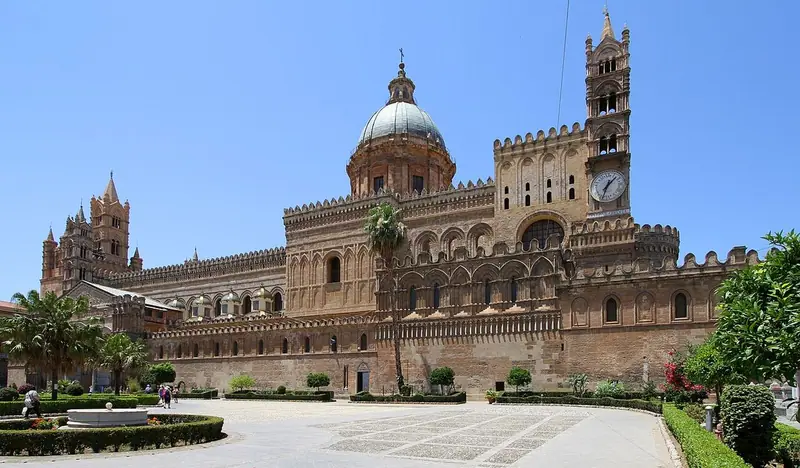 Arab-Norman11 stops · 1130 – 1194 (Norman kings of Sicily)
Arab-Norman Palermo, Monreale and Cefalù audio guide
Norman kings, Byzantine mosaicists and Arab craftsmen together: the Palatine Chapel, red-domed churches, the Zisa palace and the golden cathedrals of Monreale and Cefalù.
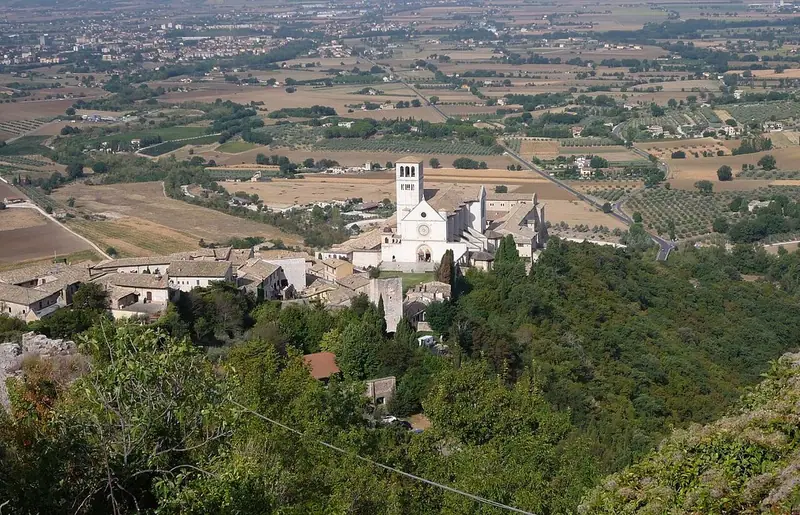 Franciscan10 stops · 1182 – 1253 (lives of Francis and Clare; basilica begun 1228)
Assisi audio guide
The hill town of Saint Francis: the double basilica with Giotto’s frescoes, his tomb, Santa Chiara, San Damiano and a Roman temple on the main square.
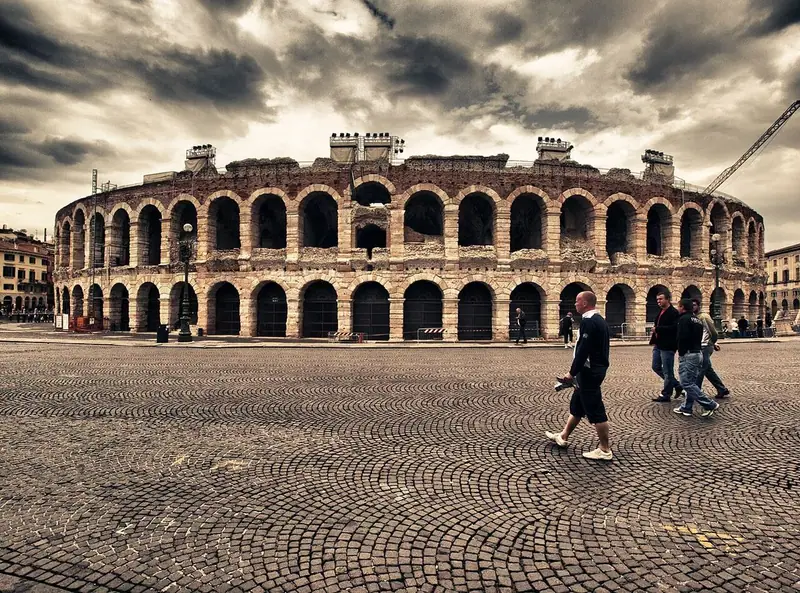 Roman11 stops · 1st c. BCE – 1797 (Roman colony to the end of Venetian rule)
City of Verona audio guide
A Roman arena still used for opera, the towers and tombs of the della Scala lords, and the Romanesque splendour of San Zeno, in a bend of the Adige.
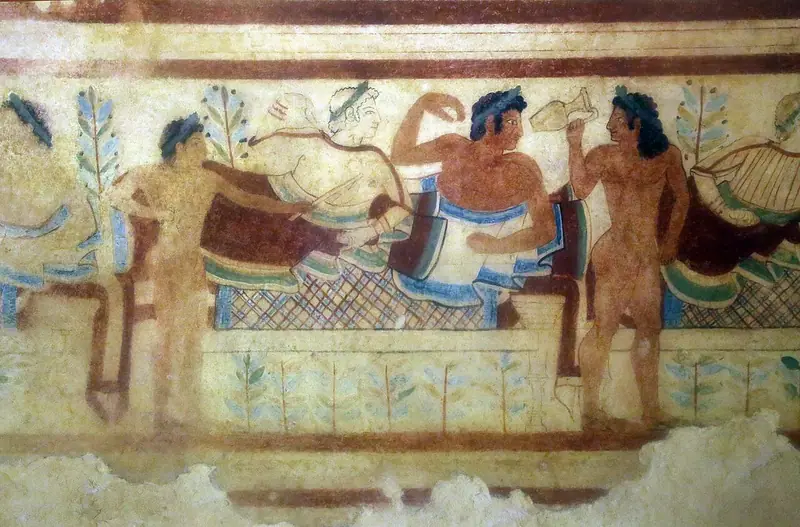 Etruscan9 stops · 9th – 3rd century BCE
Etruscan Necropolises of Cerveteri and Tarquinia audio guide
The Etruscan cities of the dead: the tumuli and tomb streets of the Banditaccia at Cerveteri, the Tomb of the Reliefs, and the painted tombs of Tarquinia’s Monterozzi necropolis.
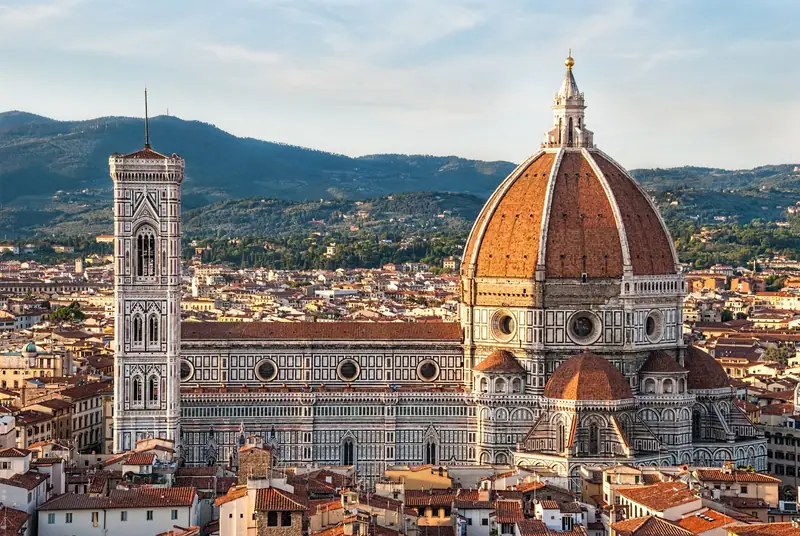 Renaissance7 stops · 1296–1436
Florence Duomo audio guide
The Gates of Paradise, Giotto’s Campanile and Brunelleschi’s dome, the great monument of Renaissance Florence.
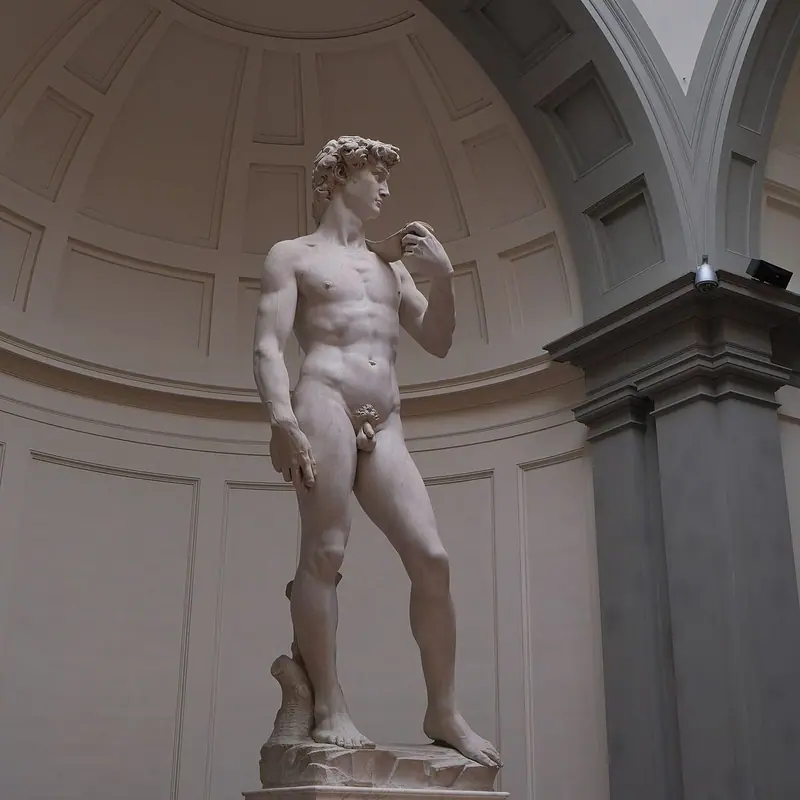 Renaissance8 stops · High Renaissance
Galleria dell’Accademia audio guide
Michelangelo’s unfinished Prisoners and the tribune of his David, then the plaster models and the Medici musical instruments.
Every guide, in every country
Colosseum and every other guide we publish, including future ones. One payment, no subscription.