Before you start
Herculaneum, Ercolano in Italian, lies on the Bay of Naples in Campania, southern Italy, beneath the modern town of Ercolano, about ten kilometres south-east of Naples and between the city and Pompeii. Together with Pompeii and Torre Annunziata it has been a UNESCO World Heritage Site since 1997, and it is managed by the Parco Archeologico di Ercolano. The site is compact and best seen as a loop: from the viewpoint over the excavations down to the ancient shoreline and the boat sheds, into the Suburban Baths, then up into the town to the House of the Deer, the House of Neptune and Amphitrite, the Central Baths, the College of the Augustales and the Decumanus Maximus.
Use it as a self-guided tour of Herculaneum: 8 stops in visit order, each played when you’re ready, at your own pace.
 Free preview · Stop 1
The View from Above
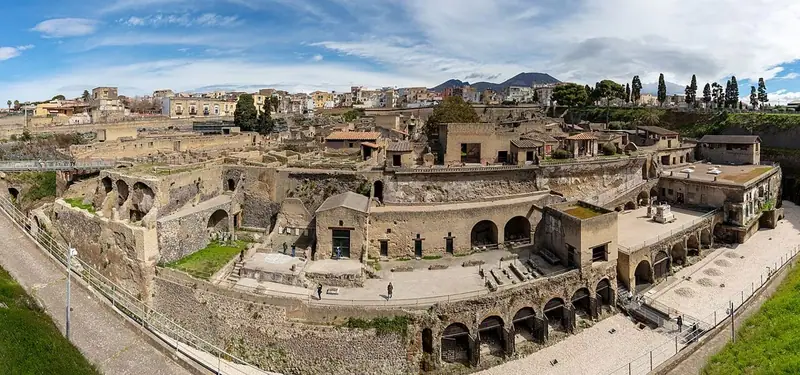
Start on the walkway above the excavations, beside the modern town. From here you can see Herculaneum laid out below, and the most striking thing is how deep it is. The ancient town sits some twenty metres below today’s street level, buried by the pyroclastic flows of 79 CE, and the wall of volcanic rock around the edges shows the scale of that burial. Notice how the modern houses of Ercolano press right up to the edge: much of the ancient town still lies beneath them, including most of the forum and the theatre, which can only be reached by Bourbon-era tunnels. Look for the grid of streets, the roofs and upper floors, which survive far better than at Pompeii. Then follow the path down; you are walking towards what was once the shoreline of the Bay of Naples.
Photo: Diego Delso · CC BY-SA 4.0 · Wikimedia Commons
What to see at Herculaneum: 8 stops, in visit order
- 01
 The View from AbovePanorama sugli scaviFree preview
- 02
 The Boat ShedsI fornici sull’antica spiaggiaIn the guide
- 03
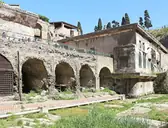 Suburban BathsTerme SuburbaneIn the guide
- 04
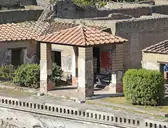 House of the DeerCasa dei CerviIn the guide
- 05
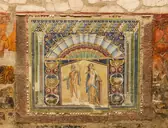 House of Neptune and AmphitriteCasa di Nettuno e AnfitriteIn the guide
- 06
 Central BathsTerme CentraliIn the guide
- 07
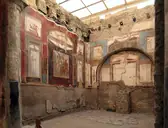 College of the AugustalesSede degli AugustaliIn the guide
- 08
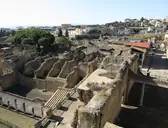 Decumanus MaximusIl Decumano MassimoIn the guide
Site map of Herculaneum
History of Herculaneum
Herculaneum was built by the peoples of ancient Campania and, in its last phase, by the Romans. Roman civilisation itself spanned well over two thousand years. Tradition dates the founding of Rome to 753 BCE; kings ruled until about 509 BCE, when the Republic was established; after a century of civil wars, Augustus became the first emperor in 27 BCE; the Empire reached its greatest extent under Trajan in 117 CE; the Western Empire ended in 476 CE, while the Eastern Roman, or Byzantine, Empire endured until the fall of Constantinople in 1453. Legend claimed the town was founded by Hercules himself, hence its name. In reality it was probably an Oscan settlement, later under Greek and Samnite influence, and it became a Roman municipality after the Social War of the early first century BCE. By the first century CE it was a prosperous seaside town of perhaps four or five thousand people, popular with wealthy Romans.
The full history continues in the guide.
Herculaneum guide: questions
How many stops does the Herculaneum guide have?
8 stops, in visit order: 1. The View from Above; 2. The Boat Sheds; 3. Suburban Baths; 4. House of the Deer; 5. House of Neptune and Amphitrite; 6. Central Baths; 7. College of the Augustales; 8. Decumanus Maximus.
Can I do a self-guided tour of Herculaneum with this guide?
Yes. The guide is made for a self-guided tour: 8 stops in visit order, each with a photo, a story and a voice, so you can explore Herculaneum at your own pace, without joining a group. Download it before you go and it works offline.
How long is each guide?
The 8 stops add up to about 7 minutes of listening in total. You play each stop when you’re ready, so you can go at your own pace.
Does the guide work offline?
Yes, once it’s downloaded. The guide is a single self-contained web page (about 9.1 MB) with the photos, text and audio built in. Download it to your phone before you go (Wi-Fi is best); after that it opens in any modern browser on iPhone or Android, with no app, account or mobile signal needed.
Does it use GPS or need my location?
No. The guide doesn’t use GPS and doesn’t know where you are: you play each stop when you reach it. It works on iPhone and Android in any modern browser, and it’s in English.
What’s included?
One self-contained HTML guide: 8 stops in visit order, each with a photo, text and a voice, plus the story of who built the site.
Who built Herculaneum?
Herculaneum was built by the peoples of ancient Campania and, in its last phase, by the Romans. Roman civilisation itself spanned well over two thousand years.
Where is Herculaneum?
Herculaneum, Ercolano in Italian, lies on the Bay of Naples in Campania, southern Italy, beneath the modern town of Ercolano, about ten kilometres south-east of Naples and between the city and Pompeii.
Is there a free audio guide to Herculaneum?
The first stop, The View from Above, is free to read and hear on this page, so you can try the Herculaneum audio tour before you buy. The full guide, with all 8 stops, is a one-off purchase: download it once and it’s yours to keep, working offline.
Is the Herculaneum guide worth it?
If you’d like to know what you’re looking at, yes. For $10 you get 8 stops in visit order, each with a photo, a short history and a voice you play when you’re ready, plus a site map of the stops, and about 7 minutes of listening in all. It’s short on purpose, so you spend your time looking, not listening. It’s yours to keep, works offline and needs no app. The first stop is free on this page, so you can try it before you buy. If you’d like hours of detail, a guided tour will go deeper.
Audio guide or guided tour?
It depends how you like to visit. This guide lets you explore Herculaneum at your own pace, at any time, for a one-off price. A guided tour gives you a live expert you can ask questions, but at fixed times and usually for a higher price. Many people use both: a tour for the big picture, and the guide to read beforehand or to revisit the stops in their own time.
Is this the official Herculaneum guide?
No. It’s an independent guide by The Historian Guide, not affiliated with or endorsed by the operator of Herculaneum. For tickets and opening hours, check the official site operator before you go.
Does the guide include entry tickets or opening hours?
No. The guide is a digital companion only. Admission to Herculaneum is separate, so check the official site operator for current tickets and opening hours before you go.
- Stop 1 · The View from Above: Diego Delso · CC BY-SA 4.0 · Wikimedia Commons · resized
- Stop 2 · The Boat Sheds: Ad Meskens You are free to use this picture for any purpose as long as you credit its author, Ad Meskens. Example: © Ad Meskens / Wikimedia Commons If you use this work outside of the Wikimedia projects, a message or a copy is very much appreciated. This image is not in the public domain. A statement such as "From Wikimedia Commons" or similar is not by itself sufficient. If you do not provide clear attribution to the author you do not comply with the terms of the file's license and you may not use this file. If you are unable or unwilling to provide attribution you should contact Ad Meskens to negotiate a different license. · CC BY-SA 4.0 · Wikimedia Commons · resized
- Stop 3 · Suburban Baths: Bernard Gagnon · CC BY 4.0 · Wikimedia Commons · resized
- Stop 4 · House of the Deer: Bernard Gagnon · CC BY 4.0 · Wikimedia Commons · resized
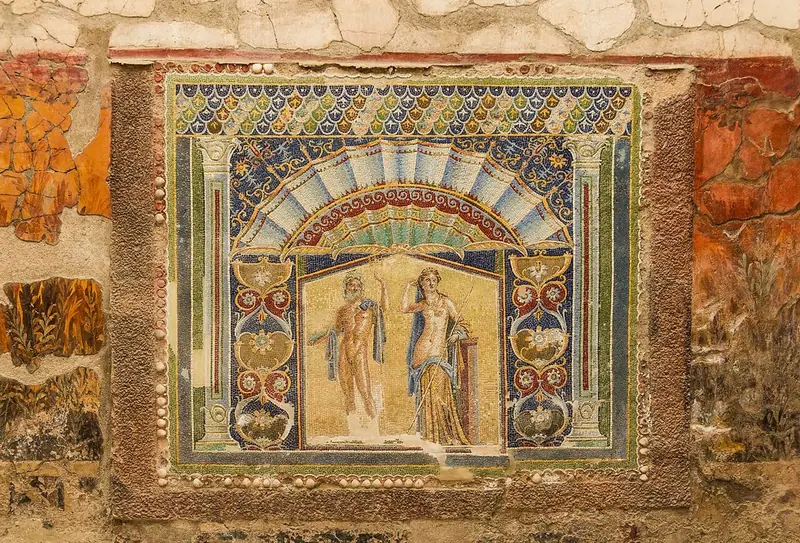
- Stop 5 · House of Neptune and Amphitrite (also the cover): Jebulon · CC0 · Wikimedia Commons · resized
- Stop 6 · Central Baths: Dave & Margie Hill / Kleerup from Centennial, CO, USA · CC BY-SA 2.0 · Wikimedia Commons · resized
- Stop 7 · College of the Augustales: Falk2 · CC BY-SA 4.0 · Wikimedia Commons · resized
- Stop 8 · Decumanus Maximus: Falk2 · CC BY-SA 4.0 · Wikimedia Commons · resized


All photographs from Wikimedia Commons under the licences shown.
More guides in Italy
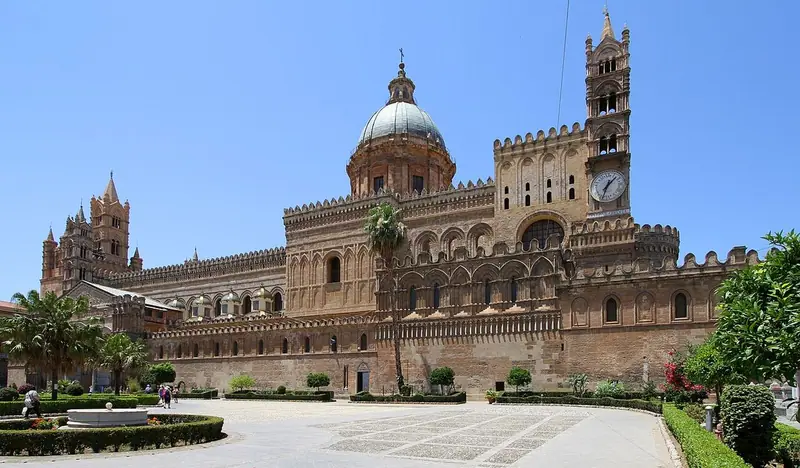 Arab-Norman11 stops · 1130 – 1194 (Norman kings of Sicily)
Arab-Norman Palermo, Monreale and Cefalù audio guide
Norman kings, Byzantine mosaicists and Arab craftsmen together: the Palatine Chapel, red-domed churches, the Zisa palace and the golden cathedrals of Monreale and Cefalù.
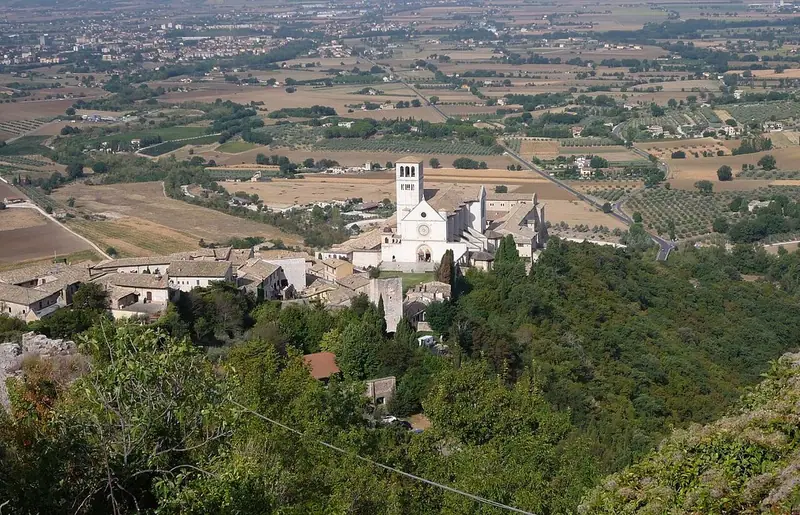 Franciscan10 stops · 1182 – 1253 (lives of Francis and Clare; basilica begun 1228)
Assisi audio guide
The hill town of Saint Francis: the double basilica with Giotto’s frescoes, his tomb, Santa Chiara, San Damiano and a Roman temple on the main square.
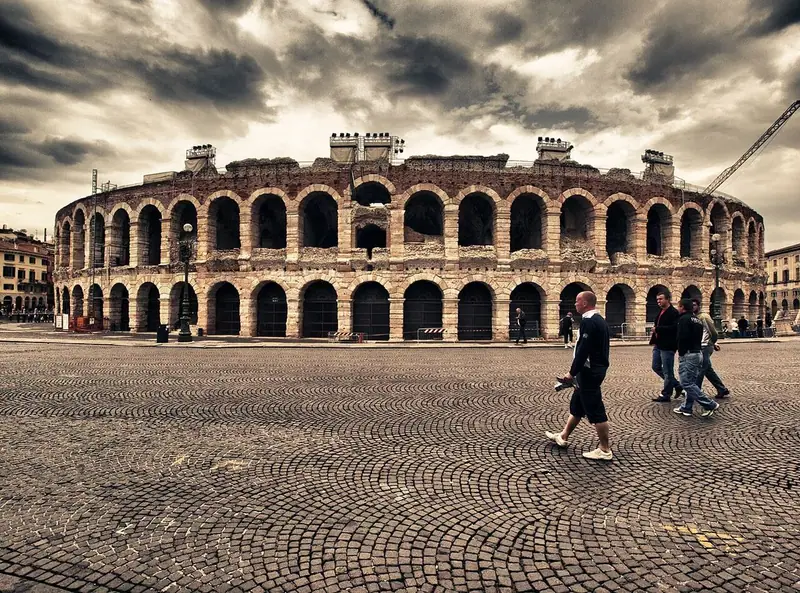 Roman11 stops · 1st c. BCE – 1797 (Roman colony to the end of Venetian rule)
City of Verona audio guide
A Roman arena still used for opera, the towers and tombs of the della Scala lords, and the Romanesque splendour of San Zeno, in a bend of the Adige.
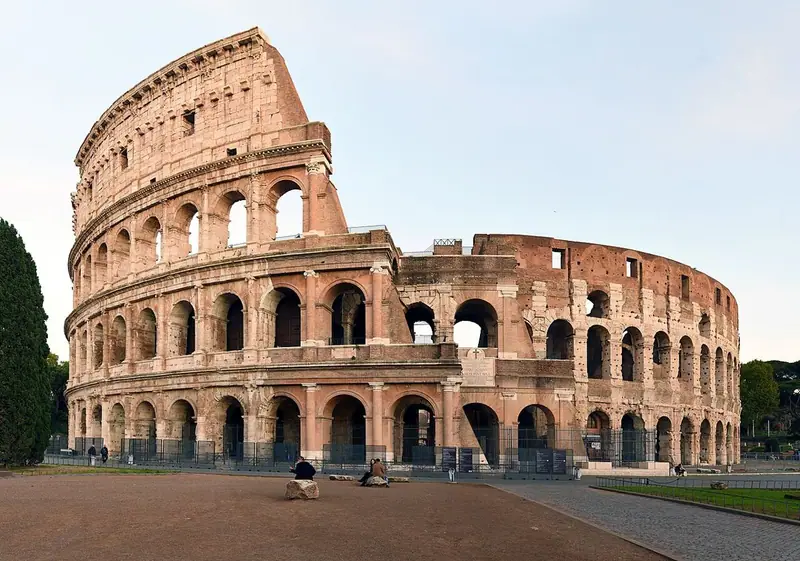 Roman7 stops · 70–80 CE
Colosseum audio guide
From the outer façade into the corridors and seating, then down to the arena floor and the hypogeum beneath it.
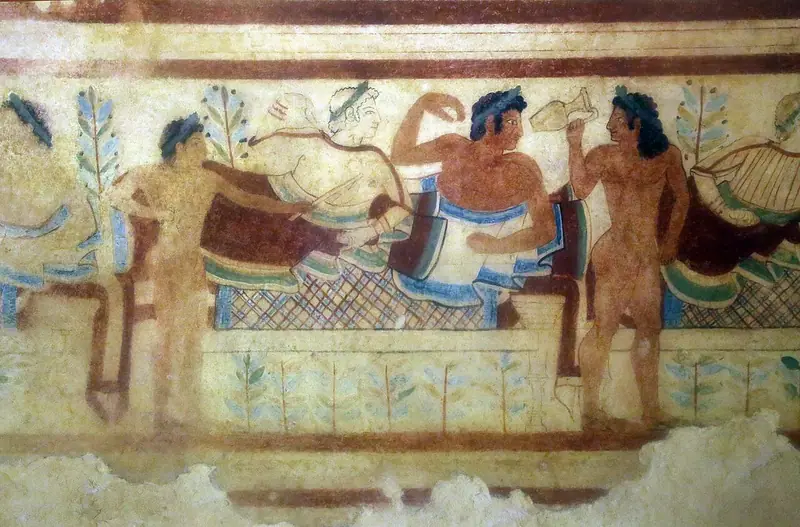 Etruscan9 stops · 9th – 3rd century BCE
Etruscan Necropolises of Cerveteri and Tarquinia audio guide
The Etruscan cities of the dead: the tumuli and tomb streets of the Banditaccia at Cerveteri, the Tomb of the Reliefs, and the painted tombs of Tarquinia’s Monterozzi necropolis.
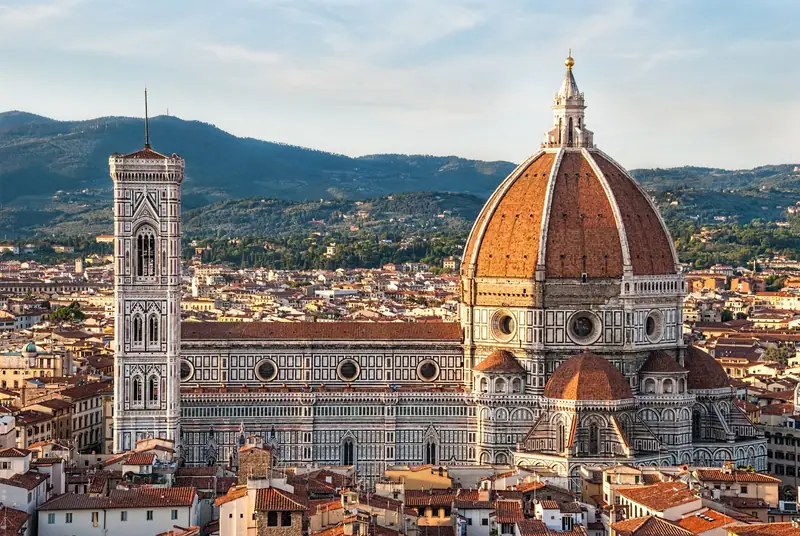 Renaissance7 stops · 1296–1436
Florence Duomo audio guide
The Gates of Paradise, Giotto’s Campanile and Brunelleschi’s dome, the great monument of Renaissance Florence.
Every guide, in every country
Herculaneum and every other guide we publish, including future ones. One payment, no subscription.